Home / Education / Crypto / Regulation / Historic Senate Crypto CLARITY Act Vote Set for May 14 — Why It Matters for Bitcoin, ETH, XRP & the Entire Market
Florida Passed Crypto Rules 37–0 — But Viral ‘CLARITY Act’ Claim Gets One Big Thing Wrong
Share
Key Takeaways
The CLARITY Act could finally establish clear US crypto regulations after years of uncertainty and SEC enforcement disputes.
Bitcoin, Ethereum, and XRP may receive permanent commodity classification under CFTC oversight if the bill becomes law.
Clear regulation could accelerate institutional investment, crypto ETFs, and broader adoption across the digital asset market.
The May 14 Senate vote is viewed as a historic turning point for America’s future crypto leadership position.
After years of regulatory uncertainty, lawsuits, and political gridlock, the United States is finally approaching a defining moment for the crypto industry. On May 14, the Senate Banking Committee will hold its first formal markup of the CLARITY Act, a sweeping market structure bill that could establish long awaited federal rules for digital assets.
US Senate Banking Committee to Vote on Crypto Market Structure Bill on May 14. | Source: Wu Blockchain
The stakes extend far beyond Washington. For Bitcoin, the legislation could cement commodity status into law. For Ethereum and DeFi, it may provide clearer protections for developers and institutional participation. For XRP and other contested tokens, it could remove years of regulatory overhang and open the door to broader adoption and potential ETF pathways.
With bipartisan support building, prediction markets favoring passage, and the White House signaling alignment, the upcoming vote is shaping up to be one of the most important moments in crypto policy history and one that could influence the next major cycle across the entire digital asset market.
What Is the CLARITY Act?
The Digital Asset Market Clarity Act of 2025, formally designated H.R. 3633, is a comprehensive federal framework designed to answer a question that has paralyzed the American crypto industry for over a decade: which federal regulator governs digital assets, under what rules, and with what protections for investors and consumers?
The answer has never been straightforward because two powerful regulatory agencies, the Securities and Exchange Commission (SEC) and the Commodity Futures Trading Commission (CFTC), have spent years locked in a jurisdictional grey zone. The SEC historically claimed authority over most crypto tokens as securities. The CFTC maintained that Bitcoin and similar assets are commodities. Every project launched in between those poles had to guess which agency applied, often finding out the hard way through enforcement letters and years of costly litigation.
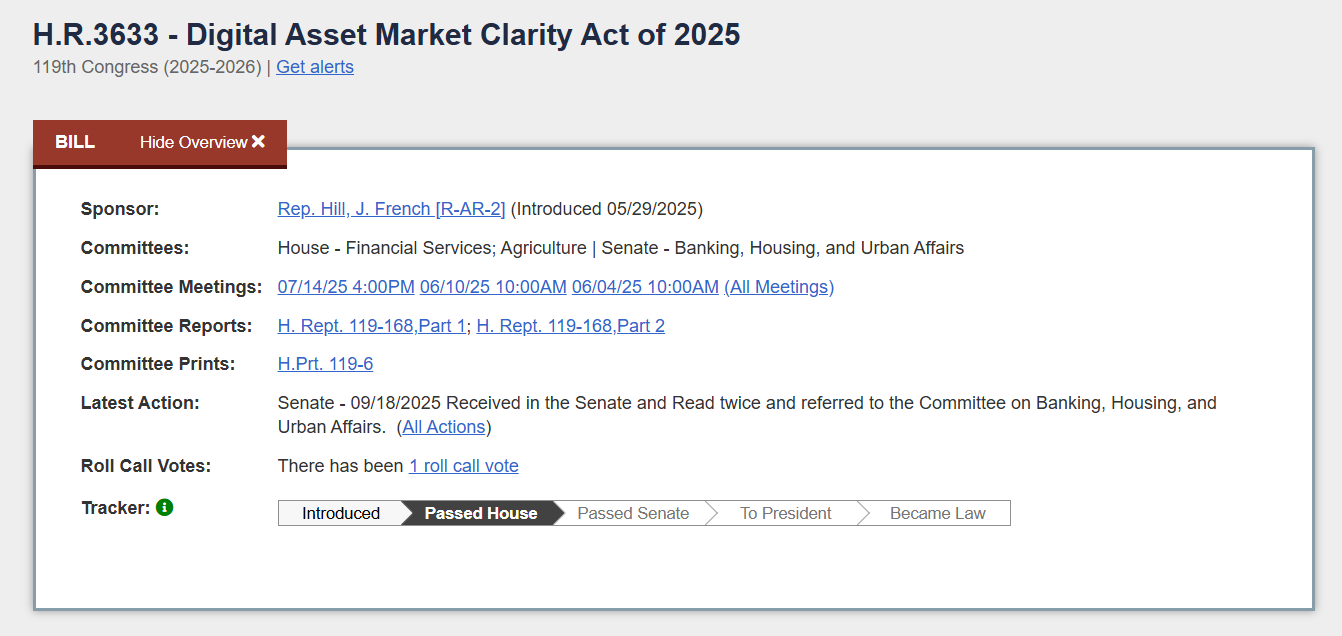
The CLARITY Act passed House in 2025. | Source: Congress.gov
The CLARITY Act would resolve something that has lingered for too long: which federal regulator governs digital asset markets, under what rules, and with what protections for investors and consumers. It draws a clear line by establishing a formal taxonomy for digital assets, granting the CFTC exclusive jurisdiction over spot markets for assets classified as digital commodities, while preserving SEC authority over investment contract assets.
It also creates a registration and licensing regime for exchanges, brokers, dealers, and custodians; introduces consumer disclosure requirements; and for the first time provides explicit legal protections for open-source software developers building decentralized finance protocols.
The bill also prohibits Federal Reserve banks from researching, designing, building, testing, or issuing a central bank digital currency absent congressional authorization, a provision that carried significant weight in securing House Republican support.
How the CLARITY Act Nearly Collapsed Before Reaching the Senate
Understanding why this committee markup matters so much requires understanding just how many times this process has nearly collapsed.
The Bill’s Origins in the House
The bill’s roots trace to May 2025, when House Committee on Financial Services Chairman French Hill introduced the legislation. The House Committees on Financial Services and Agriculture held joint markup sessions on June 23, 2025, and the full House passed the bill on July 17, 2025, by a vote of 294 to 134.
That margin was not close. Democrats crossed over in meaningful numbers. It reflected a clear political read that crypto regulation had become a mainstream voter priority, not a fringe tech policy debate.
Then the Senate Happened
The bill stalled almost immediately, primarily over a single but fiercely contested provision: stablecoin yield.
Banks argued that allowing stablecoins to pay passive interest would pull deposits out of the FDIC-insured banking system and create systemic financial instability.
Crypto firms countered that banks were simply trying to protect their deposit base from competitive disruption. The standoff consumed most of the second half of 2025.
Multiple Senate Drafts Emerged
Senator Scott and Subcommittee on Digital Assets Chair Cynthia Lummis released a discussion draft of the Senate Banking Committee’s version of the bill on July 22, 2025.
On September 5, 2025, the Senate Banking Committee released a 182-page discussion draft building on the previously released discussion draft.
On September 9, 2025, twelve Senate Democrats released a framework for crypto market structure legislation. They wanted a seat at the table but had not yet committed their votes.
Stablecoin Yield Became the Breaking Point
On January 12, 2026, the Senate Banking Committee released a 278-page draft bill that prohibits digital asset service providers from offering interest or yield to users for simply holding stablecoin balances, but allows for stablecoin rewards or activity-linked incentives.
On January 21, 2026, the Senate Agriculture Committee published a draft version of the Digital Commodity Intermediaries Act, which was advanced out of committee on January 29, 2026, after a series of Democrat-proposed amendments were rejected.
Coinbase Pulled Its Support
Then Coinbase threw a spanner in the works. The company withdrew its support for the bill in early 2026, citing three specific concerns: insufficient protections for open-source software developers, the blanket prohibition on stablecoin yield, and unsettled DeFi regulation.
CEO Brian Armstrong was blunt, telling the industry that Coinbase would rather have ‘no bill than a bad bill.’ That withdrawal removed the single largest industry force behind the legislation and forced negotiators back to the drawing board.
The breakthrough came on May 1, 2026, when Senators Thom Tillis and Angela Alsobrooks reached a bipartisan compromise. The deal bans passive yield on stablecoins, meaning simply holding USDC or USDT will not generate interest-like returns.
However, activity-based rewards tied to actual transactions, trading volume, or platform use remain permitted.
Why the May 14 Vote Is Historic
That compromise was enough to bring Coinbase back to the table. Armstrong reversed course publicly after personally reviewing updated drafts alongside SEC Chairman Paul Atkins and US Treasury Secretary Scott Bessent.
The alignment of the administration, both regulatory agencies, and the industry’s most powerful domestic exchange behind the same piece of legislation for the first time gave Chairman Scott the political cover to schedule the May 14 executive session.
HarrisX National Survey: The Numbers That Changed the Political Calculus
Any serious analysis of the CLARITY Act’s political trajectory must engage with the data released on May 7, 2026, from a national survey conducted by HarrisX. The poll surveyed 2,008 registered voters between May 1 and May 4, 2026, with a margin of error of 2.2 percentage points. The results reshaped the political calculus for wavering senators almost overnight.
The poll found 52% supported the bill after voters reviewed a policy summary of the legislation, while 11% opposed it. That is a net approval margin of 41 points before any advocacy messaging. The figure becomes even more striking when you consider that 64% of respondents said they had not heard of the bill before the survey, meaning the 52% support was achieved purely on the policy merits, not on name recognition or prior industry lobbying.
NEW: HarrisX national survey finds strong bipartisan support for American leadership in digital finance — and majority support for passing the CLARITY Act.
Our latest study of 2,008 registered voters shows Americans want clear federal rules for crypto and digital assets. 👇… pic.twitter.com/qsEMHVQ06a
The partisan breakdown decisively shattered the narrative that crypto regulation is a partisan divide. Public support extended across party lines, with HarrisX reporting support from 58% of Republicans, 55% of Democrats, and 42% of independents. The survey added that senators supporting the bill could gain a 20-point electoral advantage.
Support for the CLARITY Act crosses party lines. | Source: @HarrisXdata on X.
The electoral data is where the survey gets genuinely consequential for Senate math. Harrisx found 37% of voters would be more likely to support a senator who votes for CLARITY, while 17% would be less likely, creating a net 20-point benefit. The effect remained positive with Republicans, Democrats, and independents. In a Senate where competitive seats are decided by margins far smaller than 20 points, this is not a number any professional political operation can ignore.
About half of all voters, 47%, said they would consider voting for a candidate outside their preferred party if that candidate supported the bill and their own party did not. Among crypto users, that figure rises to 72%.
The survey also captured the geopolitical anxiety that has been building as other nations sprint ahead. 70% of voters say the US should have already passed crypto legislation, 62% say it is important for the US to set the global rules for digital finance, and 60% prefer clear federal legislation over case-by-case enforcement.
The strongest argument for action, per the survey findings, was national security: a majority of voters said digital payment systems built and controlled outside the US would weaken American national security.
What Happens on May 14 and the Road That Follows
The Senate Banking Committee will hold an executive session on May 14 at 10:30 a.m. in the Dirksen Senate Office Building. Banking Committee members are expected to vote on the bill text and any proposed amendments. If approved, the Banking Committee language would then be combined with the Senate Agriculture Committee’s section to create one final Senate version before the bill heads to the full chamber for a floor vote.
🚨 This is one of the most important weeks for crypto regulation in years.
The Clarity Act officially heads for a Senate Banking Committee markup vote on Thursday (8:00 PM IST). This would be the FIRST ever committee vote on a full US crypto market structure bill.
Committee Chairman Tim Scott is aiming to complete the markup before May 21, the start of the Memorial Day recess. The White House is targeting July 4, America’s 250th anniversary, for the President’s signature.
The urgency is real and the warnings from industry leaders are pointed. Ripple CEO Brad Garlinghouse warned at the Consensus 2026 conference in Miami that failure to move the bill within the next two weeks could push the issue deeper into the 2026 US midterm political cycle. Garlinghouse said the legislation’s chances would “drop precipitously” if lawmakers failed to act before campaign pressures intensified.
Galaxy Research estimated the bill’s 2026 passage odds near 50%, while warning that delays beyond mid-May could trigger a multi-year reset after elections. Prediction market Polymarket has shown elevated odds of approximately 75% that the bill could become law this year, though that figure is sensitive to any slippage in the committee timeline.
The structural obstacles after markup are significant. The bill still requires a 60-vote threshold on the Senate floor, reconciliation with the Senate Agriculture Committee’s version, alignment with the House-passed bill, and a presidential signature before becoming law. That 60-vote bar means a minimum of seven Democratic senators must cross the aisle. Every unresolved question on stablecoin rules, DeFi oversight, ethics restrictions for public officials, and anti-money laundering provisions carries disproportionate weight precisely because of that arithmetic.
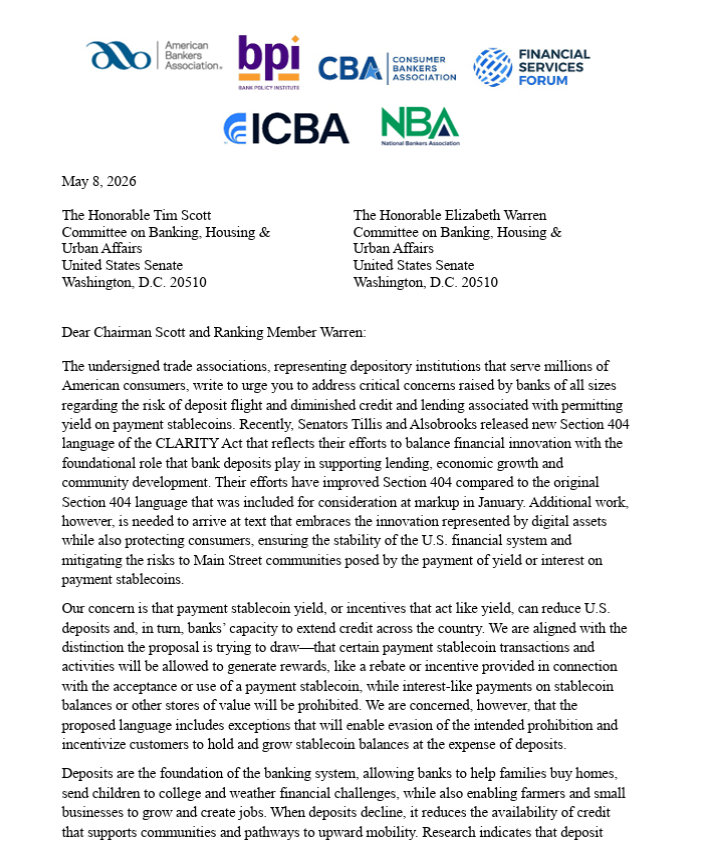
Though the crypto industry is cheering the hearing date, the banking industry said it still has concerns. A joint letter addressed to Senate Banking Committee leaders Tim Scott and Elizabeth Warren from a coalition of banking trade associations said they still had concerns with the bill, proposing edits to the text of the legislation.
The Independent Community Bankers of America (ICBA) joined that coalition in writing directly to committee members, warning that permitting yield on payment stablecoins risks deposit flight from the insured banking system and a contraction in credit and lending that would ultimately harm Main Street communities.
Banking groups warned the Senate that stablecoin yield could drain deposits and hurt lending. | Source: ICBA
While the ICBA acknowledged that the Tillis-Alsobrooks Section 404 compromise language reflects genuine efforts to balance financial innovation with the foundational role bank deposits play in supporting lending and economic growth, it argued that additional work is still needed to arrive at text that protects consumers, safeguards the stability of the US financial system, and fully mitigates the risks posed by stablecoin yield.
That position has not softened heading into the May 14 markup, which means the yield question, though nominally resolved by the bipartisan compromise, remains a live pressure point from the banking lobby
What the CLARITY Act Means for Bitcoin
Bitcoin’s regulatory position has never been the central uncertainty the CLARITY Act is resolving. The SEC has never claimed Bitcoin is a security. The SEC has never treated Bitcoin as a security because Bitcoin purchasers do not rely on the entrepreneurial or managerial efforts of others to produce a profit.
But there is a critical distinction between administrative guidance and statutory law. In March 2026, the SEC and CFTC issued a landmark joint interpretive guidance that formally classified Bitcoin as a digital commodity. SEC Chairman Paul Atkins and CFTC Chairman Michael Selig issued a joint statement declaring that “after more than a decade of uncertainty, this interpretation will provide market participants with a clear understanding of how the Commission treats crypto assets under federal securities laws.” That was a meaningful step. It was not, however, permanent.
The CLARITY Act converts that administrative classification into federal statute. A future administration cannot reverse it. That statutory permanence is the foundation on which institutional capital deployment safely scales. Pension funds, insurance companies, and endowments with legal obligations around asset classification need statute-backed certainty, not an interpretive release that could be withdrawn in the next election cycle.
BTC and ETH are already treated as commodities. Formal confirmation under CFTC jurisdiction changes little for their legal status but boosts institutional confidence, accelerates custody solutions, and strengthens the foundation for additional ETF products. US spot Bitcoin ETFs have already demonstrated the power of regulatory unlocks, attracting nearly $1 billion in inflows in the early weeks of May 2026 alone, a number that analysts project could scale dramatically once the comprehensive CLARITY framework is in place.
What the CLARITY Act Means for Ethereum
Ethereum’s position under the CLARITY Act is more nuanced but equally significant. The March 2026 joint SEC-CFTC guidance classified Ether as a digital commodity alongside Bitcoin. The CLARITY Act codifies that classification into law. But the bill’s implications for Ethereum extend well beyond the commodity label itself.
The CLARITY Act provides explicit legal protections for open-source software developers and creates a formal legal exclusion for decentralized finance activities, two provisions that address the dominant legal risk overhanging Ethereum’s entire ecosystem.
Under the current framework, the line between deploying a smart contract and operating an unregistered securities exchange has been dangerously blurry. The CLARITY Act draws that line at the protocol level. Developers who build on Ethereum without taking custody of user assets are explicitly protected from being classified as broker-dealers or exchanges.
For institutional adoption, the commodity classification confirmation also accelerates the spot ETF product pipeline. Asset managers who have flagged regulatory clarity as the key bottleneck to expanding their Ethereum-backed offerings will have a defined CFTC approval pathway once the bill is enacted. The broader effect is that the institutional inflow cycle that began with Bitcoin ETFs in early 2024 extends to Ethereum with a more durable legal foundation underneath it.
What the CLARITY Act Means for XRP
Of all the major digital assets, XRP stands to gain the most from the CLARITY Act, for reasons rooted directly in its specific regulatory history.
XRP has operated under the shadow of the SEC’s enforcement action against Ripple Labs since December 2020, when the commission filed suit alleging XRP was an unregistered security. A district court ruling in 2023 found that secondary market retail sales of XRP did not constitute securities transactions, but institutional sales remained in a contested legal grey zone. That overhang suppressed XRP’s institutional adoption for years, with major custodians and trading platforms restricting XRP products specifically because of the unresolved regulatory status.
The SEC and CFTC jointly classified Bitcoin, Ether, Solana, and XRP as digital commodities on March 17, 2026, but that classification is an interpretive release, not statute. A future administration could reverse it. The CLARITY Act makes the classification permanent federal law, which is the entire mechanism behind the institutional capital case for XRP.
XRP stands to gain the most because commodity classification would effectively end the regulatory overhang from the SEC enforcement action that has weighed on XRP since December 2020, unlocking spot ETF filings and broader institutional participation.
Standard Chartered analysts have projected $4 to $8 billion in inflows into XRP ETF products alone by the end of 2026 in a scenario where the CLARITY Act passes. That projection assumes asset managers who have been waiting specifically because of XRP’s regulatory ambiguity can file for and receive CFTC-pathway approvals once statutory commodity classification is federal law.
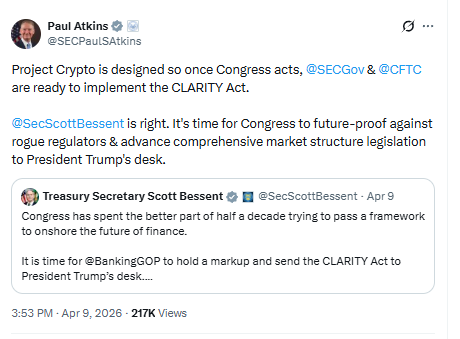
The coordinated endorsements in April 2026, with Coinbase publicly backing the bill, US Treasury Secretary Bessent framing the legislation as a national security issue in a Wall Street Journal opinion piece, and SEC Chairman Atkins confirming that both agencies already have joint implementation infrastructure ready through the Project Crypto initiative, represent the most favorable regulatory environment XRP has faced since it launched.
SEC Chairman Paul Atkins and US Treasury Secretary Scott Bessent on CLARITY Act
Implications for the Broader Digital Asset Market
The CLARITY Act’s impact extends well beyond the individual headline assets. The legislation effectively creates two distinct asset classes with different regulatory regimes.
Digital commodities, which are decentralized assets operating on mature blockchains where no single company controls more than 20% of the network, are regulated by the CFTC. Investment contract assets, which are tokens issued by centralized companies that give investors rights to profit from the efforts of that company, remain under SEC jurisdiction.
Ethereum and Solana are also highly likely to fall into the digital commodity category after the law is passed, with the CFTC gaining exclusive jurisdiction over their spot markets.
Assets including Avalanche and Cardano would likely follow, each gaining the same CFTC spot ETF pathway and institutional adoption dynamics that Bitcoin, Ethereum, and XRP will benefit from immediately.
For DeFi, Section 409 of the bill provides an explicit exclusion for decentralized finance activities from intermediary registration requirements. Protocol developers who do not take custody of user assets or exercise control over user funds are not classified as brokers, dealers, or exchanges. This protection was one of the most actively lobbied provisions in the entire bill and its inclusion was one of the specific conditions Coinbase cited when reversing its opposition in April 2026.
For exchanges and custodians, the bill creates a new registration category under CFTC oversight with explicit operational requirements around customer identification, sanctions compliance, asset segregation, and conflict-of-interest management.
The 360-day rulemaking timeline written into the bill gives the CFTC and SEC roughly a year after enactment to finalize implementing regulations, meaning practical compliance obligations for exchanges would take effect in the second half of 2027 at the earliest.
A base case scenario where the ClARITY Act passes by August 2026 projects 30 to 40% growth in institutional crypto assets under management over 12 months, $15 to $25 billion in inflows into new ETF products, and 20 to 35% price appreciation in Bitcoin and Ethereum over a one-year horizon.
A negative case where the bill fails or is delayed until 2027 projects a market correction of 15 to 25%, slower DeFi growth, and continued dominance of European and Asian trading platforms.
Global Competitive Dimension Under the Lens
The urgency behind the May 14 markup cannot be separated from the global competitive context. The European Union’s Markets in Crypto-Assets (MiCA) regulation has been fully operational since late 2024, providing the legal certainty that has enabled European crypto firms to scale institutional partnerships and compliance infrastructure ahead of their American counterparts. Singapore, the United Arab Emirates, and Hong Kong have all published comprehensive digital asset frameworks.
US Treasury Secretary Scott Bessent framed this explicitly in a Wall Street Journal op-ed on April 9, 2026, warning that blockchain developers and crypto companies are already relocating to Singapore and Abu Dhabi because those jurisdictions built clear regulatory frameworks first. Europe’s MiCA framework is operational. The US is still debating committee scheduling.
The United States currently leads the world in crypto market capitalization, blockchain developer talent density, and institutional infrastructure around Bitcoin and Ethereum ETFs. But that lead is not permanent. The HarrisX survey’s finding that 62% of American voters believe it is important for the US to set the global rules for digital finance reflects a genuine public awareness of this competitive dynamic, one that gives lawmakers who understand the stakes a compelling domestic political argument for acting before the midterm election window narrows the viable legislative calendar to nothing.
Key Risks and Outstanding Questions
The May 14 markup is not the finish line, and several material risks remain between the committee session and a presidential signature.
The 60-vote Senate floor threshold is the most significant structural hurdle. The bill needs at least seven Democratic votes, which means the final language on stablecoin yield, ethics restrictions for public officials, DeFi oversight, and anti-money laundering must satisfy Democratic priorities without alienating the coalition that delivered the strong House vote. Many Democrats have argued that the bill needs stronger anti-money laundering provisions and tighter ethics rules to prevent public officials from profiting from crypto ventures.
The DeFi governance question remains contested at the edges. While the bill provides broad developer protections, the definition of when a protocol becomes sufficiently centralized to lose that protection is still being refined, and the CFTC has not yet defined detailed verification methodologies for the decentralization threshold written into the bill.
Senate Banking Committee Chair Tim Scott said the panel was “nearing consensus” on a bipartisan markup after missing two earlier deadlines in 2026, but was still working to resolve objections from Senator John Kennedy before moving ahead with the process.
US Senate’s CLARITY Act Vote Could Reshape Crypto Markets Forever
The Senate Banking Committee’s May 14 markup is the most important event in US crypto policy since the House passed the CLARITY Act with 294 votes in July 2025. It represents the Senate’s first formal committee debate over comprehensive digital asset market structure legislation, and its outcome will determine whether the United States joins the growing list of jurisdictions that have established clear, durable rules for digital finance.
🚨 BREAKING
🇺🇸 US Senate will vote on the Clarity Act this Thursday at 10:30 AM ET
73% chance of approval per Polymarket
But here's what nobody is talking about:
Pension funds, Insurance companies, Sovereign wealth funds – all of them legally blocked from entering crypto due… pic.twitter.com/A8L7H72VVW
The data is unambiguous. A nationally representative survey of 2,008 voters finds 52% supporting the CLARITY Act on the merits, with a net positive across Republicans, Democrats, and independents, and a 20-point net electoral benefit for senators who vote yes.
Prediction market Polymarket recently showed elevated odds at 75% that the Clarity Act could become law this year. The White House, both regulatory agencies, and the largest domestic exchange are publicly aligned. The stablecoin yield compromise that blocked progress for most of 2025 and early 2026 has been reached.
For Bitcoin, the bill converts commodity status from administrative guidance into federal statute.
For Ethereum, it provides the DeFi developer protections and commodity confirmation that institutional allocators have been waiting for.
For XRP, it removes the regulatory overhang that has weighed on the asset since 2020 and unlocks a spot ETF pathway.
For the broader market, the combined effect could trigger a sustained institutional inflow cycle similar to what followed the Bitcoin ETF approvals in January 2024 but broader in scope, because the CLARITY Act covers the entire digital asset ecosystem.
Analysts expect stronger institutional inflows, increased adoption, and potential long-term growth across major digital asset markets.
Why does this matter for Bitcoin and Ethereum?
The bill could permanently classify them as digital commodities, increasing institutional confidence and reducing regulatory uncertainty.
Why is XRP heavily impacted?
The legislation may remove XRP’s long-standing SEC legal uncertainty and improve chances for future XRP ETF approvals.
Will the bill automatically become law after May 14?
No, it still requires Senate approval, House alignment, and the President’s signature before becoming federal law.
Disclaimer:
The information provided in this article is for informational purposes only. It is not intended to be, nor should it be construed as, financial advice. We do not make any warranties regarding the completeness, reliability, or accuracy of this information. All investments involve risk, and past performance does not guarantee future results. We recommend consulting a financial advisor before making any investment decisions.
Dr. Guneet Kaur is a senior editor at CCN.com and a Science Fellow at Exponential Science. She is a fintech and blockchain expert with extensive experience in digital finance education, blockchain ecosystems, and cryptocurrency markets. She has worked with global media such as Cointelegraph, as well as education and blockchain platforms, to design and lead strategic content and learning initiatives. As an educator and assessor for top-tier executive programs, she bridges real-world fintech trends with academic insight.
Dr. Kaur is also a published researcher and peer reviewer across fintech and data science journals, including Financial Innovation Journal and International Journal of Big Data Intelligence and Applications. Her work spans data-driven analysis, Web3 innovation, and technical content development. With a strong foundation in both industry and academia, she translates complex financial technologies into practical applications, empowering learners, professionals, and institutions across the rapidly evolving digital finance landscape.


 Easy
Easy