Final regulations will determine when rewards become disguised bank deposit interest.
The fight over stablecoin yield is becoming one of the biggest obstacles to the CLARITY Act, but the latest Senate text does not eliminate all ways Americans can earn rewards from stablecoins.
The distinction is much narrower.
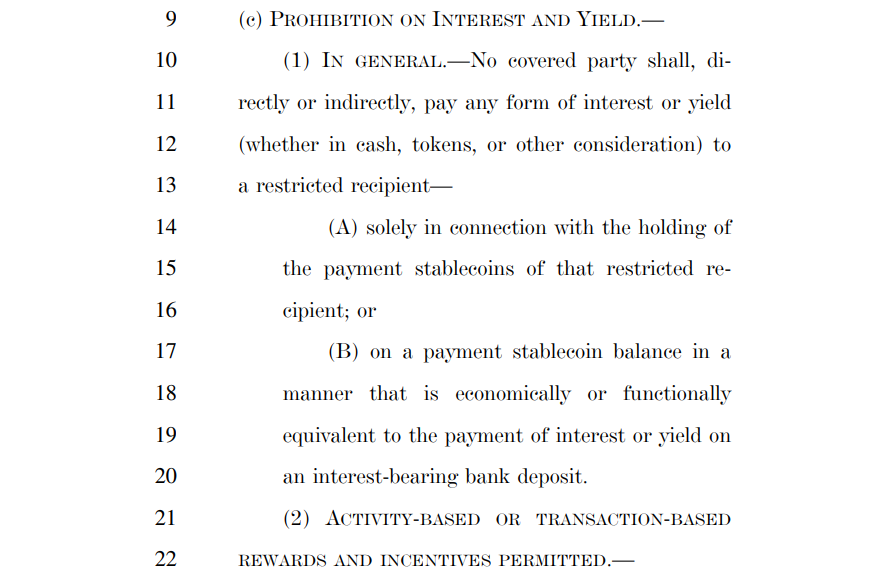
Under the Senate’s July 22 draft, Section 10404 would stop digital asset service providers and their affiliates from paying US customers interest or yield solely for holding payment stablecoins, including rewards structured to function like interest on a bank deposit. The legislation explicitly preserves rewards tied to real transactions, market activity, and capital placed at risk.
That compromise has not satisfied banks. The American Bankers Association and other industry groups argue that the current language could still allow stablecoins to compete with deposits and potentially pull funding away from community lending.
The CLARITY Act is not law yet. The Senate delayed further action until after its August recess, with a procedural vote currently scheduled for Sept. 15.
What Stablecoin Yield Would CLARITY Actually Ban?
The clearest casualty would be a product that effectively works like this: hold $10,000 of USDC on an exchange, do nothing, and receive a fixed or variable percentage simply because the balance remains there.
Section 10404 prohibits covered crypto businesses from paying yield solely for holding a payment stablecoin or designing a rewards program that is economically equivalent to an interest-bearing bank account. Even calling it a loyalty or promotional reward would not protect it if the economics are essentially deposit interest.
But the same section expressly identifies activities that regulators must treat differently when they involve genuine activity rather than passive balances.
Five Stablecoin Earning Methods the CLARITY Act Preserves
Beyond transactional and market-making activities, the CLARITY Act preserves compensation earned through network participation, such as staking stablecoins (or protocol tokens in connected consensus mechanisms), validating blocks, or participating in decentralized governance.
Because these rewards compensate users for providing operational, security, or administrative services to the underlying protocol, regulators classify them as active network contributions rather than passive, deposit-like interest.
Cashback for spending stablecoins: A user could still receive a rebate for actually paying a merchant with USDC or another payment stablecoin. The draft specifically protects rewards associated with transactions, payments, and the acceptance of stablecoins.
Rewards for stablecoin transfers and remittances: A platform could incentivize users to send or remit stablecoins, such as by offering a fee rebate on a cross-border USDC transfer. “Transfer,” “remittance,” and “settlement” activities are all expressly listed among permissible categories.
Providing liquidity for market making: Depositing stablecoins into liquidity or market-making arrangements can still generate compensation because the legislation specifically protects rewards connected with providing liquidity for market-making activity. Unlike passive exchange-traded funds, these assets are actively deployed and exposed to market risks.
Using stablecoins as trading collateral: Traders could still receive incentives connected to posting USDC or another stablecoin as collateral for trading. The bill names “posting of collateral in connection with trading” as a permitted activity.
Putting stablecoins into lending or other credit-risk strategies: Section 10404 also protects compensation for “putting assets at credit or investment risk.” That means the stablecoin-yield prohibition itself would not outlaw genuine lending arrangements where capital is exposed to borrower or investment risk. Other securities, commodities, or DeFi rules could still apply to the specific product.
Stablecoins yield restrictions under the CLARITY Act. | Source: CLARITY Act draft
Stablecoin Yield Isn’t Disappearing, but Passive Yield Could
The dividing line is therefore risk and activity.
Simply parking stablecoins with a crypto platform and collecting a bank-like APY is what lawmakers are targeting. Spending them, providing liquidity, posting them as trading collateral, transferring them, or putting them at genuine credit risk are specifically contemplated by the July draft as permissible reward-generating activities.
There is still regulatory uncertainty. The SEC, CFTC, and Treasury would have up to one year after enactment to jointly write rules defining when rewards cross the line into disguised deposit interest.
So even if CLARITY survives its September Senate test, stablecoin yield would not disappear. It would shift from getting paid for simply holding dollars on-chain toward getting paid for actually using or putting those dollars at risk.
Disclaimer:
The information provided in this article is for informational purposes only. It is not intended to be, nor should it be construed as, financial advice. We do not make any warranties regarding the completeness, reliability, or accuracy of this information. All investments involve risk, and past performance does not guarantee future results. We recommend consulting a financial advisor before making any investment decisions.
Dr. Guneet Kaur is a senior editor at CCN.com and a Science Fellow at Exponential Science. She is a fintech and blockchain expert with extensive experience in digital finance education, blockchain ecosystems, and cryptocurrency markets. She has worked with global media such as Cointelegraph, as well as education and blockchain platforms, to design and lead strategic content and learning initiatives. As an educator and assessor for top-tier executive programs, she bridges real-world fintech trends with academic insight.
Dr. Kaur is also a published researcher and peer reviewer across fintech and data science journals, including Financial Innovation Journal and International Journal of Big Data Intelligence and Applications. Her work spans data-driven analysis, Web3 innovation, and technical content development. With a strong foundation in both industry and academia, she translates complex financial technologies into practical applications, empowering learners, professionals, and institutions across the rapidly evolving digital finance landscape.