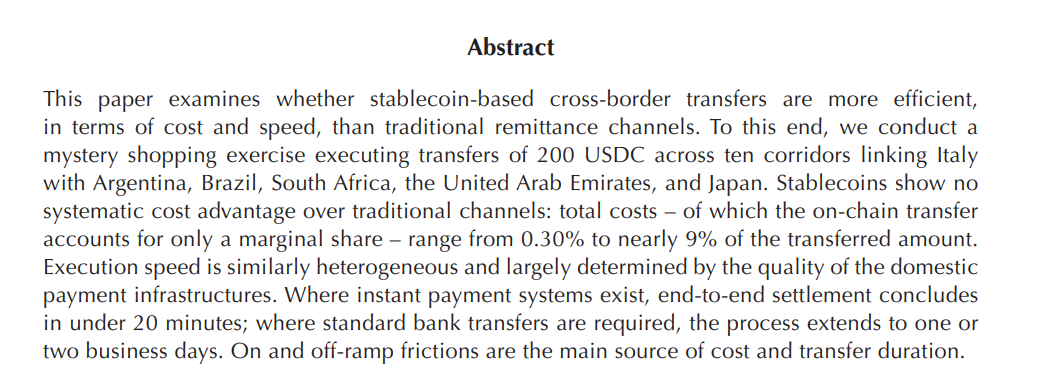
In a real-world mystery shopping exercise, researchers executed 200 USDC transfers across 10 payment corridors connecting Italy with Argentina, Brazil, South Africa, the United Arab Emirates, and Japan.
Rather than relying on simulations, the team completed actual transfers and measured end-to-end costs and settlement times.
Bank of Italy’s 200 USDC study finds stablecoin remittance fees reach 9%. | Source: bancaditalia.it
The results challenge one of crypto’s most common narratives. Total remittance costs ranged from 0.3% to nearly 9% of the amount transferred, while blockchain fees accounted for only a small portion of the overall expense. Instead, the highest costs came from converting fiat into stablecoins and back again.
Try Our Recommended Crypto Exchanges
Sponsored
Disclosure
We sometimes use affiliate links in our content, when clicking on those we might receive a commission at no extra cost to you. By using this website you agree to our terms and conditions and privacy policy.
The researchers found that the efficiency of stablecoin remittances depends less on blockchain technology and more on the financial infrastructure surrounding it.
Every transaction passed through five stages: funding an exchange account, purchasing USDC, transferring tokens onchain, converting USDC back into local currency, and withdrawing funds into a bank account. The first two stages form the on-ramp, while the final two make up the off-ramp. These fiat conversion steps accounted for most of the cost and delay, not the blockchain transfer itself.
Across the eight comparable payment corridors, total costs ranged from 0.30% for transfers from Italy to Argentina to 8.96% in the reverse direction. Italy-to-Brazil transfers cost 2.70%, while Italy-to-the-UAE transfers cost 7.20%. The researchers said such wide differences make it impossible to claim that stablecoins consistently offer cheaper remittances than traditional services.
The blockchain leg itself typically accounted for only a fraction of total expenses, reinforcing the conclusion that exchanges, foreign-exchange spreads, and banking infrastructure determine most of the final price.
Speed Depends on Payment Infrastructure, Not Crypto
The study reached a similar conclusion on settlement times.
Where both countries supported modern instant payment systems, transfers were settled in under 20 minutes. Corridors that relied on conventional banking infrastructure often required one or even two business days, despite the blockchain transaction completing much faster. Researchers concluded that domestic payment systems, rather than distributed ledger technology, remain the primary determinant of end-to-end speed.
To ensure consistency, the researchers selected USDC because it is widely available across all jurisdictions included in the study and transferred the tokens over Ethereum, despite acknowledging that networks such as Solana and Tron generally offer lower fees. They noted that Ethereum was chosen because it was the only blockchain supported by all participating exchanges and because onchain fees contributed only marginally to total costs.
The Bank of Italy argues that regulatory frameworks, exchange competition, and tighter integration between crypto platforms and domestic payment systems will play a greater role in reducing costs than improvements to blockchain throughput alone.
The report also notes that jurisdictions with instant payment systems and stronger banking connectivity tend to deliver faster, cheaper transfers than those with fragmented financial infrastructure.
The research arrives as governments around the world adopt stablecoin legislation and payment companies accelerate the adoption of digital dollars. While blockchains continue to offer fast settlement, the Bank of Italy’s experiment suggests that making remittances meaningfully cheaper will require fixing the traditional financial rails that still sit at both ends of every stablecoin transaction.
Dr. Guneet Kaur is a senior editor at CCN.com and a Science Fellow at Exponential Science. She is a fintech and blockchain expert with extensive experience in digital finance education, blockchain ecosystems, and cryptocurrency markets. She has worked with global media such as Cointelegraph, as well as education and blockchain platforms, to design and lead strategic content and learning initiatives. As an educator and assessor for top-tier executive programs, she bridges real-world fintech trends with academic insight.
Dr. Kaur is also a published researcher and peer reviewer across fintech and data science journals, including Financial Innovation Journal and International Journal of Big Data Intelligence and Applications. Her work spans data-driven analysis, Web3 innovation, and technical content development. With a strong foundation in both industry and academia, she translates complex financial technologies into practical applications, empowering learners, professionals, and institutions across the rapidly evolving digital finance landscape.