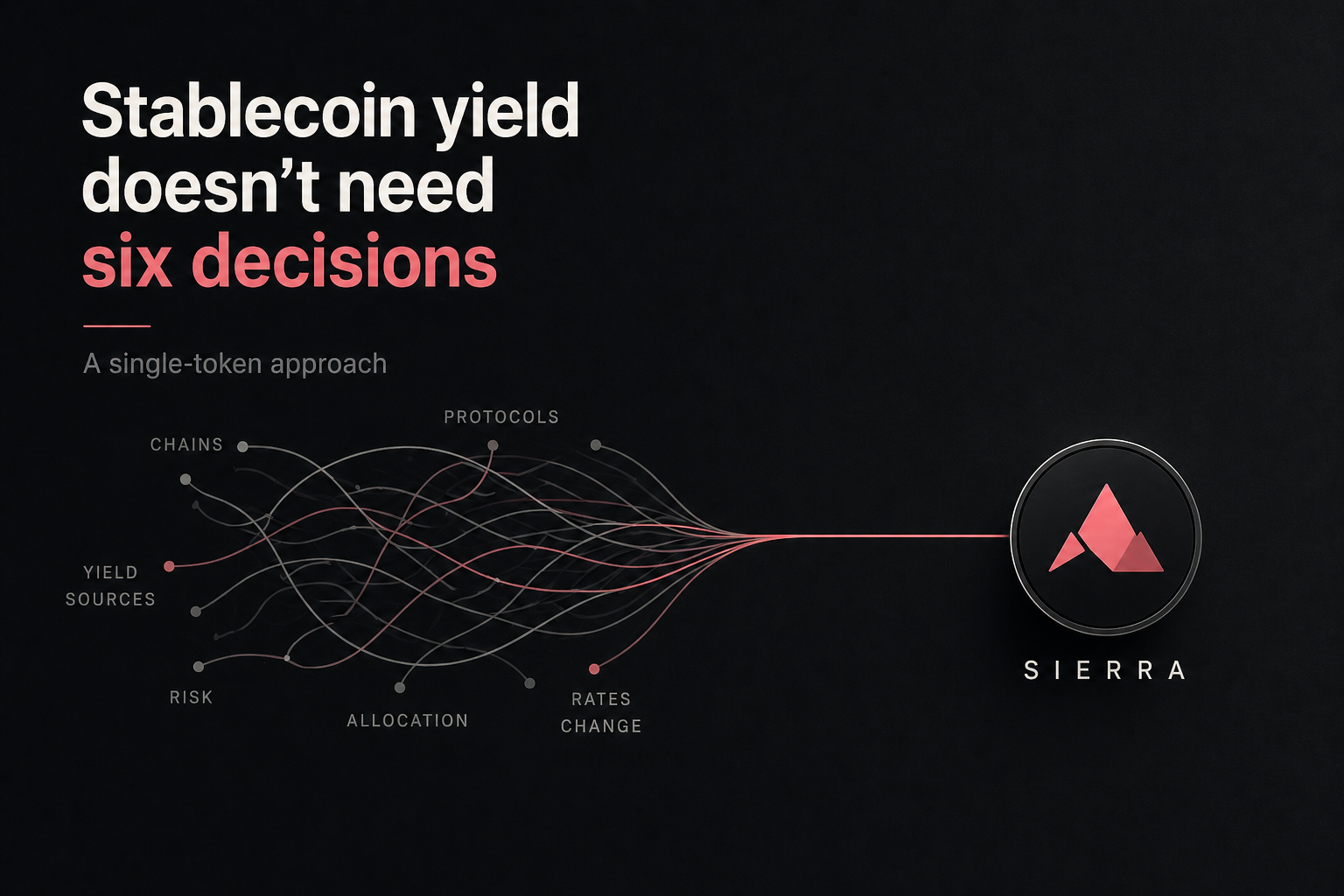
If you’re earning yield on stablecoins right now, you’ve probably made six separate decisions to get there. Which chain. Which protocol. How the yield is generated. What risks come with it. How to split your capital. And what to do when rates change, which they will, next week.
Sierra built a token called SIERRA to skip all of that.
What SIERRA is and how it works
SIERRA is a Liquid Yield Token on Avalanche. You swap USDC for it on the Sierra app or on LFJ, Avalanche’s largest DEX. Yield starts accruing the moment you hold it. You don’t stake. You don’t lock anything up. You don’t claim rewards from some dashboard.
Behind the token sits a reserve portfolio: U.S. Treasury money market funds, investment grade commercial paper, and DeFi lending on Aave, Morpho, Euler, Wildcat, and Pendle. OpenTrade (backed by a16z Crypto and Circle) runs the operational layer, routing capital between these sources through one protocol. An FCA-regulated asset manager oversees the real world asset collateral in segregated accounts at Tier-1 banks. Fireblocks handles custody for the DeFi vaults, with whitelisting and policy enforcement baked in.
Sierra’s Risk Framework decides how the allocation shifts. When DeFi lending rates move or RWA yields change, Sierra rebalances. You don’t touch anything.
The tax structure worth paying attention to
Most yield products distribute rewards. Tax authorities in many jurisdictions treat those distributions as income. You earn it, you owe taxes on it, even if you haven’t sold a thing.
SIERRA doesn’t distribute yield. Instead, the mint and redeem price rises over time. Buy SIERRA at $1.00, redeem at $1.08 six months later. Your cost basis gets set at purchase. You decide when to sell and realize the gain. Because you’re selling the same number of tokens at a higher price, your tax advisor may classify that as capital gains rather than income.
That distinction matters if you care about controlling when your tax events happen. Talk to your own tax professional about how it applies in your jurisdiction.
SIERRA works across DeFi, not just in a wallet
Most yield tokens sit in your wallet and accrue. SIERRA does that too, but it also plugs into protocols where you can compound, hedge, or trade the yield itself.
SIERRA has incentivized liquidity pools on Uniswap and LFJ. LPs earn trading fees and incentives on top of the token’s own yield.
SIERRA is an OFT on LayerZero, which means you can bridge it between Ethereum and Avalanche through Stargate Finance. Zero slippage, no bridging fees, unlimited size. You pay gas only.
On Pendle, you can lock in a fixed rate of return on SIERRA or speculate on where the yield goes next. Pendle splits SIERRA into Principal Tokens and Yield Tokens, both tradeable. Holding the PTs earns Peaks through Sierra’s Summit Program, which runs through September 2026. Sierra will allocate at least 30% of its governance token (SGT) supply to Summit participants at TGE, with no vesting and no penalties on converted tokens.
RedStone publishes SIERRA’s exchange rate onchain. That price feed lets lending markets, vaults, and other protocols price SIERRA programmatically. Sierra is using it to push SIERRA as yield bearing collateral in DeFi lending markets through 2026.
Built for institutions, open to everyone
OpenTrade manages Sierra’s reserves with the same platform it runs for regulated fintechs in Latin America, Europe, and Asia. Fireblocks provides MPC custody with whitelisting, policy enforcement, and audit trails. RWA collateral sits in segregated accounts.
None of that requires you to be an institution. You swap USDC on a DEX. Yield accrues that block. You bridge to Ethereum through Stargate if you want. You redeem whenever.
What’s next
Sierra plans to add yield sources in 2026: SuperState’s USCC for basis trades on CME, commercial paper, Pendle PTs as zero coupon instruments, and OpenTrade’s Figment SOL Staking Basis Vault. More LayerZero deployments will open crosschain minting and redemption on additional chains. On the distribution side, Sierra is targeting CEX listings with fiat on-ramps, integrations with consumer platforms, and lending market partnerships so SIERRA can serve as borrowable collateral.
Sierra is also pursuing CeFi distribution on exchanges in regions where demand for yield bearing stablecoin assets runs high.
The pitch is straightforward. One token. Yield accrues. Risk is managed by the protocol. You keep custody. If you’re tired of juggling five tabs to earn 4% on stablecoins, it’s worth a look.
Disclaimer:
We occasionally work with brands we trust to bring you deeply researched content. This article was developed in collaboration with a trusted partner.

With over half a decade of experience commentating on the cryptocurrency market and even more as a trader and investor, Jay has developed a robust knowledge base that enables him to dive deep into the inner workings of crypto platforms and the broader market to deliver unique, user-focused insight.
Jay's work has spanned public relations firms, crypto projects, affiliate sites, and news outlets.