Key Takeaways
- Senator Cynthia Lummis rejected claims that stablecoins are causing widespread deposit flight from community banks.
- Bank of America data showed household deposit balances rising across all income groups in early 2026, though tax refunds partly drove the increase.
- Lummis said community-bank deposits grew approximately 5%, outperforming the broader banking industry.
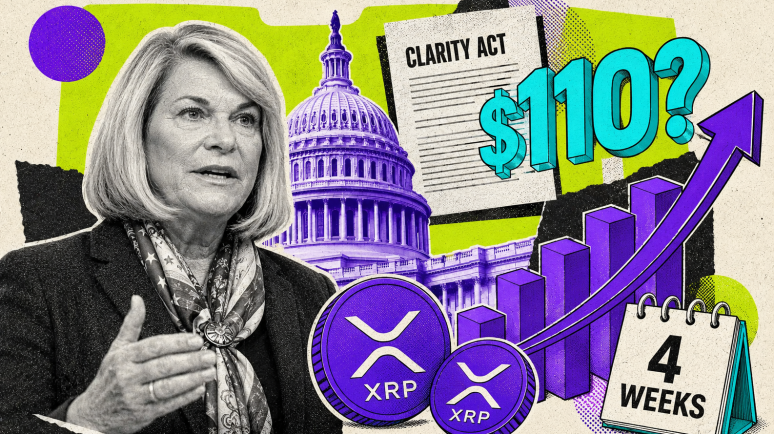
US Senator Cynthia Lummis has rejected claims that stablecoins are draining deposits from community banks, arguing that available banking data points to continued deposit growth rather than widespread flight into digital dollars.
The Wyoming Republican made the case as negotiations over the CLARITY Act intensify following the Senate’s decision to delay a vote until September.
Lummis, a prominent cryptocurrency advocate, said defeating the market-structure legislation would preserve a banking system that critics themselves describe as broken.
Lummis Challenges Stablecoin Deposit Claims
In an X post, Lummis cited Bank of America and Federal Deposit Insurance Corporation data to challenge concerns that stablecoins are weakening smaller lenders.
Bank of America Institute found that household checking and savings balances increased across all income groups during the first five months of 2026.
Median deposits rose approximately 15% for lower-income households and 4% for higher-income households, although the bank noted that tax refunds contributed to the increase and balances could decline later in the year.
Lummis also said domestic bank deposits had expanded for seven consecutive quarters, with community banks outperforming the wider industry by recording roughly 5% deposit growth.
She argued that the deeper problem facing community banking is consolidation.
According to Lummis, the US lost approximately 2,000 community banks over the past decade while only 62 new banks were formed. Acquisitions were generally led by larger regional institutions rather than cryptocurrency companies.
CLARITY Draft Tightens Stablecoin Yield Rules
Lummis also pushed back against suggestions that the CLARITY Act’s stablecoin provisions would accelerate deposit flight by allowing crypto platforms to compete directly with interest-bearing bank accounts.
The Senate draft’s Section 10404 would prohibit digital-asset service providers from paying interest or yield solely for holding payment stablecoins.
It would also cover loyalty, promotional, subscription or incentive programs when their rewards are economically equivalent to interest on a bank deposit.
Transaction-based incentives would remain permissible when attached to genuine activities such as payments, transfers, conversions, remittances or settlements, and when they do not function like passive yield.
The draft legislation would additionally restrict misleading claims suggesting that stablecoins are deposits, government-backed products or protected by FDIC insurance
Lummis characterized these provisions as stricter than the current framework, rather than a concession to crypto companies.
Separately, she said the Senate Banking Committee had included nine community-bank measures in housing legislation intended to support deposit retention.
September Vote Raises Legislative Stakes
The Senate postponed consideration of the CLARITY Act until after its August recess, leaving supporters with a narrow legislative window before the November midterm elections.
Senate Majority Leader John Thune has indicated that the measure will return to the floor in September.
Lummis responded to the delay by saying she would “not stop fighting” for the bill and that the push for digital-asset legislation was “far from over.”
The dispute over stablecoin rewards has become one of several obstacles facing the legislation. Community banks fear that widely available digital dollars could draw customers away from conventional accounts, particularly if crypto platforms offer attractive incentives.
Lummis maintains that the proposed restrictions address that risk while preserving legitimate payment rewards.
Her broader argument is that blocking the CLARITY Act would neither reverse bank consolidation nor strengthen local lenders. It would simply leave the existing digital-asset market without a comprehensive federal framework.
Recommended Secure Partners
The information provided in this article is for informational purposes only. It is not intended to be, nor should it be construed as, financial advice. We do not make any warranties regarding the completeness, reliability, or accuracy of this information. All investments involve risk, and past performance does not guarantee future results. We recommend consulting a financial advisor before making any investment decisions.

Giuseppe Ciccomascolo began his career as an investigative journalist in Italy, where he contributed to both local and national newspapers, focusing on various financial sectors.
Upon relocating to London, he worked as an analyst for Fitch's CapitalStructure and later as a Senior Reporter for Alliance News. In 2017, Giuseppe transitioned to covering cryptocurrency-related news, producing documentaries and articles on Bitcoin and other emerging digital currencies. He also played a pivotal role in establishing the academy for a cryptocurrency exchange website. Crypto remained his primary area of interest throughout his tenure as a writer for ThirdFloor.









 CLARITY Act on the Brink? Lummis Stands Firm as Hawley Revolts and Senate Odds Plunge