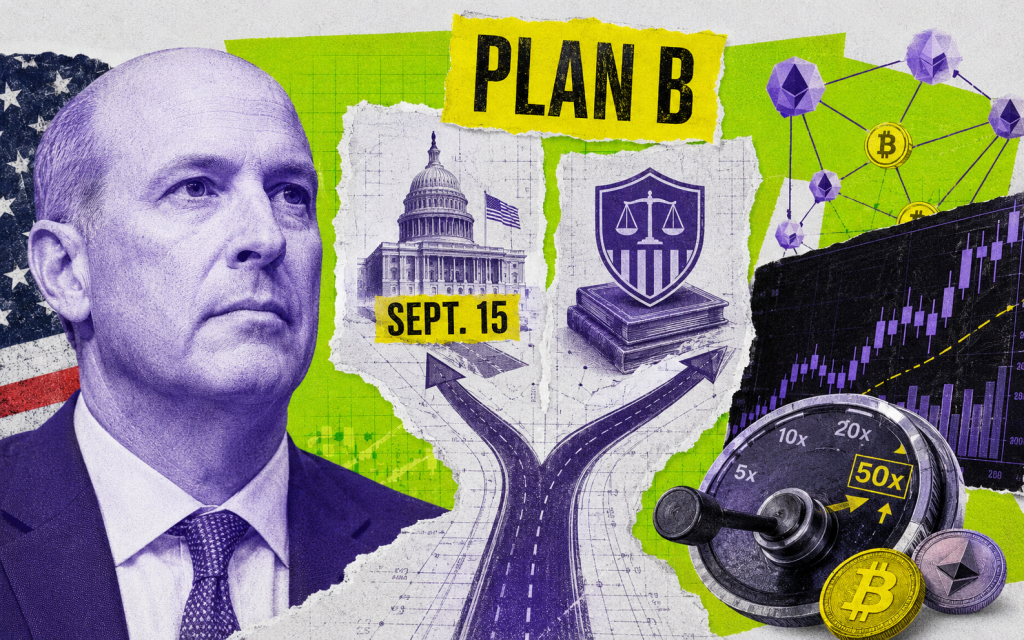
CFTC Chair Michael Selig is preparing rules for US DeFi and leveraged crypto trading if the CLARITY Act fails in the Sept. 15 vote. | Credit: CCN.com
Share
Key Takeaways
CFTC Chair Michael Selig is preparing an agency-led crypto framework if the CLARITY Act fails to advance in the Sept. 15 Senate vote.
The proposed rules could let CFTC-supervised exchanges offer leveraged or margined cryptocurrency trading in the US.
CFTC staff will consult DeFi developers about legal pathways for operating onchain protocols within the country.
The Commodity Futures Trading Commission is preparing to build its own regulatory framework for cryptocurrency markets if Congress fails to advance the CLARITY Act in a key Senate vote scheduled for Sept. 15.
CFTC Chair Michael Selig unveiled the contingency plan during the first meeting of the agency’s Innovation Advisory Committee. The 43-member group includes senior executives from Coinbase, Kraken, Ripple, Gemini, Robinhood, Nasdaq, the New York Stock Exchange and CME Group.
Selig said legislation remains the preferred route because it would establish a durable division of responsibilities between the CFTC and Securities and Exchange Commission.
However, he has directed staff to explore how the agency could use its existing authority to regulate crypto trading, decentralized finance and prediction markets.
Top Crypto Tax Accounting Software
Sponsored
Disclosure
We sometimes use affiliate links in our content, when clicking on those we might receive a commission at no extra cost to you. By using this website you agree to our terms and conditions and privacy policy.
Under the proposed framework, registered firms and currently unregistered crypto exchanges could seek designation as CFTC-supervised crypto asset markets.
The status could allow platforms to offer leveraged or margined crypto products under rules tailored to digital assets. Such a system could create a regulated US pathway for products that American traders often access through offshore exchanges.
Selig said the CFTC would give lawmakers time to vote on the CLARITY Act. If negotiations fail, however, the agency will “move swiftly” to propose its own rules.
“If Clarity continues to stall because of Democrat obstruction, the CFTC will utilize its existing authorities to begin establishing a regime for crypto asset markets,” Selig said.
The remarks follow President Donald Trump’s call for Congress to pass a “fair version” of the bill. Trump also recently said Selig was working to bring Hyperliquid into the US in a “fully compliant and legal” way.
DeFi Developers Could Receive a US Legal Pathway
The CFTC’s fallback plan would not be limited to centralized exchanges. Selig also directed agency staff to engage with developers building onchain financial protocols.
The goal is to determine how developers could legally offer decentralized products in the US without exposing themselves to the enforcement uncertainty that has previously pushed many projects offshore.
Selig did not explain which protocols would qualify or how the agency would distinguish decentralized software development from operating a regulated financial marketplace.
Like SEC, the CFTC isn’t waiting around for politicians to figure out how to pass crypto legislation (or even try to learn about crypto for a number of senators)…
CFTC Chairman Selig: “If we have to utilize that authority to create rules without the supporting legislation,… pic.twitter.com/SqMju8cWVd
Still, formal engagement could mark an important change for DeFi teams seeking clearer rules.
The committee will also examine prediction-market regulation. Kalshi and Polymarket executives both hold seats on the panel, reflecting the rapid growth of event contracts.
Selig criticized attempts by individual states to restrict prediction markets, arguing that the CFTC had protected federally regulated platforms from “rogue state attorneys general.”
Crypto Executives Back Federal Market Rules
Coinbase CEO Brian Armstrong said the CLARITY Act had a “great chance of passing,” arguing that both political parties could receive roughly 90% of what they want from the legislation.
The bill would clarify when digital assets fall under SEC or CFTC supervision. However, negotiations have continued over issues including ethics restrictions and the treatment of decentralized finance.
Robinhood CEO Vlad Tenev warned that the existing patchwork of 50 state-level regulatory regimes ultimately harms customers more than crypto companies.
Sounds like clarity is coming either way: 1. 60+ votes in the Senate on September 15th 2. Or a new set of rules from the CFTC and SEC on September 16th https://t.co/k1xaG2P4Cg
Meanwhile, Depository Trust & Clearing Corporation CEO Frank La Salla said improved SEC-CFTC coordination had given traditional finance an “open lane” to advance blockchain and tokenization projects.
The Sept. 15 vote will therefore determine more than the bill’s immediate prospects. If Congress cannot agree, Selig has made clear that the CFTC is prepared to pursue Plan B, using existing powers to bring leveraged trading, DeFi protocols and other crypto markets under federal oversight.
Disclaimer:
The information provided in this article is for informational purposes only. It is not intended to be, nor should it be construed as, financial advice. We do not make any warranties regarding the completeness, reliability, or accuracy of this information. All investments involve risk, and past performance does not guarantee future results. We recommend consulting a financial advisor before making any investment decisions.
Giuseppe Ciccomascolo began his career as an investigative journalist in Italy, where he contributed to both local and national newspapers, focusing on various financial sectors.
Upon relocating to London, he worked as an analyst for Fitch's CapitalStructure and later as a Senior Reporter for Alliance News. In 2017, Giuseppe transitioned to covering cryptocurrency-related news, producing documentaries and articles on Bitcoin and other emerging digital currencies. He also played a pivotal role in establishing the academy for a cryptocurrency exchange website. Crypto remained his primary area of interest throughout his tenure as a writer for ThirdFloor.








 Bitcoin to $1.5M? Trump’s CLARITY Act and BTC Buying Support Puts Cathie Wood Prediction in Focus