The best DEX platforms give crypto traders a way to swap tokens directly from their wallets without having to hand over funds to a centralized exchange. Instead of creating an account, passing KYC, depositing crypto, and waiting for withdrawals, users connect a wallet and trade through smart contracts.
Chain coverage, liquidity depth, routing quality, and smart contract risk vary significantly across platforms. And the wrong choice can mean worse prices, failed transactions, or real losses.
The CCN team tested major DEX platforms across Ethereum, Solana, BNB Chain, Base, Arbitrum, Optimism, and other active networks to identify which platforms actually deliver on the fundamentals. This guide compares AMM-based exchanges, order book DEXs, and DEX aggregators based on the criteria that matter for real trading: slippage, gas costs, wallet support, aggregation, and security track record.
Whether you’re swapping blue-chip DeFi assets on Ethereum or hunting early liquidity on a newer chain, the right DEX depends on where you trade, what you’re trading, and how much risk you’re willing to carry. Here’s what the data shows.
Key Takeaways:
DEXs let users trade directly from wallets, offering self-custody and broad DeFi access.
Key DEX factors include liquidity, slippage, chain support, fees, routing, and security.
AMMs use liquidity pools, while aggregators find the best prices across multiple DEXs.
DEXs provide privacy and early token access but carry smart contract and scam risks.
The best DEX depends on trading needs, risk tolerance, wallet setup, and preferred chains.
Best Decentralized Exchanges in 2026 Are:
Filters
Crypto accepted
Disclosure
We sometimes use affiliate links in our content, when clicking on those we might receive a commission at no extra cost to you. By using this website you agree to our terms and conditions and privacy policy.
Founded in 2017 in Belize, Cryptonex Exchange is a reputable player in the cryptocurrency market, providing users with a comprehensive platform for trading various digital assets.
Promotions
Register And Top Up The Balance To Receive A Greeting Bonus From $20 To $100 In CNX.
ChangeNow is one of the best hybrid crypto exchanges out there. While offering crypto custodial services, users also enjoy some other decentralized exchange features, like dApps integration. Here, you can swap, buy, sell, and enjoy others services like Now payments, Now Nodes, a white label wallet that allows you launch your own non-custodial wallet, a telegram bot, a widget, a tracker, and a native token. It's centralized nature comes in the fact that you can buy and sell crypto with lots of fiat payment methods and currencies, so it is a full package.
Promotions
Unlock 1,500+ Cryptocurrencies And Seamless Instant Swaps In The All-in-one Crypto Super App ChangeNOW
Fees (Maker/Taker)
$0 Per Month, $15 Per Month, $100 Per Month
Products
Trade, Spot Trading, OTC Trading+7
Trade
spot trading
OTC trading
peer to peer
day trading
Earn/stake
pay
loans
NFTs
wallet
Cryptocurrencies
Bitcoin, Ethereum, Tether+219
Bitcoin
Ethereum
Tether
Build'N'Build
USD Coin
Solana
Ripple
Dogecoin
Cardano
Toncoin
Shiba Inu
Avalanche
TRON
Chainlink
Polkadot
Polygon Matic
Wrapped Bitcoin
Litecoin
Dai
NEAR Protocol
Bitcoin Cash
Monero
Stellar
Cosmos
Filecoin
Ethereum Classic
Aptos
Hedera Hashgraph
Immutable
Optimism
Arbitrum
VeChain
The Sandbox
Decentraland
Axie Infinity
Injective Protocol
Render Token
The Graph
Maker
Aave
Chiliz
Helium
PAX Gold
Compound
Lido DAO Token
THORChain
Stacks
Arweave
Sui
Conflux Network
Lido Staked ETH
Bitget Token
Wrapped Ethereum
OKB
Uniswap
Pepe
Ondo
Mantle
First Digital USD
Bittensor
Kaspa
Celestia
XDC Network
Artificial Superintelligence Alliance
Jupiter
Quant
Worldcoin
PayPal USD
Bonk
Flare
Tether Gold
Sei
JITO
JasmyCoin
PancakeSwap
Core
Floki Inu
Ethereum Name Service
SushiSwap
Kava.io
1inch Network
Tezos
Algorand
Flow
Trust Wallet Token
Curve DAO Token
KuCoin Token
MultiversX
Gitcoin
Zcash
IOTA
Basic Attention Token
Frax
Ethena
Ethena USDe
Fasttoken
Pi Network
SATS
Adventure Gold
Audius
Alchemy Pay
Arkham
API3
Bounce Token
Altlayer
Aergo
Amp
Aevo
ARPA Chain
Astar
Ark
Ankr
AirSwap
Alpaca Finance
Blur
Badger DAO
Bancor
BakeryToken
Biconomy
Chromia
Celer Network
Celo
Shentu
Civic
Convex Finance
Cartesi
Cyber
COTI
DigiByte
DIA
ether.fi
FUNToken
FLUX
Firo
Ampleforth
Golem
GMX
Gnosis
Moonbeam
Holo
IoTex
ICON
Illuvium
JUST
Kadena
Liquity
Livepeer
Lisk
Memecoin
Manta Network
Treasure
Mask Network
MetisDAO
Origin Protocol
ORDI
Ontology
Osmosis
Powerledger
Phala Network
Pendle
Portal
Pyth Network
ConstitutionDAO
Polkastarter
Quickswap Old
Qtum
iExec RLC
Rocket Pool
Reserve Rights
Ronin
Ravencoin
Starknet
Storj
Status
Spell Token
Sun (New)
SuperVerse
Toko Token
Theta Fuel
Tellor
Tensor
LayerZero
Usual
Eigenlayer
Hamster Kombat
Neiro - First Neiro on Ethereum
Catizen
Berachain
KAITO
Pudgy Penguins
Solayer
Bio Protocol
ChainGPT
Cookie DAO
Solv Protocol
Alchemix
Bitcoin SV
Movement
DeXe
Binance Staked SOL
Nexo
Wrapped eETH
Hyperliquid
Casper
Zilliqa
Secret
Nervos Network
TrueUSD
BitTorrent
Mina
Dash
STEPN
Gemini Dollar
UNUS SED LEO
Synthetix
APEcoin
Gala
Theta Network
Fantom
Cronos
Internet Computer
Binance USD
Payment Methods
Bank Transfer, Bank Wire Transfer, SEPA (Single Euro Payments Area)+230
Bank transfer
Bank Wire Transfer
SEPA (Single Euro Payments Area)
ACH (Automated Clearing House)
Visa
MasterCard
Apple Pay
Google Pay
PIX
FPS (Faster Payments Service)
Revolut
Bitcoin
Ethereum
Tether
Build'N'Build
USD Coin
Solana
XRP
Dogecoin
Cardano
Toncoin
Shiba Inu
Avalanche
TRON
Chainlink
Polygon
Polkadot
Wrapped Bitcoin
Litecoin
Dai
NEAR Protocol
Bitcoin Cash
Monero
Stellar
Cosmos
Filecoin
Ethereum Classic
Aptos
Hedera Hashgraph
Immutable
Optimism
Arbitrum
VeChain
The Sandbox
Decentraland
Axie Infinity
Injective Protocol
Render Token
The Graph
Maker
Aave
Chiliz
Helium
PAX Gold
Compound
Lido DAO Token
THORChain
Stacks
Arweave
Sui
Conflux Network
Lido Staked ETH
Bitget Token
Wrapped Ethereum
OKB
Uniswap
Pepe
Ondo
Mantle
First Digital USD
Bittensor
Kaspa
Celestia
XDC Network
Artificial Superintelligence Alliance
Jupiter
Quant
Worldcoin
PayPal USD
Bonk
Flare
Tether Gold
Sei
JITO
JasmyCoin
PancakeSwap
Core
FLOKI
Ethereum Name Service
SushiSwap
Kava.io
1inch Network
Tezos
Algorand
Flow
Trust Wallet Token
Curve DAO Token
KuCoin Token
MultiversX
GateToken
Zcash
IOTA
Basic Attention Token
Frax
Ethena
Ethena USDe
Fasttoken
Pi Network
SATS
Adventure Gold
Audius
Alchemy Pay
Arkham
API3
Bounce Token
Altlayer
Aergo
Amp
Aevo
ARPA Chain
Astar
Ark
Ankr
AirSwap
Alpaca Finance
Blur
Badger DAO
Bancor
BakeryToken
Biconomy
Chromia
Celer Network
Celo
Shentu
Civic
Convex Finance
Cartesi
Cyber
COTI
DigiByte
DIA
ether.fi
FUNToken
FLUX
Firo
Ampleforth
Golem
GMX
Gnosis
Gitcoin
Moonbeam
Holo
IoTex
ICON
Illuvium
JUST
Kadena
Liquity
Livepeer
Lisk
Memecoin
Manta Network
Treasure
Mask Network
Metis
Origin Protocol
ORDI
Ontology
Osmosis
Powerledger
Phala Network
Pendle
Portal
Pyth Network
ConstitutionDAO
Polkastarter
Qtum
iExec RLC
Rocket Pool
Reserve Rights
Ronin
Ravencoin
Starknet
Storj
Status
Spell Token
SUN
SuperVerse
Toko Token
Theta Fuel
Tellor
Tensor
LayerZero
Usual
Eigenlayer
Hamster Kombat
Neiro - First Neiro On Ethereum
Catizen
Berachain
KAITO
Pudgy Penguins
Solayer
Bio Protocol
ChainGPT
Cookie DAO
Solv Protocol
Alchemix
Bitcoin SV
Movement
DeXe
Binance Staked SOL
Nexo
Wrapped eETH
Hyperliquid
Casper
Zilliqa
Secret
TrueUSD
BitTorrent
Mina
Dash
STEPN
Gemini Dollar
UNUS SED LEO
Synthetix
APEcoin
Gala
Theta Network
Fantom
Cronos
Internet Computer
Binance USD
QuickSwap (Old)
Languages
Azerbaijani, Catalan, Czech+55
Azerbaijani
Catalan
Czech
Danish
German
Estonian
English
Spanish
French
Hausa
Croatian
Indonesian
Italian
Swahili
Latvian
Lithuanian
Hungarian
Malay
Dutch
Norwegian
Uzbek
Filipino
Polish
Portuguese
Portuguese (Brazil)
Romanian
Slovenian
Slovak
Serbian
Finnish
Swedish
Vietnamese
Turkish
Zulu
Greek
Bulgarian
Kazakh
Russian
Tajik
Ukrainian
Georgian
Armenian
Hebrew
Urdu
Arabic
Farsi
Amharic
Hindi
Bengali
Sinhala
Thai
Lao
Burmese
Khmer
Korean
Japanese
Chinese (Simplified)
Chinese (Traditional)
Licenses
N/A
Security
256-Bit SSL Encryption, 2FA Google Authenticator, 2FA Authy
Disclaimer: Investing in cryptocurrencies carries significant risk. Values are highly volatile. Never invest more than you can afford to lose. This site does not provide financial advice. Act based on your own research and consult with a financial professional before making decisions. Don’t invest unless you’re prepared to lose all the money you invest.
Affiliate disclosure: This website may contain affiliate links, which means we may earn a commission if you click on a product link and make a purchase/register.
Why Trust Us?
DEX coverage is easy to get wrong. Platforms change — liquidity shifts, chains fall out of favor, smart contract vulnerabilities emerge — and a guide written six months ago may already be pointing readers toward the wrong platforms.
CCN's crypto team has reviewed exchanges, wallets, DeFi tools, and Web3 security products across multiple market cycles. For this guide, we focused on real trading usability: how platforms actually perform on live swaps, not just how they present themselves in documentation or marketing materials.
We also drew on how these platforms are used in practice by active DeFi traders, liquidity providers, and wallet users. A DEX that looks strong on paper but consistently produces worse routing, higher slippage, or opaque fee structures didn't make the cut.
What Is a Decentralized Exchange?
A decentralized exchange, or DEX, is a crypto trading platform that lets users swap tokens directly from a self-custody wallet. Unlike a centralized exchange, a DEX does not usually hold customer funds, create exchange accounts, or process withdrawals. Trades are executed through smart contracts on blockchain networks.
Most DEXs use an automated market maker, or AMM, model. AMMs rely on liquidity pools rather than having traditional buyers and sellers place orders. Other DEXs use order books that look more like centralized trading interfaces but still settle trades on-chain or via decentralized infrastructure.
DEXs give users more control, privacy, and wallet-level access to DeFi. The trade-off is that users must understand gas fees, wallet safety, slippage, smart contract risk, and network congestion.
How to Choose a Decentralized Exchange
The best decentralized exchange depends on your chain, trade size, wallet, token pair, and tolerance for fees.
Chain Coverage
Chain coverage is one of the first things to check when choosing a DEX. Some platforms are built primarily for a single ecosystem, such as Solana, Ethereum, or BNB Chain. Others work across multiple EVM networks, including Base, Arbitrum, Optimism, Polygon, Avalanche, and Linea.
A top DEX should support the chains you actually use. Ethereum may offer deep liquidity for blue-chip DeFi assets, but gas costs can be high. Solana and some Layer 2 networks may offer faster, cheaper swaps, but token coverage and risk profiles differ.
AMM vs Orderbook Model
Most decentralized exchanges use AMMs. These platforms let users trade against liquidity pools, where token prices are determined by pool balances and pricing formulas. AMMs are simple, permissionless, and widely used for spot swaps.
Orderbook DEXs work differently. They match buyers and sellers through bid and ask orders, providing a closer experience to that of a centralized crypto exchange. This can be better for limit orders, derivatives, and advanced trading, but it may require more complex infrastructure.
For casual swaps, AMMs are often easier. For active traders, an order book or a hybrid DEX may offer better control.
Liquidity Depth & Slippage
Liquidity depth determines how much your trade moves the price. If a pool has deep liquidity, large swaps can usually be executed with lower slippage. If liquidity is thin, even a modest trade can produce a worse final price than expected.
Slippage is especially important for volatile tokens, small-cap coins, new launches, and memecoins. A DEX may technically support thousands of tokens, but that does not mean every pair is safe or efficient to trade.
Before swapping, check the quoted output, price impact, minimum received, and route details. The best DEX exchange for one token pair may not be the best for another.
Gas Fees & Transaction Costs
Gas fees are network transaction costs. On the Ethereum mainnet, gas can become expensive during periods of congestion. On Solana, BNB Chain, and many Layer 2 networks, transaction costs are often much lower, although conditions vary.
A cheap DEX fee does not always mean a cheap trade. The total cost includes protocol fees, liquidity provider fees, network gas, bridge costs, and price impact. For small trades, gas can matter more than slippage. For large trades, liquidity depth and routing often matter more.
Good DEXs show fees clearly before you approve a transaction.
Aggregation & Best-Price Routing
A DEX aggregator searches multiple decentralized exchanges to find a better route for your swap. Instead of trading through a single pool, an aggregator may split the trade across multiple liquidity sources to reduce slippage and improve the final outcome.
This is useful when swapping large amounts, trading across less liquid pairs, or avoiding manual checks across multiple DEXs. Aggregators can be especially valuable on networks with fragmented liquidity.
However, aggregation can add complexity. Users should still check token approvals, route details, estimated gas, and minimum received before confirming a swap.
Smart Contract Audits
DEXs rely on smart contracts. If those contracts contain bugs or are exploited, users can lose funds. Smart contract audits are not a guarantee of safety, but they are an important signal.
A reliable decentralized crypto exchange should publish audit information, bug bounty details, documentation, and contract addresses. It should also have a history of transparent incident reporting.
Users should be more cautious with brand-new DEXs, unaudited forks, anonymous teams, and platforms offering unusually high yields. A slick interface does not remove smart contract risk.
Supported Wallets
Wallet support affects how easy a DEX is to use. Ethereum and EVM-based DEXs commonly support MetaMask, Rabby, Coinbase Wallet, WalletConnect, Ledger-connected wallets, and other browser or mobile wallets.
Solana DEXs typically support Phantom, Solflare, and Backpack wallets, among others. Some multichain platforms support both EVM and non-EVM wallets, but the experience can vary significantly by chain.
The best decentralized exchange for beginners should make wallet connection, token approval, transaction review, and slippage settings clear.
Limit Orders & Advanced Features
Basic DEXs focus on simple token swaps. More advanced platforms may offer limit orders, DCA tools, cross-chain swaps, perpetual futures, concentrated liquidity, liquidity farming, trading charts, and portfolio views.
Advanced tools can improve execution, but they also introduce more risk. Limit orders may involve extra smart contract permissions. Perpetual futures involve leverage and liquidation risk. Cross-chain swaps may involve bridges or messaging protocols.
Choose features based on your experience level. Beginners should start with simple swaps before using advanced DeFi tools.
Pros and Cons of Decentralized Exchanges
Decentralized exchanges are powerful, but they are not automatically better for every trader. They offer greater control and direct on-chain access, but users also assume greater responsibility.
Pros
Cons
Non-custodial trading
Users are responsible for wallet security
No standard account sign-up or KYC flow
Smart contract risk is always present
Access to DeFi tokens before CEX listings
Gas fees can be expensive on some chains
Transparent on-chain execution
Slippage can be high on illiquid pairs
Useful for self-custody users
Scam tokens and fake contracts are common
Available across many chains and wallets
Mistakes are hard or impossible to reverse
Pros
Pro #1: You Keep Control of Your Crypto
The biggest advantage of a DEX is self-custody. You do not need to deposit funds into an exchange account before trading. Instead, you connect your wallet, approve the transaction, and keep control of your assets.
This matters for users who do not want to rely on centralized exchange withdrawals, account freezes, or custody risk. However, it also means wallet security becomes your responsibility.
Pro #2: DEXs Usually Do Not Require KYC
Most decentralized exchanges do not require users to create accounts or complete standard KYC checks. The DEX simply interacts with your wallet and smart contracts.
This makes DEXs more accessible for users who value privacy or want a faster trading flow. However, users are still responsible for following local laws and tax rules.
Pro #3: Access to More Tokens
Many tokens become available on DEXs before they are listed on centralized exchanges. This can give users early access to new DeFi assets, memecoins, governance tokens, and ecosystem launches.
The downside is that early access also means higher risk. Fake tokens, low-liquidity pools, honeypots, and unaudited projects are common.
Pro #4: Transparent On-Chain Trading
DEX trades are recorded on public blockchains. Users can verify transactions, pool balances, contract activity, and liquidity changes through block explorers and analytics platforms.
This transparency is one of DeFi’s strengths. It allows traders and researchers to inspect activity directly, rather than relying solely on exchange-reported data.
Pro #5: Better Integration With DeFi
DEXs connect naturally with wallets, lending protocols, yield farms, bridges, staking platforms, and portfolio tools. For active DeFi users, this makes decentralized exchanges more flexible than centralized platforms.
A DEX can be part of a broader self-custody strategy, especially for users who already interact with multiple chains and DeFi applications.
Cons
Con #1: Smart Contract Risk
Every DEX relies on code. If the code fails, users can lose money. Even audited protocols can suffer exploits, oracle issues, governance attacks, or liquidity pool problems.
Users should avoid approving unlimited token permissions to unknown contracts and should regularly review wallet approvals.
Con #2: Slippage and Failed Transactions
DEX trading depends on pool liquidity and blockchain execution. During volatile markets, quoted prices can change before the transaction is confirmed. If your slippage tolerance is too low, the transaction may fail. If it is too high, you may receive a worse price than expected.
This is especially important when trading new or illiquid tokens.
Con #3: Gas Fees Can Be High
On some networks, especially the Ethereum mainnet during busy periods, gas fees can make smaller trades uneconomical. A $20 swap fee may not matter on a large trade, but it can destroy value on a small one.
Layer 2s and cheaper chains can reduce costs, but they introduce separate liquidity and bridging considerations.
Con #4: Scam Tokens Are Common
DEXs are permissionless. That means anyone can create a token and launch a pool. This openness is useful, but it also creates room for scams.
Users must verify contract addresses, avoid random airdropped tokens, check liquidity locks where relevant, and be cautious with tokens promoted through paid hype.
DEX vs CEX: Which Is Better?
A DEX is usually better for users who prioritize self-custody, DeFi access, privacy, and direct wallet trading. A centralized exchange may be better for users who want fiat deposits, customer support, simple tax reporting, account recovery, and a beginner-friendly interface.
For many crypto users, the best answer is not one or the other. Centralized exchanges are useful for fiat on-ramps and off-ramps, while DEXs are useful for on-chain swaps and DeFi opportunities.
The key difference is responsibility. On a CEX, the platform manages much of the trading experience. On a DEX, the user must understand wallets, approvals, gas, slippage, and contract risk.
AMM DEXs vs DEX Aggregators
AMM DEXs and DEX aggregators are often grouped together, but they are not the same thing.
An AMM DEX is a venue where trades happen through liquidity pools. Examples include general-purpose AMMs, stablecoin-focused AMMs, concentrated liquidity platforms, and ecosystem-specific exchanges.
A DEX aggregator is a routing tool. It searches different liquidity sources and attempts to find the best route for the user’s trade. In some cases, that route may use one DEX. In other cases, it may split the order across several pools or venues.
For simple trades on a highly liquid pair, a major AMM may be enough. For larger trades, long-tail tokens, or fragmented liquidity, a DEX aggregator can often deliver better results.
Safety Tips Before Using a DEX
Before using any DEX crypto platform, take a few basic precautions.
First, verify the website URL. Fake DEX websites are common, especially for major brands. Bookmark the correct site instead of relying on search ads or social links.
Second, verify token contracts. Many scam tokens use names and tickers that look almost identical to legitimate assets.
Third, review wallet permissions. Token approvals allow smart contracts to move specific tokens from your wallet. Consider using approval management tools and avoid giving unlimited approvals to unknown protocols.
Fourth, test with a small transaction before making a larger swap. This is especially useful when using a new chain, a new wallet, or an unfamiliar token pair.
Finally, remember that on-chain mistakes are usually final. If you send funds to the wrong contract, approve a malicious transaction, or buy a fake token, customer support may not be able to recover your funds.
Final Thoughts on the Best DEX Platforms
The best decentralized exchanges in [current:year] are not just the platforms with the biggest names or the highest reported volume. They are the ones that hold up when it actually matters: during volatile markets, on less liquid pairs, and when routing quality determines whether a large swap is economical.
For Ethereum and EVM traders, liquidity depth and gas optimization matter most. For Solana users, speed, routing, and ecosystem coverage are more important. For large swaps, a DEX aggregator will often beat a single venue. For advanced traders, orderbook DEXs and limit order tools offer more precise execution.
What separates the best platforms from the rest is transparency. The DEXs worth using show you fees before you commit, publish their audit history, and don't obscure price impact or routing details. In a space where mistakes are final, and support doesn't exist, that clarity is essential.
Frequently Asked Questions
What is a decentralized exchange (DEX)?
A decentralized exchange is a crypto trading platform that lets users swap tokens directly through a self-custody wallet. Trades are executed by smart contracts rather than by a centralized company holding user deposits.
How does a DEX differ from a centralized exchange?
A centralized exchange holds user funds, manages accounts, and usually requires KYC. A DEX lets users trade from their own wallets. Centralized exchanges are often easier for beginners, while DEXs offer more control and direct access to DeFi.
Do DEXs require KYC?
Most DEXs do not require standard KYC because they do not create user accounts or custody funds. Users connect a wallet and interact with smart contracts. However, laws vary by jurisdiction, and some front-end interfaces may restrict access in certain regions.
Are DEXs safe?
DEXs can be safe when used carefully, but they carry risks. These include smart contract bugs, scam tokens, phishing websites, malicious approvals, slippage, and user error. Major audited DEXs are generally safer than unknown or unaudited platforms, but no DEX is risk-free.
What are gas fees and how do they affect DEX trading?
Gas fees are blockchain transaction costs. Every DEX trade requires network resources, so users pay gas to submit and confirm transactions. High gas fees can make small swaps uneconomical, especially on congested networks.
What is impermanent loss?
Impermanent loss affects liquidity providers, not ordinary token swappers. It happens when the price of tokens in a liquidity pool changes compared with simply holding those tokens. Fees may offset the loss, but liquidity provision still carries market risk.
Which DEX has the deepest liquidity?
There is no single permanent answer because liquidity changes by chain, token pair, and market conditions. Major platforms such as Uniswap, Curve, PancakeSwap, Raydium, and leading aggregators often have deep liquidity in their strongest markets. The best approach is to compare the quoted output, price impact, and routing before each trade.
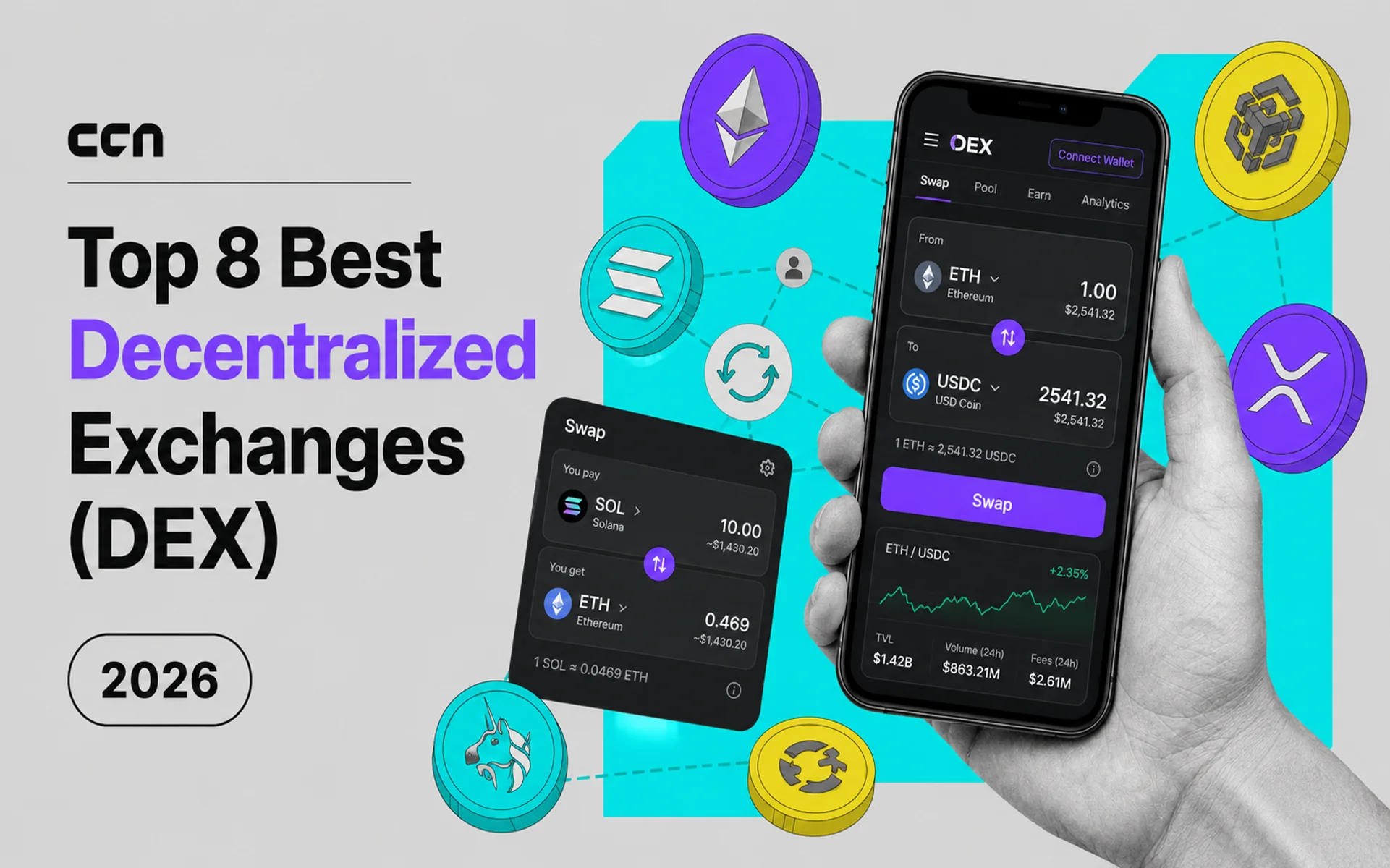
Top 8 best decentralized exchanges (DEX) in 2026, featuring on-chain token swaps, wallet connections, and DeFi trading tools.