Key Takeaways
- Kevin O’Leary says Bitcoin could reach $150,000–$200,000.
- He dismissed most cryptocurrencies as “poo-poo coins.”
- Other prominent investors, including Tim Draper and Arthur Hayes, also predict Bitcoin could surpass $200,000.
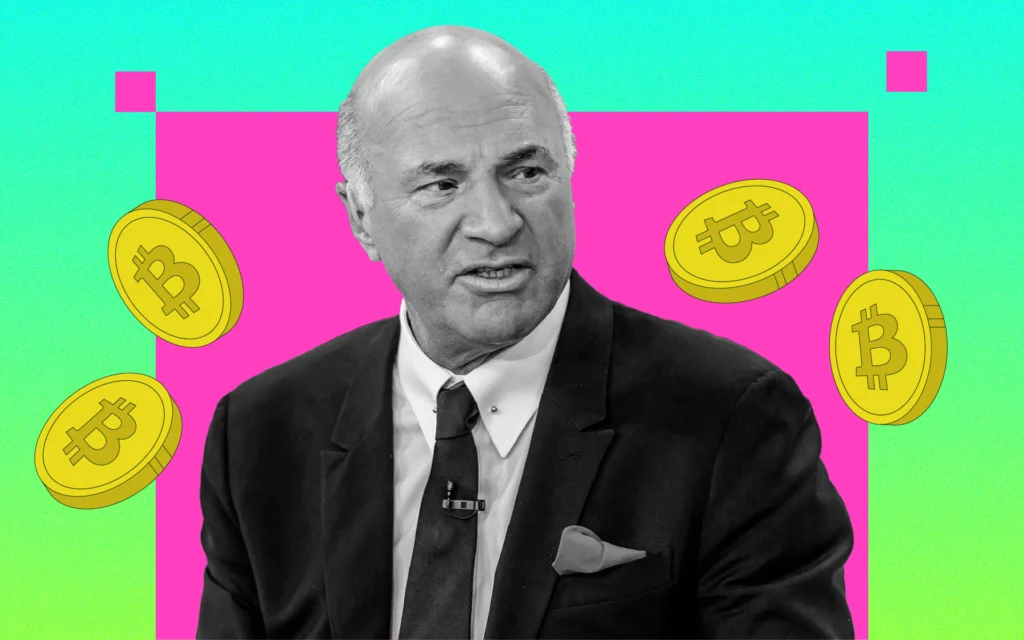
Investor Kevin O’Leary said Bitcoin could climb to as much as $200,000 if US lawmakers manage to pass the CLARITY Act, as the price of Bitcoin recovers slightly despite experts sharing concerns over mounting regulation delays.
However, the famed “Shark Tank” personality claimed that other alternative coins besides Ethereum were “poo poo.”
The comments come just over five years since O’Leary slammed the entire crypto ecosystem as “garbage” and “worthless.”
Bullish Bitcoin Outlook
O’Leary linked Bitcoin’s potential rise to progress on US crypto legislation, particularly the proposed Digital Asset Market CLARITY Act.
“The point is, it is worth more to tenants than Bitcoin until Bitcoin becomes a regulated security through the Clarity Act and gets up to $150,000 — or maybe $200,000,” he said in an interview on Fox.
He suggested that once Bitcoin operates within a defined regulatory framework, it could attract broader institutional participation and compete more directly with other large-scale capital uses.
O’Leary also highlighted Bitcoin’s role in monetising unused energy, saying it captures value “where there’s no use for electricity any other way.”
“Only Two Crypto” Worth Owning
O’Leary reiterated that he sees value in just two digital assets — Bitcoin and Ethereum — dismissing the rest of the market.
“All you need to own is Bitcoin and Ethereum, and you own 97% of the volatility of all the other poo-poo coins,” he said.
He said thousands of smaller tokens had failed to recover after the market decline in October and argued institutions have little reason to hold them.
“…and all of them — thousands of them — never came back,” he said.
He said their “true poo-poo-ness will be made obvious.”
“There just is no reason for an institution to own them,” he added.
From “Garbage” To Crypto Advocate
O’Leary’s stance marks a shift from his earlier criticism of cryptocurrencies.
In 2019, he called Bitcoin “garbage” and a “useless currency,” citing volatility and the difficulty of using it for large transactions.
He later reversed course as governments including Canada, Switzerland and Australia moved to support the sector.
“Facts changed,” he said, explaining his decision to invest in crypto as regulatory acceptance grew.
“Wait a second… the world’s changing. I got to be an investor,” he said.
O’Leary said this shift in policy support and growing institutional interest convinced him that crypto was evolving into a legitimate asset class — adding that investing in firms such as FTX gave him “an inside seat” in the industry.
However, that move resulted in heavy losses after the exchange collapsed.
“I put about $9.7 million into crypto… I think that’s what I’ve lost. It’s all at zero,” he said on CNBC in 2022.
Adding: “All the data, all the coins, everything.”
He added that his total exposure, including equity and promotional arrangements, was “just under $15 million… all-in.”
“There’s only the murder of my money in this case,” he said, while acknowledging: “It was not a good investment.”
Despite the setback, O’Leary has continued to back the sector, saying: “The promise of crypto remains. This will not change it.”
CLARITY Act Faces Delays
The delay has been driven in part by divisions between banking groups and crypto firms over how such assets should be treated.
Banking lobbyists have pushed for tighter restrictions on yield-bearing stablecoins, warning that interest-like features could pose risks similar to traditional deposit products without equivalent safeguards.
Crypto proponents, meanwhile, argue that overly strict rules could stifle innovation and limit the sector’s growth.
Senator Thom Tillis, a key Republican involved in the discussions, said the Senate Banking Committee is unlikely to take up the legislation as initially planned, suggesting a potential shift in timing.
“We need to be looking at May as a markup time,” he said, adding that lawmakers must “hear everybody” before advancing the bill.
Industry groups have urged lawmakers to move more quickly.
The Digital Chamber, a blockchain trade association, said advancing the bill would provide long-awaited certainty for millions of users and reinforce U.S. leadership in financial technology.
“The clearest way to carry the work already done into the next phase of the legislative process” is to bring the bill forward for consideration, the group said.
Some industry executives warned that prolonged deadlock could have broader consequences.
Anil Oncu, CEO of payments firm Bitpace, said the ongoing dispute reflects deeper tensions between traditional finance and the crypto sector.
“The greatest danger now is not that stablecoins destabilise the banking system… it is that the current deadlock produces either no regulation at all, or regulation so compromised that it satisfies nobody and protects nothing,” he said.
He added that the divide between banks and crypto firms may already be narrowing in practice, even as policymakers continue to debate the rules.
“While Washington argues over regulatory perimeters, adoption is rendering the ‘banks versus crypto’ framing obsolete,” Oncu said.
Tim Draper’s Equally Bullish Call
Venture capitalist Tim Draper has also been among the most persistent Bitcoin bulls, repeatedly forecasting that the crypto could reach $250,000 despite missing earlier timelines.
Draper first made the prediction in 2018, initially targeting 2022, and has since extended the timeframe multiple times.
On April 14, he most recently suggested the level could be reached within roughly 18 months.
His thesis is rooted in long-term adoption and macroeconomic trends, particularly inflation and the debasement of fiat currencies.
Draper argued that Bitcoin is evolving beyond speculation into a widely used store of value and medium of exchange.
He has pointed to growing acceptance of decentralized financial systems as a key driver, maintaining that Bitcoin’s utility will expand as trust in traditional financial infrastructure weakens.
Draper’s credibility among supporters stems partly from an earlier high-profile call.
In 2014, when Bitcoin was trading below $200, he predicted it would reach $10,000 within three years — a level it ultimately surpassed in 2017.
He also backed his conviction with significant investment, purchasing around 30,000 Bitcoin through a U.S. government auction the same year.
Other Bulls Also See Bitcoin Above $200,000
O’Leary’s forecast is not isolated, with several prominent investors and analysts projecting Bitcoin could surpass $200,000 under favourable macroeconomic and policy conditions.
Arthur Hayes, founder of Maelstrom Fund and former BitMEX CEO, said Bitcoin could reach that level as global liquidity expands.
In a recent essay, he argued that a new Federal Reserve programme — Reserve Management Purchases (RMP) — effectively amounts to renewed money printing.
“This ain’t QE, this is Money Printer Go…Brrrrr!” Hayes wrote.
He said Bitcoin may trade sideways in the near term but could rally sharply once markets interpret the policy as equivalent to quantitative easing.
“As the market equates RMP to QE, Bitcoin will quickly retake $124,000 and punch quickly towards $200,000,” he said.
Hayes added that coordinated easing by major central banks could accelerate the move, warning of broader currency debasement.
“With their powers combined… the Fed, PBOC, ECB, and BOJ will accelerate the destruction of fiat money,” he wrote.
Investor Mike Alfred has also projected Bitcoin could reach between $150,000 and $200,000, describing it as a long-term “digital gold” asset.
“It’s just a matter of time… that Bitcoin’s going to $150,000 or $200,000,” he said, calling it “the most important asset maybe in all of human history to own.”

Kurt Robson is a London-based reporter at CCN, specialising in the fast-moving worlds of crypto and emerging technology. He began his career covering local news in Cornwall after graduating from Falmouth University with First Class Honours in Journalism. There, he cut his teeth on everything from council meetings to missing swans.
He quickly rose through the ranks to become a frontline journalist at several of the UK’s leading national newspapers. Over the years, he has interviewed musicians and celebrities, reported from courtrooms and crime scenes, and secured multiple front-page exclusives.
Following the upheaval of the COVID-19 pandemic, Kurt shifted his focus to technology journalism—just ahead of the AI boom. With a natural curiosity and a trained eye for emerging trends, he has found a new rhythm in reporting on innovation.
At CCN, Kurt's work focuses on the cutting edge of crypto, blockchain, AI, and the evolving digital world. Drawing on his background in people-first reporting and his deep interest in disruptive tech, Kurt delivers stories that are insightful, entertaining, and human-centric.