Bitcoin buying pressure turns positive and profit-taking eases, but sustained demand is needed to turn the rebound into a lasting rally. | Credit: CCN.com
Share
Key Takeaways
Bitcoin’s 90-day Buy/Sell Pressure Delta has turned positive, signaling recovering demand but not yet confirming a sustained uptrend.
Similar historical recoveries produced different outcomes, making continued buying pressure crucial.
Seven-day realized profits fell 19% between the August and September peaks despite higher Bitcoin prices.
Bitcoin’s buying pressure has recovered sharply, but the rebound now faces a tougher test: whether demand can keep strengthening enough to support a sustained advance.
A CryptoQuant analysis shows Bitcoin’s 90-day Buy/Sell Pressure Delta climbing out of negative territory and returning to a zone associated with stronger buying pressure.
Price has recovered in line with the indicator, suggesting that buyers have regained the upper hand over the measurement window.
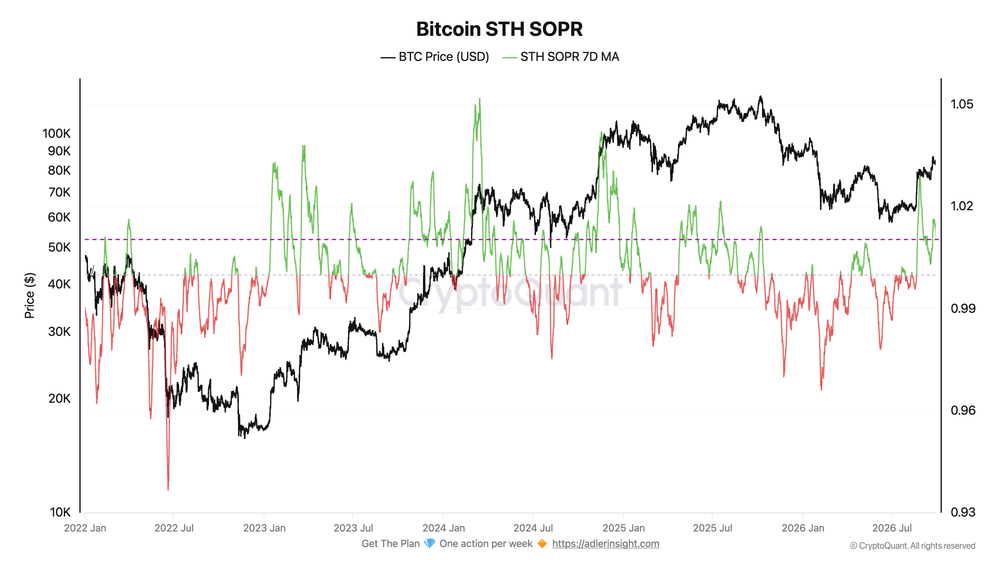
Separate research from analyst Axel Adler Jr. shows weaker profit-taking than during August, despite higher Bitcoin prices. Together, the readings suggest an improving market balance. They have not yet established that the recovery has become a durable trend.
Try Our Recommended Crypto Exchanges
Sponsored
Disclosure
We sometimes use affiliate links in our content, when clicking on those we might receive a commission at no extra cost to you. By using this website you agree to our terms and conditions and privacy policy.
Buying Pressure Returns, but History Offers Two Outcomes
The recovery in the 90-day delta marks a shift from the preceding negative readings. However, the indicator remains below the elevated buying-pressure levels seen during stronger historical expansions, according to CryptoQuant’s analysis.
That leaves Bitcoin at a decision point. Buyers have improved their position, but they still need to demonstrate that the improvement can persist and deepen.
The analysis highlights two historical comparisons with different outcomes. In early 2023, a move into a similar buying-pressure zone was followed by sustained price appreciation. A comparable test in mid-2025 produced a less durable advance before renewed weakness emerged.
The Buy Pressure Recovery Has Reached a Decision Point
“If the delta stalls near its current level and rolls over while price pushes higher, the divergence would suggest that the rally is losing support.” – By @MorenoDV_pic.twitter.com/Cvw1jgaaCq
Those examples show why a positive reading alone cannot settle the outlook. Similar starting conditions can lead to different results depending on whether demand continues to expand.
The bullish scenario would involve the delta rising further, ideally reaching the chart’s higher-buying-pressure zone, while Bitcoin holds its recent price gains. That combination would strengthen the argument that underlying demand is supporting the advance.
Conversely, a flattening or declining delta alongside higher prices would create a divergence. Under the analysis’s framework, that would suggest the rally was continuing with weakening support from buyers.
The next phase, therefore, depends on follow-through rather than the initial recovery alone.
Profit-Taking Falls Despite Higher Bitcoin Prices
Adler provides another perspective on the recovery: higher prices have not generated a larger wave of realized profits.
Seven-day realized profits reached $9.1 billion on Aug. 26, when Bitcoin traded at approximately $78,600. At the second peak on Sept. 24, realized profits totaled $7.3 billion, even though Bitcoin was trading higher, at around $84,100.
That represents a decline of roughly 19% between the two profit-taking peaks. Realized losses also fell, from $2.6 billion to $1.5 billion over the same comparison periods. By Sept. 28, seven-day net realized profit stood at $4.3 billion.
Bitcoin's September rally pushed a notable share of coins back into profit, lifting it to the highest level since January. We break down which signals would point to a continued recovery and which would point to it losing steam.
The figures suggest that the price recovery has not been accompanied by increasingly aggressive profit realization. Adler said this could indicate that holders are in no hurry to sell, potentially anticipating additional gains.
However, reduced profit-taking does not prove that investors expect higher prices. Both realized profits and losses declined, making the picture more nuanced than a simple withdrawal of sellers.
These metrics describe gains and losses associated with coins moving on-chain. They should not be treated as a direct measure of fresh capital entering Bitcoin.
CryptoQuant defines STH SOPR as the sum of spent outputs aged more than 1 hour and less than 155 days. Readings above 1 indicate that those coins moved at a profit on average; readings below 1 indicate losses. The metric covers moved coins rather than every investor’s holdings.
Adler identified a fall below 1 alongside negative net realized profit as a deterioration signal. A return toward September’s $87,200 high could increase unrealized gains, assuming unchanged cost bases.
For Bitcoin’s recovery to strengthen, buyers must sustain demand while this narrowing profit cushion remains intact. The improvement is visible; its staying power remains unproven.
Disclaimer:
The information provided in this article is for informational purposes only. It is not intended to be, nor should it be construed as, financial advice. We do not make any warranties regarding the completeness, reliability, or accuracy of this information. All investments involve risk, and past performance does not guarantee future results. We recommend consulting a financial advisor before making any investment decisions.
Giuseppe Ciccomascolo began his career as an investigative journalist in Italy, where he contributed to both local and national newspapers, focusing on various financial sectors.
Upon relocating to London, he worked as an analyst for Fitch's CapitalStructure and later as a Senior Reporter for Alliance News. In 2017, Giuseppe transitioned to covering cryptocurrency-related news, producing documentaries and articles on Bitcoin and other emerging digital currencies. He also played a pivotal role in establishing the academy for a cryptocurrency exchange website. Crypto remained his primary area of interest throughout his tenure as a writer for ThirdFloor.