Key Takeaways
- Aave founder Stani Kulechov says the CLARITY Act could unlock crypto custody, staking, and lending services for US banks and credit unions.
- The bill would give banks explicit statutory authority to custody digital assets, resolving years of regulatory uncertainty.
- Despite growing industry backing, Senate approval remains uncertain as lawmakers continue to debate ethics rules and stablecoin provisions.
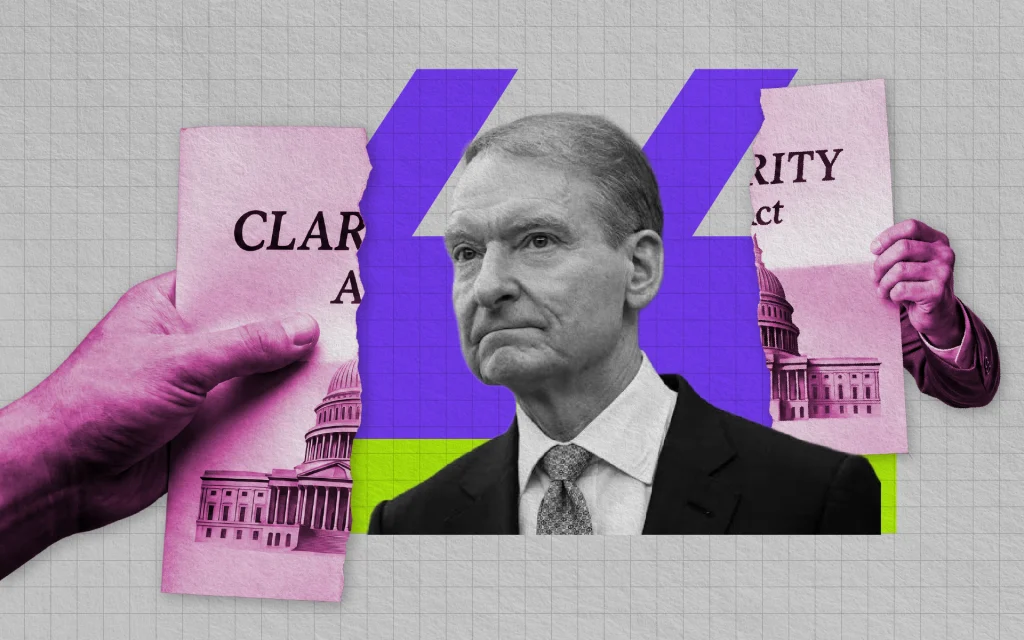
Aave founder Stani Kulechov has added a banking argument to his months-long push for the CLARITY Act, noting the legislation could expand banks’ digital asset activities, including custody, staking, and lending, as the bill’s supporting coalition grew to include Fidelity, Goldman Sachs, and SEC Chair Paul Atkins alongside the DeFi protocol.
Statutory text backs the claim. Section 401 of the bill puts bank custody authority beyond dispute after years of contested interpretive letters, and enumerates related custodial services, including staking, lending, governance, and advancing funds, as permitted activities, areas that previous OCC guidance left to supervisory negotiation.
Scope will still turn on regulators, since an SEC rule defining “exclusively administrative or ministerial” custodial staking will set the operational boundaries of bank staking services even though the activity itself gains statutory authorization.
Reach extends beyond commercial banks, as federal credit unions can enter the market under Section 401(e), turning the sector’s historically conservative posture on digital assets into a strategic choice rather than a regulatory mandate.
Kulechov’s Washington Campaign Goes Public
Bank permissions form only half of Kulechov’s case. In a July 26 post, he called the bill imperfect and dependent on delegated rulemaking, while describing it as the first regulation that touches DeFi, and disclosed that Aave has been meeting key people in Washington over the past year and increasingly in recent weeks and days, an unusually candid acknowledgment of direct lobbying from a DeFi founder.
He argued the merged text would let DeFi teams confidently build and maintain decentralized protocols without bearing obligations suited only to centralized models, a distinction he has framed as existential for non-custodial, DAO-governed software like Aave.
Senate Math Remains the Obstacle
Institutional alignment has not yet produced floor time. Democratic senators led in part by Cory Booker characterized the bill as falling short in a July 22 statement, with objections centering on stablecoin yield provisions, which banking lobbyists argue could erode deposit bases, and on the scope of ethics language governing federal officials’ digital asset holdings.
Ethics enforcement remains the sharpest sticking point, specifically whether rules barring officials from profiting from crypto should be enforced solely by the Justice Department or by state attorneys general as well.
Procedural history frames the stakes. The House passed the bill 294 to 134 in July 2025, with 78 Democrats in support. The Senate Banking Committee approved its portion 15 to 9 on May 14, 2026, and supporters will likely need 60 votes to overcome procedural opposition on the floor.
Kulechov’s bank-permissions argument now hands moderate Democrats a counterweight to the deposit flight concern: the same statute their banking constituents fear on stablecoin yield would hand those banks custody, staking, and lending businesses they currently cannot touch.
Top Trending Crypto Articles
The information provided in this article is for informational purposes only. It is not intended to be, nor should it be construed as, financial advice. We do not make any warranties regarding the completeness, reliability, or accuracy of this information. All investments involve risk, and past performance does not guarantee future results. We recommend consulting a financial advisor before making any investment decisions.

Dr. Guneet Kaur is a senior editor at CCN.com and a Science Fellow at Exponential Science. She is a fintech and blockchain expert with extensive experience in digital finance education, blockchain ecosystems, and cryptocurrency markets. She has worked with global media such as Cointelegraph, as well as education and blockchain platforms, to design and lead strategic content and learning initiatives. As an educator and assessor for top-tier executive programs, she bridges real-world fintech trends with academic insight.
Dr. Kaur is also a published researcher and peer reviewer across fintech and data science journals, including Financial Innovation Journal and International Journal of Big Data Intelligence and Applications. Her work spans data-driven analysis, Web3 innovation, and technical content development. With a strong foundation in both industry and academia, she translates complex financial technologies into practical applications, empowering learners, professionals, and institutions across the rapidly evolving digital finance landscape.