Coinbase is preparing to launch a Kalshi-powered prediction market, signaling a major step into regulated forecasting products. Here are the key details to watch. | Credit: CCN.com
Share
Key Takeaways
Polymarket, the crypto-based prediction market, is preparing to reenter the U.S. after a regulatory exile.
Sources indicate initial trading could begin by the end of November, though access may roll out gradually.
Kalshi remains the leading regulated U.S. prediction market, benefiting from a recent court victory allowing election-based contracts.
And Trump’s Truth Predict may also erode some stake of the market.
Polymarket, a cryptocurrency-based prediction market, is preparing for a highly anticipated return to the U.S. After years of operating offshore due to regulatory challenges, the platform has now disclosed new details about how its upcoming U.S. site will function, following its recent approval from the U.S. CFTC to operate under a regulated market framework.
While the precise launch date hasn’t been confirmed, insiders and leaked fee schedules suggest a late November debut may be imminent.
At the same time, the competitive environment is intensifying: Truth Social, the social media platform affiliated with former President Donald Trump, is launching its own prediction-market product, called Truth Predict, positioning itself as a direct rival to Polymarket and Kalshi.
This article explains what is currently known about Polymarket’s U.S. relaunch, compares its fee structure to that of competitors, discusses the associated risks and regulatory backdrop, and explores how the entrance of Truth Predict introduces a new dimension to the sector.
Polymarket is a cryptocurrency-based prediction market platform that allows users to trade on the outcomes of real-world events. Instead of traditional betting, Polymarket structures these trades as blockchain-based information markets, where participants buy and sell shares representing possible outcomes. For example, whether a political candidate will win an election, inflation will rise above a certain level, or a sports team will win a championship.
Built on Ethereum and Polygon, Polymarket utilizes stablecoins like USDC for trading, ensuring transparency and security through the use of smart contracts. The platform’s goal is to aggregate collective intelligence, meaning that market prices reflect the crowd’s consensus on the probability of future events.
Polymarket first gained attention for its accurate forecasts on high-profile topics such as elections, economic data releases, and global news. However, it faced regulatory challenges in 2022, when the U.S. CFTC fined its parent company for operating unregistered event-based contracts.
Since then, Polymarket has restructured to meet compliance standards and is now returning to the U.S. market with full CFTC approval and a regulated framework.
Today, Polymarket is positioning itself at the intersection of decentralized finance (DeFi) and mainstream financial data, with new partnerships, such as its exclusive deal with Yahoo Finance, signaling a move toward broader public adoption and institutional recognition.
Polymarket Gains CFTC Approval for Regulated US Market Access
Polymarket, a leading blockchain-based prediction market platform, has received official approval from the U.S. Commodity Futures Trading Commission (CFTC) to operate under a regulated structure in the United States. The new Amended Order of Designation allows Polymarket to expand its services to U.S. customers through intermediated market access, including partnerships with brokerages and futures commission merchants (FCMs).
We’re thrilled to share that we've received CFTC approval for intermediation, paving the way for seamless access to polymarkets through registered brokers & financial institutions.
This regulatory milestone marks Polymarket’s return to the U.S. market after previously restricting American users due to compliance issues in 2022. With the CFTC’s approval, Polymarket can now offer event-based markets under a recognized legal framework, aligning with the same federal oversight standards that apply to traditional derivatives exchanges.
The decision reflects the CFTC’s growing openness to innovative financial products like crypto prediction markets, positioning Polymarket as one of the first platforms to bridge decentralized technology with full regulatory compliance. The move is seen as a major step forward for the broader event-driven trading and decentralized finance (DeFi) ecosystem.
Polymarket’s compliance framework now includes enhanced market surveillance, transparent clearing processes, and standardized reporting obligations. These updates are designed to protect investors while enabling fair and efficient trading on outcomes of real-world events.
Industry analysts say the approval sets an important precedent for how the U.S. will regulate and integrate blockchain-based event markets in the future. However, Polymarket still faces challenges, including ongoing oversight requirements and potential state-level regulatory variations.
Polymarket Partners with Yahoo Finance for Exclusive Prediction Integration
On Nov. 13, Polymarket founder Shayne Coplan announced that Polymarket is now the exclusive prediction-market partner of Yahoo Finance, signaling the platform’s growing mainstream visibility.
Coplan added that “deep integrations are coming soon,” suggesting that prediction markets could soon appear directly within Yahoo Finance’s ecosystem, a major step toward mass adoption.
Polymarket is now the exclusive prediction market partner of @YahooFinance
Polymarket’s US Comeback: Is Launch Imminent This November?
After years operating overseas, Polymarket appears ready to make its long-awaited return to the U.S. market. Sources and filings suggest a relaunch could happen as early as late November, though access may roll out in stages as the company fine-tunes compliance and infrastructure.
1. Launch Timing
Polymarket currently operates a global site that excludes U.S. users, but the company is now gearing up for a return to the U.S. market.
However, caveats apply: the launch may not initially be globally accessible or fully open to all users. The initial version is likely to roll out in phases, with limited availability as compliance and infrastructure are fine-tuned.
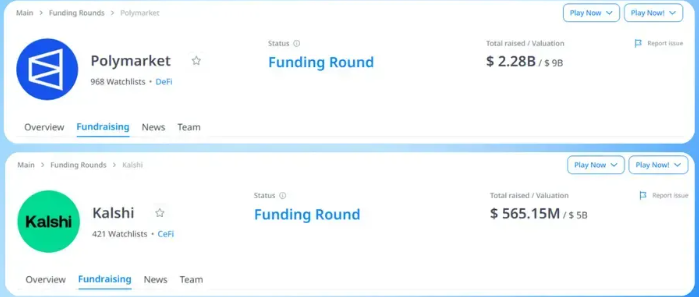
Polymarket vs Kalshi funding. | Credit: Datawallet
2. New Fee Structure: Extremely Low Costs
One of the most striking public disclosures is Polymarket’s fee schedule for the U.S. site, which is made available via Polymarketexchange.com (hosting exchange rules and CFTC filings).
Polymarket will charge a flat fee of 0.01 cents per $1 contract traded, equivalent to 0.01%.
This is substantially lower than Kalshi’s fee model, which charges dynamic fees depending on the probabilities of outcomes.
To illustrate the difference:
On $100 worth of contract volume, Polymarket users would pay $0.01, while the average Kalshi user would pay about $1.20 (i.e., 1.2%).
Even for extreme odds (1%-99%), where Kalshi’s fees are relatively lower, Polymarket’s flat rate is still about one-seventh of Kalshi’s cost.
For contracts with near 50% odds, Kalshi charges 175 times more than Polymarket, highlighting how aggressively Polymarket positions its pricing.
Such an ultra-low and flat fee model could be a powerful acquisition tool to attract large volumes and undercut rivals at the outset.
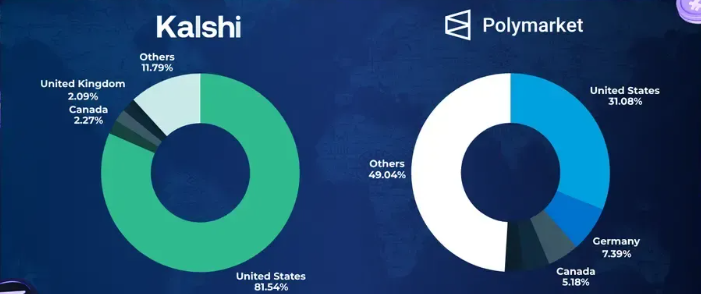
Which countries use Kalshi and Polymarket? | Credit: Datawallet
3. Acquisition of QCX and Regulatory Reset
Polymarket’s reentry is not entirely new. Earlier this year, the platform acquired QCX, a firm that had already obtained CFTC licenses for derivatives exchange and clearinghouse operations.
This move helped legitimize and stabilize Polymarket’s regulatory footing in the U.S. market.
Previously, Polymarket was fined $1.4 million in 2022 and ordered to cease U.S. trading operations as part of a settlement with the CFTC over unregistered derivatives trading.
The acquisition and regulatory repositioning suggest that the company has sought to return to a more compliant structure.
Polymarket Vs. Kalshi Vs. Truth Predict: The Battle for America’s Prediction Market
Kalshi faces new pressure from Polymarket’s ultra-low fees and an unexpected entrant — Truth Social’s “Truth Predict.” As Kalshi leans on regulation and credibility, Polymarket is waging a price war, while Truth Predict aims to fuse social media and crypto betting.
With Donald Trump Jr. tied to both legacy players, the battle for the future of U.S. prediction markets is about to heat up.
Kalshi’s Stronghold: Can It Withstand Polymarket’s Fee Shockwave?
Kalshi is currently the primary U.S.-based, regulated prediction market. Its dynamic model adjusts fees based on contract odds, creating unpredictable pricing but optimizing revenue capture.
Despite that, Kalshi’s average effective fee (1.2%) is over 100 times higher than Polymarket’s planned 0.01% flat rate. That gap allows Polymarket to capture margin-sensitive traders, particularly high-volume operators.
Kalshi has also recently gained legal clarity, following a court ruling that allowed it to offer contracts based on election outcomes. This benchmark decision paved the way for broader prediction-market activity in the U.S.
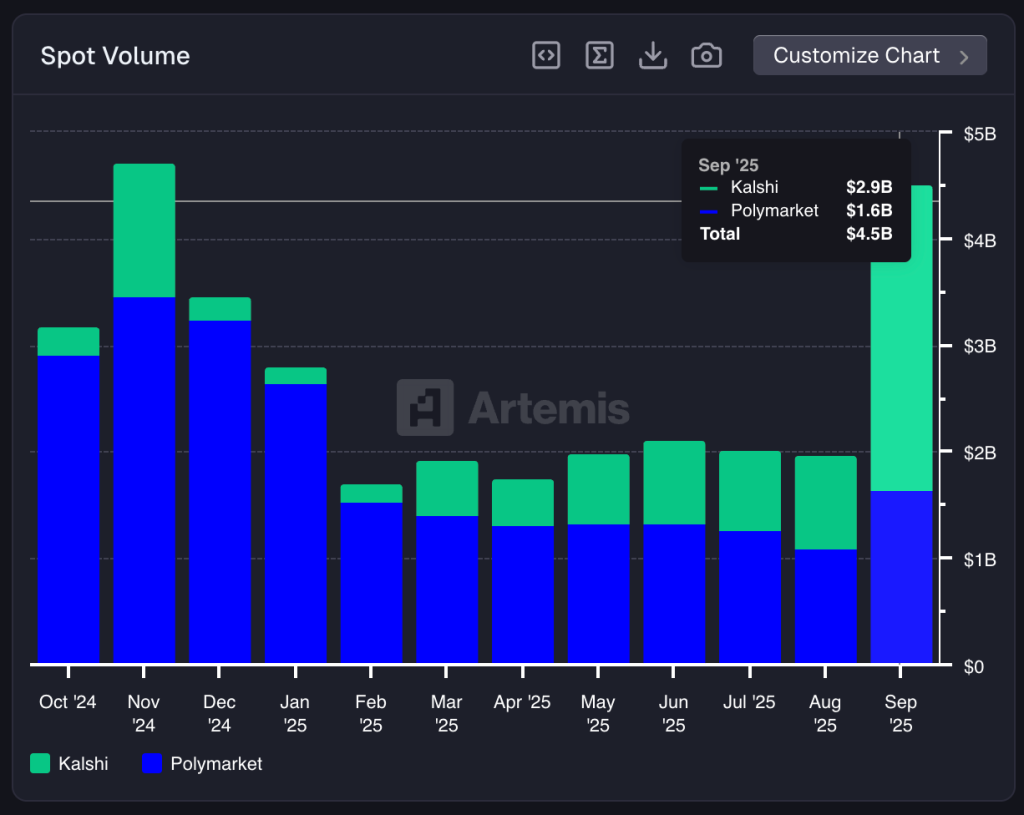
Kalshi and Polymarket spot volume. | Credit: Artemis
Truth Predict: Trump’s Bold Bet on the Future of Prediction Markets
Adding further rivalry is the news that Truth Social is launching a new crypto-based prediction market named Truth Predict. It plans to allow users to place bets on elections, sports, and economic or entertainment events.
Truth Predict is being developed in partnership with Crypto.com, a prominent crypto exchange, and is positioning itself as a direct competitor to Polymarket and Kalshi.
Interestingly, Donald Trump Jr. has ties to both Polymarket and Kalshi; he serves as a strategic advisor to Kalshi and is a member of Polymarket’s advisory board through 1789 Capital. This cross-affiliation raises questions about the competitive dynamics as the Trump family brings a new entrant into the fray.
Truth Predict will likely integrate prediction markets into the social media experience, providing a built-in audience funnel that could accelerate its adoption cycle.
How Polymarket’s US Launch Impacts Traders
For traders, Polymarket’s regulated return to the U.S. could mark a significant shift in how real-world events are traded on-chain. With the CFTC approving its new structure, participants now have a clearer compliance pathway — something that was previously lacking in decentralized prediction markets.
Opportunities for Traders
Ultra-low fees: Polymarket’s flat 0.01% trading fee dramatically lowers costs, opening the door for short-term and high-volume trading strategies. This could attract professional traders, liquidity providers, and arbitrage desks who were previously deterred by Kalshi’s higher, variable-fee model.
Regulatory clarity: CFTC authorization provides greater legal certainty and reduces enforcement risk for participants, especially institutional players seeking compliant exposure to event-based markets.
Market variety: Polymarket supports contracts tied to politics, macroeconomics, sports, and entertainment, allowing traders to diversify strategies and hedge real-world outcomes.
Stablecoin settlement: All transactions are settled in USDC, ensuring fast, transparent, and stable accounting, a major advantage over traditional fiat-settled markets.
Risks to Consider
Liquidity uncertainty: Even with low fees, market depth will depend on how quickly Polymarket attracts users and institutional participants.
State-level restrictions: While federally approved, certain U.S. states may still impose participation limits or require additional licenses.
Settlement and oracle dependence: Outcome verification relies on on-chain oracles. Any delays or disputes in event resolution could affect payouts.
Tax and reporting considerations: Event contracts may fall under derivatives tax treatment, requiring careful recordkeeping for active traders.
Legal and Market Headwinds: Polymarket’s Road to US Relaunch
Prediction markets sit at the intersection of gambling and securities/derivatives regulation. Some state regulators treat them as illegal gambling, while federal regulators like the CFTC’s approval marks a major turning point for the company.
Polymarket’s settlement in 2022 forced it offshore, and a new return hinges on maintaining clean regulatory compliance.
Past rulings in favor of Kalshi suggest some precedent for federal preemption over state gambling bans, but the landscape remains patchy and contentious.
Liquidity and Market Confidence
Ultra-low fees are attractive, but a prediction market also needs liquidity, active participants, and confidence in the settlement and oracle mechanisms that validate outcomes.
Without sufficient volume, spreads and slippage could erode the user experience. If users doubt the system’s integrity, they may flee.
Rollout Phased and Limited Access
Even if Polymarket targets a November launch, it might restrict access at first, allowing participation only for approved states or selected users
That would limit scale in the opening weeks while compliance, KYC, licensing, and technical infrastructure are validated.
Competitive Fragility
Truth Predict‘s entering the market creates an immediate contested space. Social media network integration provides a strong existing user base, which could potentially erode Polymarket’s early momentum.
Also, Kalshi remains deeply entrenched, and established gambling firms and platforms (like DraftKings or CME/FanDuel partnerships) are eyeing entry into betting products and derivatives.
What to Watch as Polymarket’s US Launch Nears
As Polymarket prepares for its highly anticipated U.S. return, several key factors will determine how smoothly the launch unfolds and how the platform fares against rising competition.
From regulatory reactions to trading activity and the rollout of rival platforms like Truth Predict, here are the main developments to keep an eye on in the coming weeks.
Late November launch: Rumors suggest that initial trading will start by the end of November, though the company might delay broad access.
Fee adherence: Will Polymarket be able to sustain the 0.01% flat rate in the face of marketing and infrastructure costs?
Yahoo Finance integration: How deep will the Yahoo partnership go – will price feeds or market links be embedded in financial news pages?
Liquidity and volume metrics: Initial trading volume will signal viability; low liquidity may raise doubts.
Truth Predict rollout speed: How fast Truth Predict embeds into Truth Social, and how aggressively it acquires users in its early beta.
Polymarket’s High-Stakes Reentry and the Future of Prediction Markets
Polymarket’s relaunch in the U.S. marks a bold attempt to reestablish its presence in a rapidly evolving prediction market space. With a rock-bottom fee structure, acquisition of QCX for regulatory compliance, and a late-November target, the platform is staking much on an aggressive price and growth strategy.
But this return is not risk-free. The legal and regulatory terrain is complex and still contested. Market confidence, liquidity, and user adoption must come quickly. And now, Truth Predict, backed by Truth Social and Crypto.com, enters as a direct competitor with a built-in social user base, adding new pressure.
For participants, observers, and regulators, this reentry will be a critical test case: can Polymarket reclaim its footing under U.S. rules, or will the next wave of prediction markets belong to new entrants?
If the launch succeeds, it could reshape how Americans interact with event-driven derivatives and betting. If it falters, it may dampen near-term investor faith in crypto-native prediction platforms. Either way, all eyes are on Polymarket’s U.S. debut, and the field is now broader than ever.
Polymarket is a cryptocurrency-based prediction market that lets users trade on the outcomes of real-world events — from elections and sports to economics and pop culture, using blockchain technology.
When is Polymarket launching in the U.S.?
Insiders and filings suggest that Polymarket’s U.S. site could launch by late November 2025, though access may initially roll out in phases to comply with regulatory and technical requirements.
Why was Polymarket previously banned from operating in the U.S.?
In 2022, the Commodity Futures Trading Commission (CFTC) fined Polymarket $1.4 million for offering unregistered derivatives trading and ordered it to cease operations for U.S. users. The company later restructured its compliance model and acquired QCX, a CFTC-licensed exchange and clearinghouse, to reenter the market legally.
How is Polymarket different from Kalshi?
Kalshi operates under a dynamic fee model and already holds full regulatory approval in the U.S. Polymarket, by contrast, is positioning itself with ultra-low, flat fees and a focus on crypto-native users. While Kalshi leans on institutional credibility, Polymarket targets accessibility and scale.
Disclaimer:
The information provided in this article is for informational purposes only. It is not intended to be, nor should it be construed as, financial advice. We do not make any warranties regarding the completeness, reliability, or accuracy of this information. All investments involve risk, and past performance does not guarantee future results. We recommend consulting a financial advisor before making any investment decisions.
Giuseppe Ciccomascolo began his career as an investigative journalist in Italy, where he contributed to both local and national newspapers, focusing on various financial sectors.
Upon relocating to London, he worked as an analyst for Fitch's CapitalStructure and later as a Senior Reporter for Alliance News. In 2017, Giuseppe transitioned to covering cryptocurrency-related news, producing documentaries and articles on Bitcoin and other emerging digital currencies. He also played a pivotal role in establishing the academy for a cryptocurrency exchange website. Crypto remained his primary area of interest throughout his tenure as a writer for ThirdFloor.


 Easy
Easy