Key Takeaways
- Kalshi has hired prediction market influencer John Wang as its new head of crypto.
- Wang said he wants to appeal to a more crypto-native user base.
- Currently, Polymarket dominates when it comes to markets for crypto-based events.
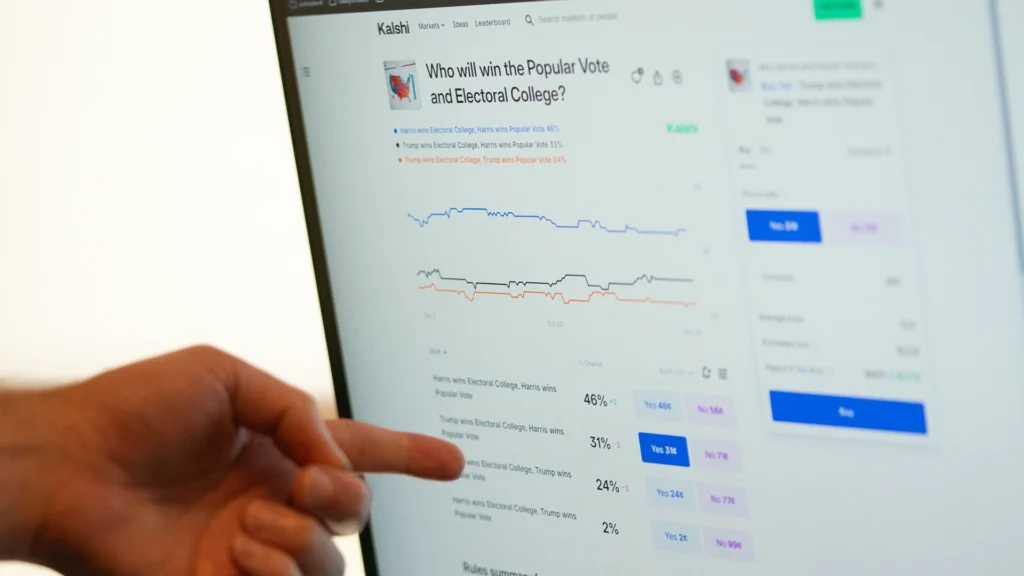
The largest U.S.-regulated prediction market, Kalshi, is pivoting toward crypto and has hired a new head of crypto to lead the charge.
While exact details aren’t known, any move to facilitate crypto payments would encroach upon Polymarket’s turf in an area where it has operated unchallenged until now.
What are Prediction Markets?
Kalshi and Polymarket are two popular prediction markets that let users place a wager on the outcome of an event.
Unlike traditional bookmakers, prediction markets use a price-as-probability model.
Users buy a contract at a price between $0 and $1 that reflects the likelihood of an event happening.
For example, if a contract is trading at $0.70, that implies a 70% chance the event will happen.
If an event happens, the prediction contract settles at $1. If the event does not happen, it settles at $0.
Because it doesn’t require a centralized authority to set odds, the prediction market model lends itself to decentralization.
Crypto-Native Predictions
The most popular prediction market globally, Polymarket, is a crypto-native platform that uses USDC and settles contracts on-chain.
Each market specifies an information source (oracle) for settlement.
For example, an election market might resolve based on Associated Press results, or a Bitcoin price market might resolve based on Coinbase’s BTC/USD feed.
In addition to its on-chain blockchain-based design, some of Polymarket’s most popular markets relate to crypto.
For example, on Aug. 25, the open interest on crypto-related predictions stood at $25.8 million, more than any other category except politics.
In contrast, trading volume on Kalshi is skewed toward sports betting, with all of the top prediction markets centered on sporting events.
While the platform does offer crypto event markets, they make up a much smaller part of its overall offering.
The company’s new head of crypto, John Wang, hopes to change that, however.
Embracing Crypto
“When it comes to Kalshi’s crypto plans, we have a lot of different initiatives lined up,” Wang told Bloomberg.
He said one of his main priorities is to launch more “culturally resonant” crypto markets—“fast-moving markets that speak directly to your crypto Twitter people.”
Of course, the biggest thing Kalshi could do to accommodate the crypto crowd would be to enable stablecoin payments.
Kalshi is registered with the Commodity Futures Trading Commission (CFTC) as a Designated Contract Market (DCM).
That means all contracts must be in U.S. dollars. It also has to run through the U.S. banking and clearing system, with full compliance around KYC/AML.
Up until now, this has prevented the platform from accepting stablecoin deposits.
However, post-GENIUS Act, Kalshi may have more leeway to embrace crypto.

James Morales is CCN’s blockchain and crypto policy reporter. He has been working in the news media since 2020, writing about topics such as payments, banking and financial technology. These days, he likes to explore the latest blockchain innovations and the evolving landscape of global crypto regulation.
With an educational background in social anthropology and media studies, James uses his platform as a journalist to explore how new technologies work, why they matter and how they might shape our future.