Could Pi Network’s ISO 20022 Integration Put It Beside XRP, XLM, and HBAR?
Share
Key Takeaways
ISO 20022 is a global financial-messaging standard, not a token certification. It improves interoperability and compliance across payment systems.
Pi Network plans to activate ISO 20022 integration by November 2025, aligning with SWIFT’s global migration. This could make Pi payments more bank-compatible.
XRP (Ripple), XLM (Stellar), and HBAR (Hedera) already lead in ISO 20022 readiness. Pi aims to join their ranks with message-level compatibility and compliance infrastructure.
ISO 20022 alignment could help cryptocurrencies like PI bridge traditional finance and blockchain, but compliance claims alone don’t guarantee adoption.
Pi Network’s upcoming integration with the ISO 20022 standard is drawing attention across the crypto and fintech industries.
Many are wondering if aligning with this global banking standard could put Pi Network in the same category as XRP (Ripple), XLM (Stellar), and HBAR (Hedera), digital assets known for bridging crypto and traditional finance.
This article breaks down Pi Network’s ISO 20022 roadmap, compares it to XRP, XLM, and HBAR, and explains how SWIFT’s own upgrade to ISO 20022 could shape Pi’s role in global payments.
Try Our Recommended Crypto Exchanges
Sponsored
Disclosure
We sometimes use affiliate links in our content, when clicking on those we might receive a commission at no extra cost to you. By using this website you agree to our terms and conditions and privacy policy.
What ISO 20022 Means for Crypto and Why It Matters
ISO 20022 is the international standard for financial messaging, the common language that banks use to exchange transaction data. It replaces outdated SWIFT MT messages with structured XML formats that carry richer information. This standard reduces errors, speeds up reconciliation, and enhances compliance.
In simple terms, ISO 20022 lets banks “speak” the same digital language. By 2025, nearly all major financial institutions will adopt it as their default system for payments and settlements.
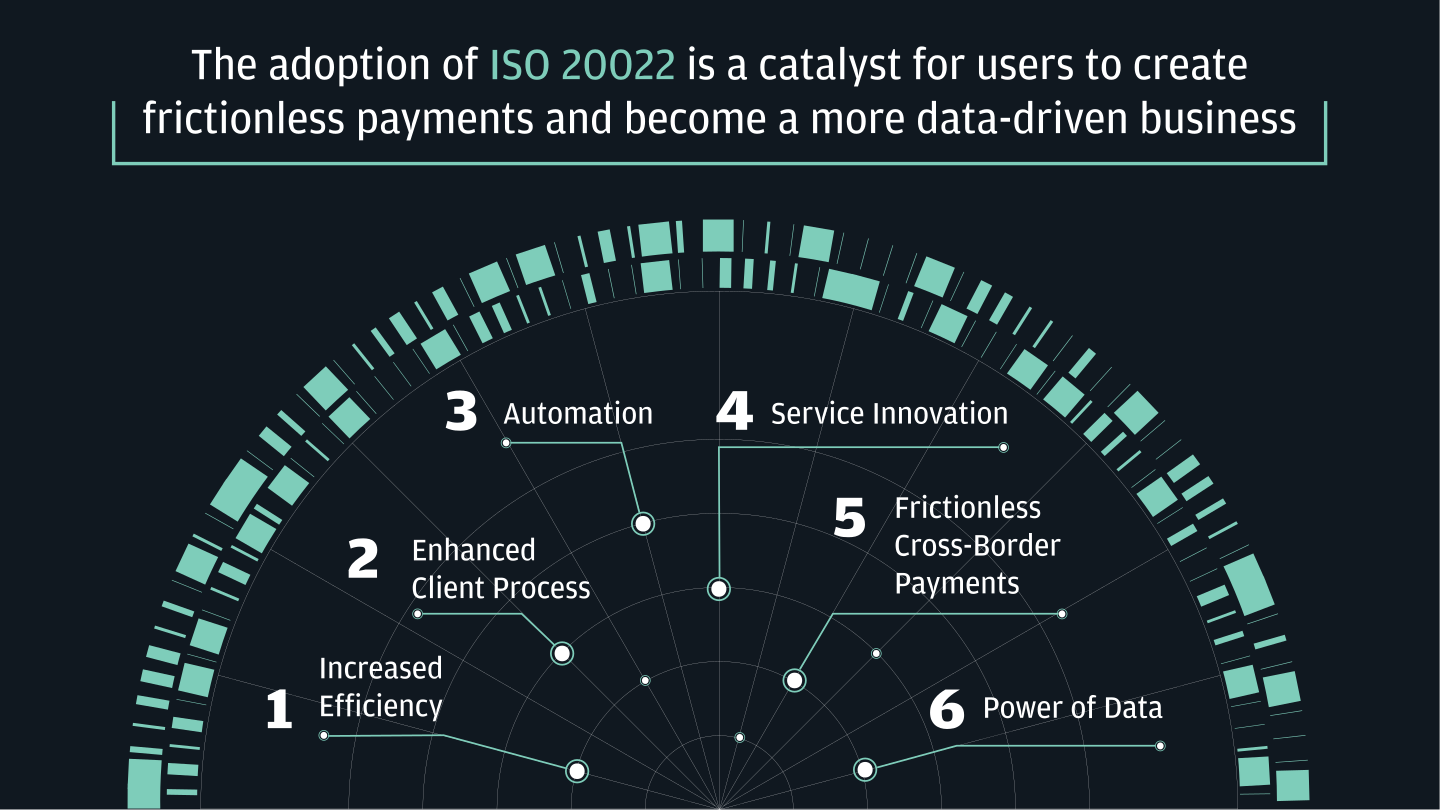
What does ISO 20022 mean for the payments industry? | Source: jpmorgan.com
For cryptocurrencies, ISO 20022 represents a bridge between blockchain and banking. When a blockchain aligns with this standard, its payment data can be easily read and processed by traditional financial systems. This interoperability is crucial for projects seeking legitimacy, faster remittances, and smoother compliance with global regulations.
A blockchain that follows ISO 20022 can include detailed transaction metadata, such as sender, receiver, purpose, and compliance flags, helping regulators, auditors, and payment processors interpret crypto payments with the same precision as fiat transactions.
Is Pi Network ISO 20022 Compliant?
Launched in 2019 by Stanford graduates, Pi Network aims to bring crypto to the masses through mobile mining. The project has grown to more than 50 million registered users, making it one of the largest social crypto ecosystems.
Now, Pi’s development team is preparing for a major step, integrating ISO 20022 by November 22, 2025, the same date when global banks complete their transition to the new standard.
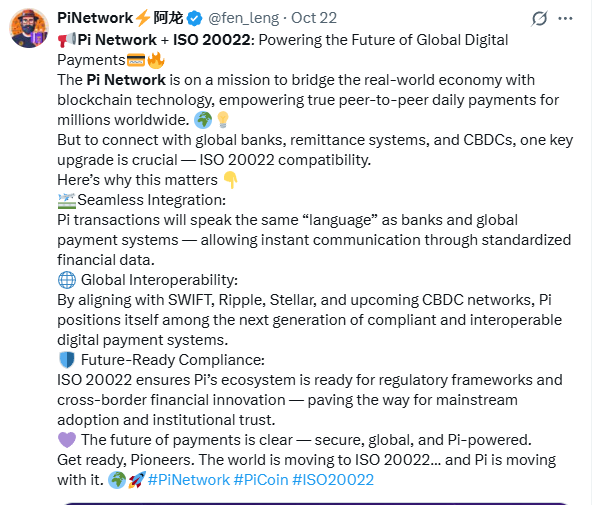
Pi Network vs. ISO 20022: | Source: @fen_leng on X.
Three Phases of Integration
Preparation phase (now–2025): Pi Network is strengthening its architecture, finalizing compliance APIs, and developing its decentralized exchange (Pi DEX).
Activation phase (November 2025): When ISO 20022 goes fully live across SWIFT and global payment systems, Pi’s network aims to generate and interpret messages in the same format.
Adoption phase (post-2025): After activation, the goal is to demonstrate real-world use, processing payments, merchant transactions, and remittances through ISO-compatible channels.
Pi Network’s ISO 20022 compliance roadmap | Source: @JackPiNetwork on X.
When these features are active, Pi transactions could be structured just like a bank wire message, allowing payment networks and government systems to identify and process Pi transfers with less friction.
Building Supporting Infrastructure
To ensure readiness, the Pi Core Team is developing a Pi DEX and compliance tools that meet KYC and AML requirements. These will help institutions handle Pi payments transparently and legally.
Pi Network officially transitioned to its Open Mainnet in February 2025, ending its enclosed phase and allowing external connectivity for apps, wallets, and integrations under defined compliance conditions. This shift enables users, developers, and potential partners to interact directly with Pi’s blockchain while maintaining security and regulatory oversight.
With the Open Mainnet now active, Pi’s ISO 20022 framework is positioned to help the network operate more like a recognized global payment system rather than a closed ecosystem, advancing its goal of bridging decentralized finance with traditional banking infrastructure.
But Pi’s alignment with ISO 20022 isn’t just about compliance, it’s about creating interoperability with banks, making it easier for governments and financial institutions to work with Pi.
Industry Readiness and Exchange Support
Exchanges like Bitget have shown interest in supporting Pi’s open-network transition. Bitget’s focus on compliance and global accessibility makes it a logical bridge for Pi users once ISO 20022 integration is complete. Such partnerships could allow Pi to connect with fiat gateways more efficiently when the standard goes live.
Pi Network Node Revolution: Strengthening the Bridge Between Web3 and Global Finance
X user @DrChengdiaoFan noted on Oct. 20 that the Pi Network Node Revolution has officially begun, marking a key step in Pi’s move toward ISO 20022 readiness and global financial interoperability.
According to the update, Pi Network is positioning itself as a Global Finance Bridge, preparing its ecosystem for the 2025 finance transition as banks and payment networks adopt ISO 20022. Node operators are described as the core of decentralization, responsible for securing the network, supporting real-world utility apps, and enabling long-term compliance with global financial standards.
@DrChengdiaoFan emphasized that running a Pi Node not only strengthens blockchain security but also prepares the network for broader financial alignment. Early node operators, she noted, represent strategic contributors ahead of the 2025 migration, helping Pi Network build a reliable bridge between Web3 infrastructure and global finance systems.
Introduction & Updates on Pi Nodes | Source: @DrChengdiaoFan on X
Caution: Challenges and Uncertainties Ahead
While Pi Network’s ISO 20022 roadmap and node expansion reflect ambition, the project still faces notable uncertainties. Its long enclosed mainnet phase led to skepticism about transparency, liquidity, and real-world usability, as Pi coins have yet to achieve official exchange listings or verifiable market valuation.
Previous delays in the open network rollout and limited disclosure of technical documentation have also raised questions about execution capability and regulatory clarity. Until Pi demonstrates fully functional ISO 20022 integration, open trading, and consistent external audits, its compliance claims remain aspirational rather than proven.
Investors and users should approach developments with informed caution, recognizing both the potential and the unverified aspects of Pi’s long-term vision.
How Pi Network Compares With RippleNet, Stellar and Hedera for Cross-Border Payments
Several digital assets have already taken steps to align with ISO 20022, giving them an early lead in institutional readiness. XRP, XLM, and HBAR are often cited as ISO 20022-compatible because their ecosystems already support structured financial messaging.
Ripple (XRP): The Banking Integration Pioneer
Ripple is one of the first blockchain companies to formally join the ISO 20022 Standards Body. Its enterprise payment solution, RippleNet, uses ISO-compliant messaging, enabling banks to send and receive standardized payment data through its network.
Although XRP itself isn’t “ISO-certified,” Ripple’s infrastructure fully supports the format. Banks using RippleNet benefit from faster, traceable, and low-cost transactions, while using XRP as a bridge asset for liquidity.
For Pi Network, Ripple’s example shows what long-term ISO 20022 adoption looks like, deep partnerships with banks and consistent compliance alignment. Pi would need similar institutional credibility and reliable infrastructure to reach that level.
Stellar (XLM): Focused on Remittances and Inclusion
Stellar’s mission mirrors ISO 20022’s goals of inclusivity and transparency. The Stellar Development Foundation is also part of the ISO 20022 Standards Body.
Stellar supports real-world remittance corridors, such as MoneyGram’s USDC on/off-ramp integration, and its messaging format can carry the same structured data used in traditional payments.
Pi Network’s potential impact is comparable: both aim to serve the unbanked and simplify global money movement. However, while Stellar has operated on open networks for years, Pi Network officially launched its open mainnet in February 2025.
If Pi’s ISO 20022 integration succeeds, it could replicate Stellar’s interoperability model, where users move value between crypto and fiat seamlessly, backed by compliance-ready data.
Hedera (HBAR): The Enterprise-Grade Innovator
Hedera Hashgraph approaches ISO 20022 from an enterprise perspective. Governed by global companies such as Google and Boeing, it’s built for speed, scalability, and governance transparency.
Its APIs allow financial messages, token transfers, and consensus data to be structured for enterprise use, an essential feature for banks migrating to ISO 20022.
If Pi achieves full message-level compatibility and governance maturity, it could join Hedera in offering compliant, high-throughput solutions for regulated industries.
Where Pi Stands
ISO 20022 alignment doesn’t automatically make a project bank-ready, but it’s an important step. XRP, XLM, and HBAR have spent years building regulatory relationships and operational proof points.
Pi Network’s advantage lies in timing, designing its integration to coincide with the 2025 industry switchover. Instead of retrofitting compliance later, Pi can build ISO 20022 compatibility directly into its next-generation infrastructure.
How SWIFT’s ISO 20022 Migration Could Boost Pi Network’s Position
By November 22, 2025, SWIFT will operate entirely on ISO 20022 messages. After that, financial institutions still using legacy formats will need translators or risk limited interoperability.
This migration isn’t just a backend update, it’s transforming how banks exchange data. Richer message structures support faster settlement, stronger compliance checks, and enhanced automation.
For example, a Pi transaction could carry ISO 20022 message tags identical to those used by major banks, including payment purpose, remittance details, and account identifiers. That allows banks and governments to interpret Pi transfers natively, without extra coding or middleware.
This compatibility could position Pi Network as one of the few community-driven digital assets ready to interact directly with financial systems just as SWIFT finalizes its upgrade.
Pi Network vs. SWIFT CIO’s Standards: Is It Truly ISO 20022-Ready?
Tom Zschach, Chief Innovation Officer (CIO) of SWIFT, publicly stated: “Surviving lawsuits isn’t resilience. Neutral, shared governance is. Institutions don’t want to live on a competitor’s rails.
He questioned whether networks like XRP (and its parent company Ripple) are suitable for global banking settlement, due to concerns about control, governance and whether the token sits on a bank’s balance sheet.
His core point: Banks won’t trust rails that are controlled by a single entity or company, or that don’t reflect industry-wide shared standards and governance. He emphasized that technical capability (throughput, speed) is less important than trust, governance, legal enforceability, compliance and neutrality.
Here’s how Pi Network’s claims compare with the key themes Zschach emphasizes:
SWIFT’s CIO’s Emphasis
Pi Network Status
Neutral, shared governance
Pi claims decentralized node operation and community participation, but still evolving. Full governance transparency and institutional oversight are not yet fully documented.
Industry-wide shared standards
Pi is focusing on ISO 20022 compliance, which aligns with a shared industry standard. This is a positive signal.
Trust and compliance infrastructure
Pi is building compliance tools (KYC/AML, node infrastructure) and has launched its Open Network. However, full institutional audits, independent validation or bank adoption are still forthcoming.
Not being just a competitor’s rail
The question remains whether Pi positions itself as a neutral infrastructure rather than a proprietary competitor rail. Claims are promising, but need further evidence of institutional neutrality and multi-stakeholder governance.
Bridging Crypto and Banking Infrastructure
Early ISO 20022 adopters may enjoy a first-mover advantage in building trust with regulators and banks. By aligning with global standards, Pi Network can approach partnerships with a clearer compliance foundation.
In time, ISO 20022 alignment could enable use cases such as:
Government-approved Pi remittance channels
Institutional custody and settlement of Pi assets
Banking apps that use Pi within regulated frameworks
Still, alignment is only the starting point. True adoption depends on transparency, liquidity, uptime, and verifiable governance, all of which Pi must continue to strengthen.
Other Blockchain Networks Already Seen as ISO 20022-Aligned
Several cryptocurrency networks are often referenced in the industry as having taken significant steps toward being compatible with the ISO 20022 messaging standard.
ADA (Cardano): Appears in many “top ISO 20022 crypto” lists thanks to its modular architecture and long-term goal of integrating with regulated financial systems.
ALGO (Algorand): Often noted for its scalability, speed, and suitability for financial-system integration, including the potential to support ISO 20022-style messaging.
QNT (Quant): Commonly recognized for its focus on interoperability across blockchains and messaging networks, which gives it strong relevance in ISO 20022 discussions.
MIOTA (IOTA): Although less prominent as a payment token, IOTA often appears in ISO 20022-related lists because of its data-centric network design, optimized for machine-to-machine communication and auditability.
XDC (XDC Network): Frequently mentioned as a hybrid blockchain tailored for trade finance and enterprise applications, with ISO 20022 compatibility cited as a key feature supporting institutional adoption.
Notably, aligning with ISO 20022 does not mean a token is officially “certified” by ISO or that banks automatically adopt it. Many industry sources emphasize that while a project may support or implement ISO-20022-style messaging, full institutional deployment is a separate matter.
In practice, alignment often means the blockchain or its gateways can generate or interpret messages in the ISO 20022 format (structured metadata like sender, purpose, remittance info) such that legacy financial systems can understand them. These projects usually position themselves as “designed for banks or payments infrastructure” rather than purely consumer or speculative tokens.
Many lists of ISO-aligned blockchain networks or cryptocurrencies include caveats: these networks may have technical architectures compatible with ISO 20022, but proof of live ISO-20022-messaging use in major banks is still limited.
Conclusion
ISO 20022 integration is more than a software milestone for Pi Network, it’s a strategic entry point into the mainstream financial ecosystem. Aligning with the same messaging standard that underpins global banking could turn Pi from a community experiment into a network that institutions can understand, monitor, and possibly transact with.
If Pi Network executes its roadmap on time, it will join XRP, XLM, and HBAR as one of the few digital assets ready for interoperability with SWIFT-based systems. That doesn’t mean instant mass adoption, but it does mean technical legitimacy, a foundation every global-scale payment project needs.
In an industry often defined by speculation, Pi’s ISO 20022 move stands out as a practical, standards-driven evolution. For millions of users and institutions watching the 2025 migration, it could mark the moment when Pi steps from mobile mining into the mainstream of digital finance.
What exactly does ISO 20022 do for cryptocurrencies?
It standardizes how transaction data is formatted, letting banks and crypto systems share information without translation errors. For crypto, it helps make payments clearer, faster, and easier to regulate.
Is Pi Network already ISO 20022-compliant?
Not yet. Pi Network is developing its compliance systems and aims to complete integration by November 22, 2025, when banks finish their own transition.
Why are XRP, XLM, and HBAR seen as leaders in this space?
They’ve already built systems that follow ISO 20022 message structures. Ripple works directly with banks, Stellar powers global remittances, and Hedera provides enterprise-grade throughput.
Will ISO 20022 make Pi Network a global digital currency?
It could open the door, but adoption also depends on trust, regulation, liquidity, and real-world use. ISO 20022 gives Pi the compatibility it needs, success will depend on execution and ecosystem growth.
Disclaimer:
The information provided in this article is for informational purposes only. It is not intended to be, nor should it be construed as, financial advice. We do not make any warranties regarding the completeness, reliability, or accuracy of this information. All investments involve risk, and past performance does not guarantee future results. We recommend consulting a financial advisor before making any investment decisions.
Onkar Singh has three years of experience as a digital finance content creator. Throughout his career, he has collaborated with various DeFi projects and crypto media outlets. In his leisure time, he enjoys fitness activities at the gym and watching movies across different genres. Balancing his professional and personal interests, Onkar continues to contribute to the digital finance landscape while pursuing his hobbies.


 Easy
Easy