Pi’s future looks shaky, yet its global community refuses to let the dream die. | Credit: Veronica Cestari/CCN.com
Share
Key Takeaways
Launched in 2019 by Stanford graduates, Pi Network set out to make crypto mining easy and free through a smartphone app.
Six years later, Pi still lacks major exchange listings, real liquidity, and proven real-world utility.
Pi claims over 100 million users worldwide, fueled by referrals, daily app engagement, and a strong social media presence that keeps hype alive.
Pi’s unofficial trading shows weakness, with the price struggling near $0.34 support, and analysts warn of the risk of a drop to new lows.
Pi Network launched in 2019 with a bold promise: to make cryptocurrency mining accessible to anyone with a smartphone.
Unlike Bitcoin, which requires expensive hardware and high electricity costs, Pi relies on a consensus mechanism known as the Stellar Consensus Protocol (SCP) to allow users, called Pioneers, to “mine” coins by simply opening an app once a day.
The project was founded by a team of Stanford graduates led by Dr. Nicolas Kokkalis and Dr. Chengdiao Fan. Their mission was to democratize access to crypto by eliminating the technical and financial barriers that prevent most people from participating. Pi coins are earned for free, creating a perception of inclusivity that has fueled rapid adoption.
From the outset, Pi Network positioned itself as a mobile-first cryptocurrency, focused on harnessing the power of social trust, gamification, and community building. It promised an ecosystem where Pi coins could eventually be used for peer-to-peer payments, marketplace transactions, and even dApps.
Yet, six years later, Pi Network remains in a gray zone, still not officially tradable on major exchanges like Coinbase and Kraken, and questions remain about its true value.
While the mainnet technically exists, coins cannot be freely transferred or traded on external exchanges like other cryptocurrencies.
Try Our Recommended Crypto Exchanges
Sponsored
Disclosure
We sometimes use affiliate links in our content, when clicking on those we might receive a commission at no extra cost to you. By using this website you agree to our terms and conditions and privacy policy.
The main reason for this is to allow the team to complete key steps such as KYC (Know Your Customer) verification to ensure users are real people, develop the ecosystem of apps and services that will give Pi real utility, and test the network’s scalability and security.
The team has cited compliance, scalability, and KYC verification for the delay.
This has left many early adopters in limbo. Some Pioneers have accumulated thousands, or even millions, of Pi coins, yet these holdings remain locked and illiquid. Without exchange listings or a clear timeline for open trading, the actual market value of Pi is impossible to determine.
Recently, Pi Network users on X have been reporting frustrations around “Tentative Approval” in the KYC and migration process. This status means that although a user’s documents or account may have passed initial checks, their approval is still not final, leaving them unable to fully access or move their Pi.
@PiCoreTeam Many Pi Network users are experiencing this issue of Tentative Approval.
The Pi Network has disregarded complete users while some are having their Pi Network stolen and others are being given Tentative Approval. This is not the right of crypto; changes must be made. pic.twitter.com/ouCXtlTr3W
The uncertainty extends beyond trading. Skeptics question whether Pi will ever achieve meaningful utility or risks being another overhyped project that never delivers. And yet, paradoxically, the lack of clarity has not dampened global enthusiasm.
Pi Network’s Open Mainnet Isn’t Enough: 3 Alarming Reasons Why Pi Still Struggles in 2025
Despite Pi’s Open Network launch on Feb 20, 2025, uncertainty persists due to thin exchange support/liquidity, ongoing KYC–migration backlogs, and still-limited real-world utility.
1. Lack of Major Exchange Listings and Liquidity
Until Pi is listed on reputable exchanges like Coinbase and Kraken, its coins cannot be freely valued or traded. Some unofficial exchanges claim to trade Pi IOUs, but these markets are not endorsed by the core team and carry high risk. The absence of liquidity undermines confidence among traditional investors.
2. Concerns Over Governance, Centralization, and Regulatory Clarity
While Pi presents itself as decentralized, the core team holds significant control over the blockchain, token distribution, and ecosystem governance. This concentration of power raises questions about whether Pi is truly aligned with the ethos of decentralization.
In addition, regulatory bodies have yet to clarify how Pi should be classified—as a utility token, payment token, or something else entirely.
3. Questions About Pi Coin’s Real-World Utility
The central unknown is: What can Pi be used for? While some merchants have accepted Pi informally during community events, a broad and sustainable use case remains elusive. Without proven adoption, Pi risks being seen as a digital novelty rather than a functioning currency.
The Boostr app enables users to spend Pi on services like mobile recharges, utility bills, and gift cards directly within the Pi Browser. However, it struggles with adoption, regulatory uncertainty, and the volatility of the broader crypto market.
How Pi Network Builds and Sustains Hype
Pi Network builds and sustains hype by leveraging a mobile-friendly mining model that attracts everyday users with little technical knowledge, combined with a strong referral system that rewards community growth.
It regularly teases progress toward milestones like KYC completion and mainnet launches, creating anticipation, while keeping the ecosystem enclosed long enough to spark curiosity and speculation about future value.
The project also sustains attention through an active in-app community, social media engagement, and the development of apps like Boostr that showcase potential real-world utility, even though full external trading remains limited.
Massive community growth:Pi boasts over 120 million users worldwide, making it one of the largest crypto communities ever built. This scale is unmatched by most altcoins and gives the project visibility in mainstream conversations.
Referral and engagement system: The daily “mining” mechanism and referral-based growth model (often called as the pyramid scheme) incentivize users to open the app every 24 hours. Network effects are strong: the more people join, the higher the collective belief in Pi’s potential value.
Strong social media presence:Pi dominates platforms like X, Telegram, and Facebook with constant chatter, memes, and grassroots campaigns. Regular updates from the core team, although sometimes vague, keep the narrative alive. Viral marketing has also been key to maintaining momentum.
7 Use Cases of Pi Network You Should Know
Pi Network’s use cases span peer-to-peer transfers, community marketplaces, merchant payments, dApps and e-commerce, micropayments for creators, cross-border remittances, and future gaming, AI, and smart contract applications.
Peer-to-Peer (P2P) Transactions: Users can already send Pi to one another within the app, laying the foundation for micro-payments and personal transfers.
Community-Driven Marketplaces & PiFest Events:PiFest, a recurring event, showcases merchants accepting Pi for goods and services. Community marketplaces also allow informal bartering and trade.
Merchant Adoption & Real-World Payments: Some small businesses, particularly in Asia, Africa, and Latin America, have experimented with accepting Pi for food, clothing, and electronics.
dApps, E-Commerce Platforms & Developer Tools: Developers are experimenting with apps built on Pi’s blockchain, from simple games to e-commerce integrations.
Micropayments, Tipping & Content Monetization: Pi could enable low-fee payments for content creators, tipping in live streams, or pay-per-use services.
Remittances & Financial Inclusion: With millions of users in developing economies, Pi presents itself as a low-cost option for cross-border transfers where banking access is limited.
dApps for Gaming, AI and Smart Contracts: The roadmap suggests Pi’s blockchain will support gaming economies, AI-powered apps, and programmable contracts, expanding beyond simple payments.
Pi Network Protocol Upgrades and Roadmap
The Pi team has rolled out upgrades from Version 19 through Version 23, introducing KYC verification, compliance checks, and enhanced security. These moves are meant to prepare the network for broader adoption and regulatory scrutiny.
🚀 Pi Network Protocol Upgrade v23 – A Milestone Towards Mainnet
1. From v19 → v23: What’s new?
The upgrade from protocol version 19 to 23 is not just a technical update, but a strategic milestone showing that Pi’s blockchain infrastructure is maturing and getting closer to… pic.twitter.com/NRIkk5w4rs
Scaling infrastructure for millions of daily transactions.
Encouraging developers to build dApps that drive real utility.
Future plans include opening the mainnet, listing Pi on exchanges, and expanding the ecosystem with financial services, marketplaces, and more.
Pi Network’s Activity Collapse: Data Reveals a Growing Crisis
Pi Network is facing a serious dilemma, and the data tells the story.
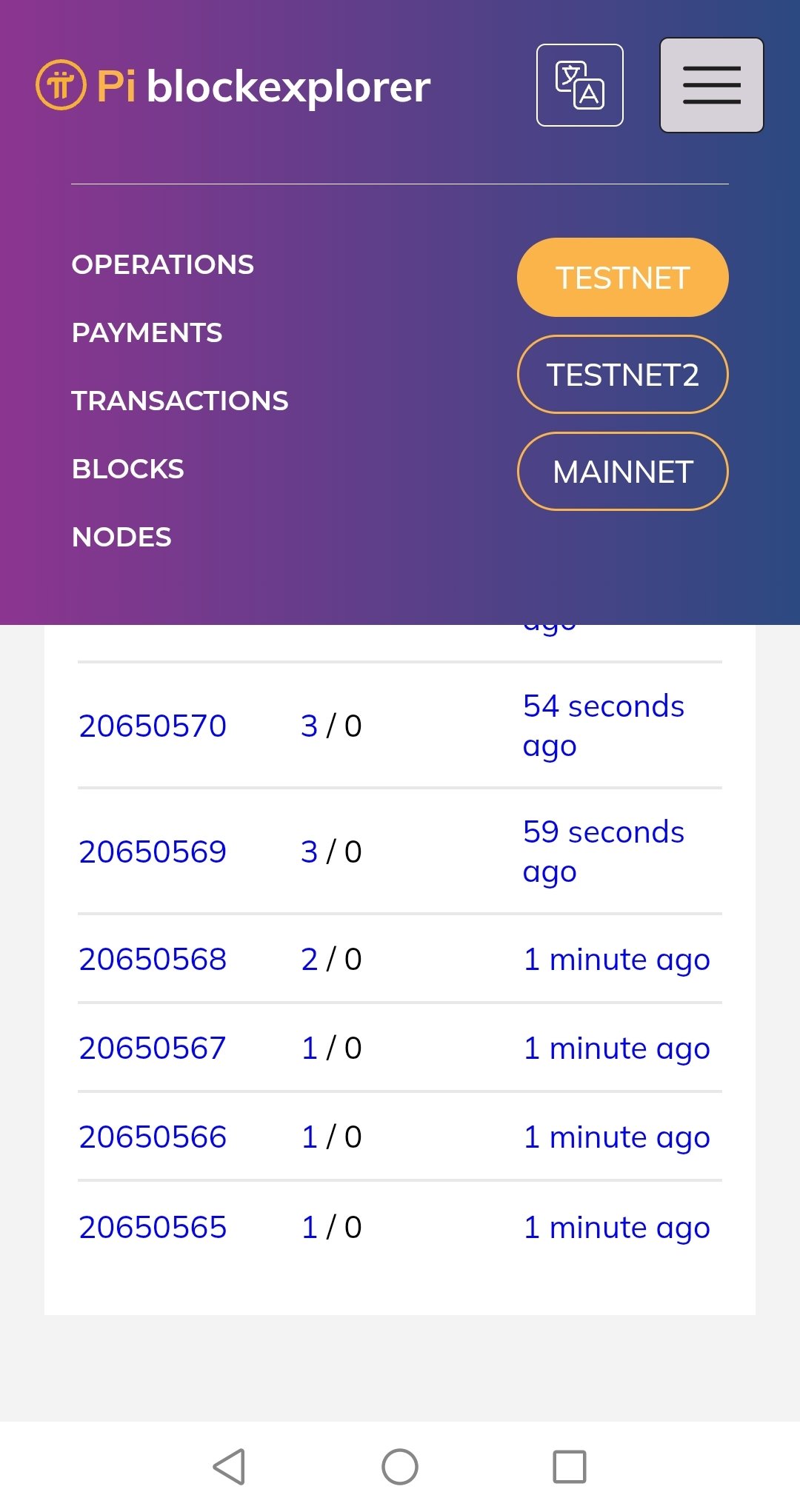
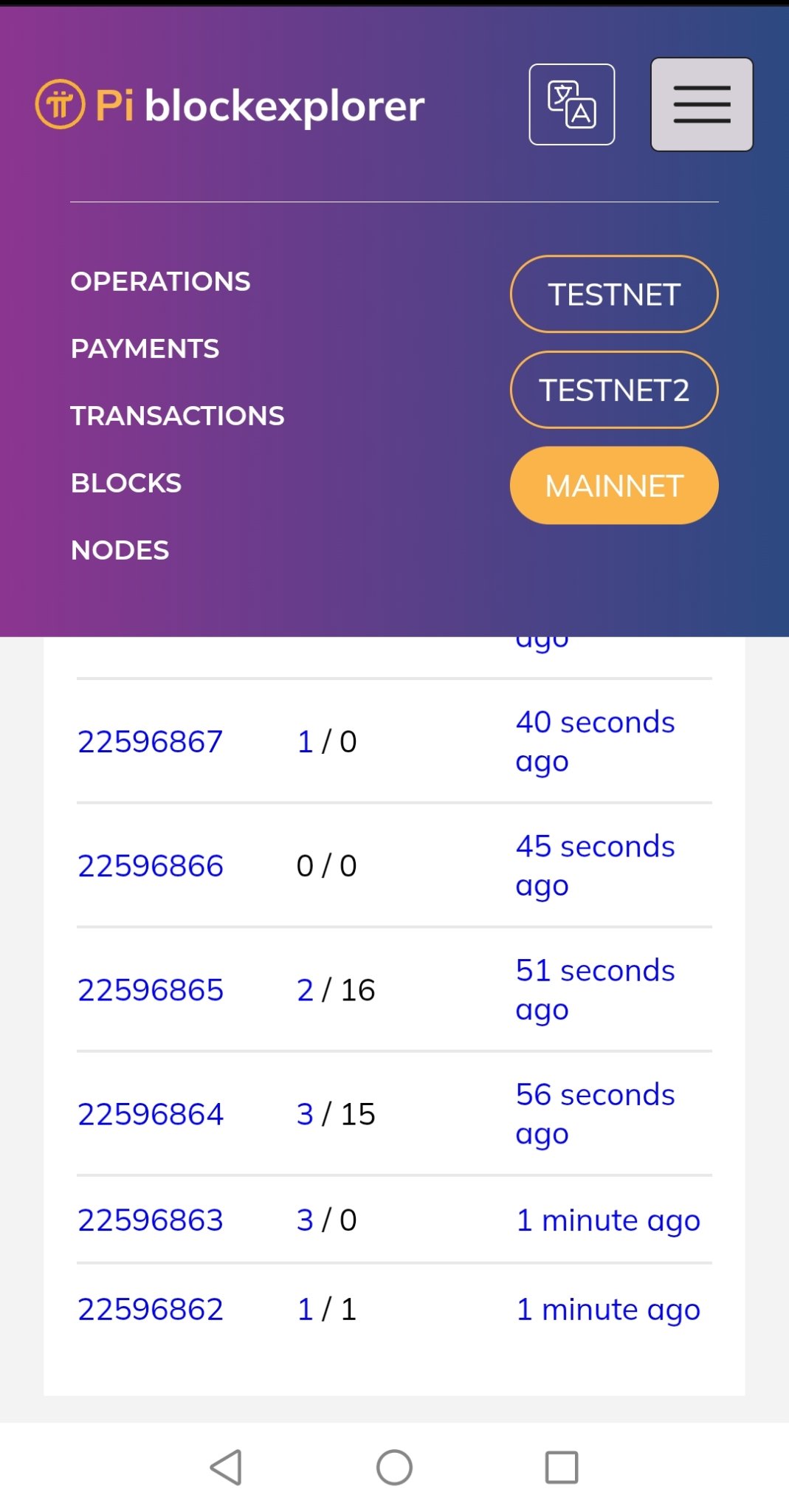
Activity on the Pi testnet has dropped dramatically. Before the open mainnet launch, each block on the testnet carried dozens of transactions. Now, usage is almost nonexistent—nearly identical to the mainnet, which itself sees close to zero activity aside from migration transfers as users move unlocked Pi to exchanges.
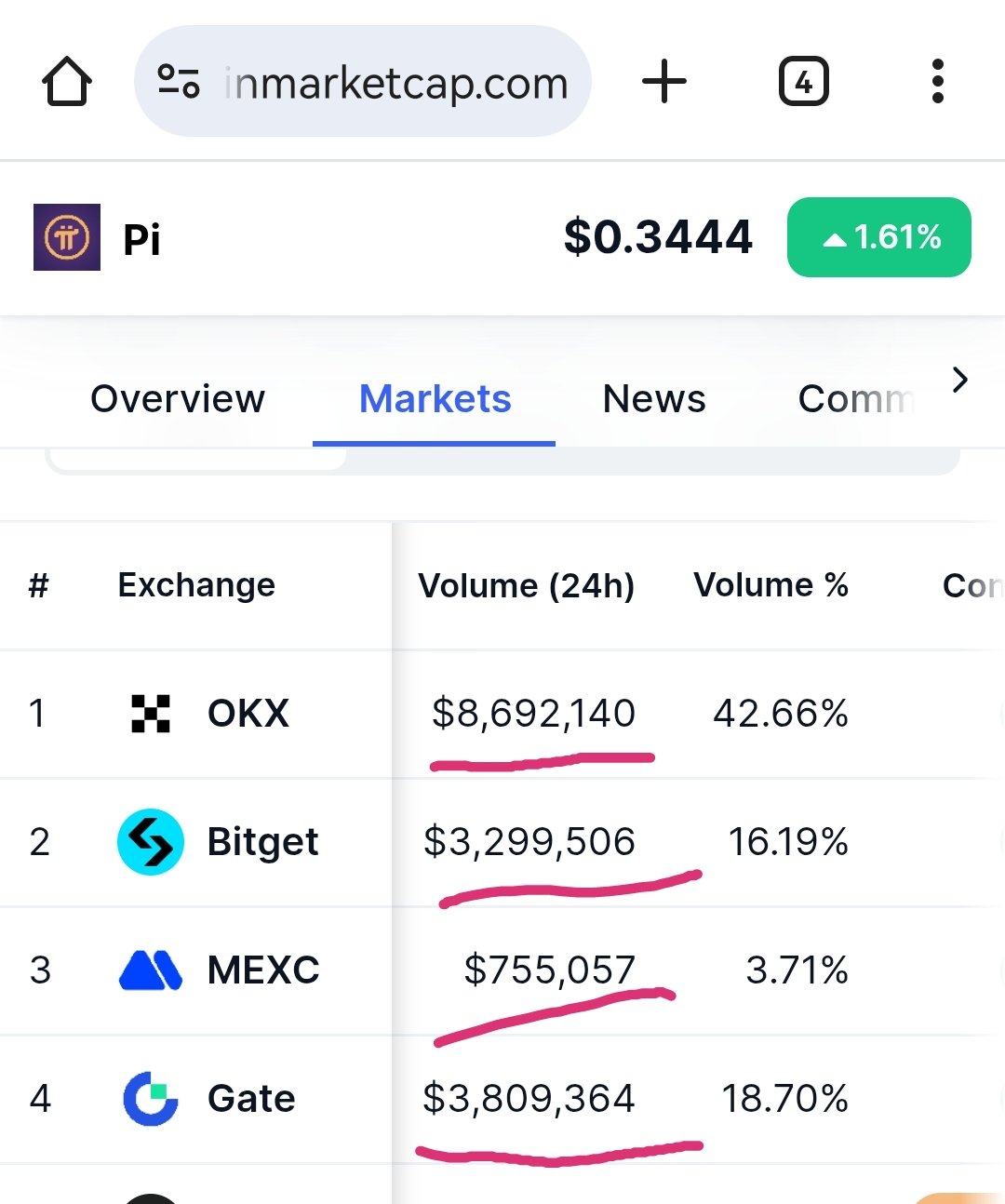
Meanwhile, exchange trading volume is shrinking fast. Daily volume has fallen to just $20 million, raising concerns about liquidity drying up.
According to X user Dr. Pi, this raises an urgent question: Shouldn’t the Pi Core Team step back, reflect, and make strategic adjustments before the ecosystem weakens further?
The Pi community’s disappointment is growing. Developers still have no clarity on when their projects will be able to connect to the mainnet, despite waiting since 2021. Pioneers remain uncertain about KYC approvals, migration timelines, or a concrete future development roadmap.
This lack of transparency risks alienating both developers and users. Without clear milestones or communication, trust erodes—and with it, the community’s willingness to build and participate.
The Risk of a Vicious Cycle
Poor metrics are hard to ignore. Investors and outsiders will inevitably notice declining activity and liquidity. As confidence wanes, adoption slows further, feeding into a vicious cycle that could undermine the very foundation of the Pi ecosystem.
If Pi Network wants to move from hype to long-term value, decisive action and transparent planning are no longer optional—they’re essential.
PI Price Breakdown? Bearish Pressure at $0.34 Support with Faint Hints of Reversal
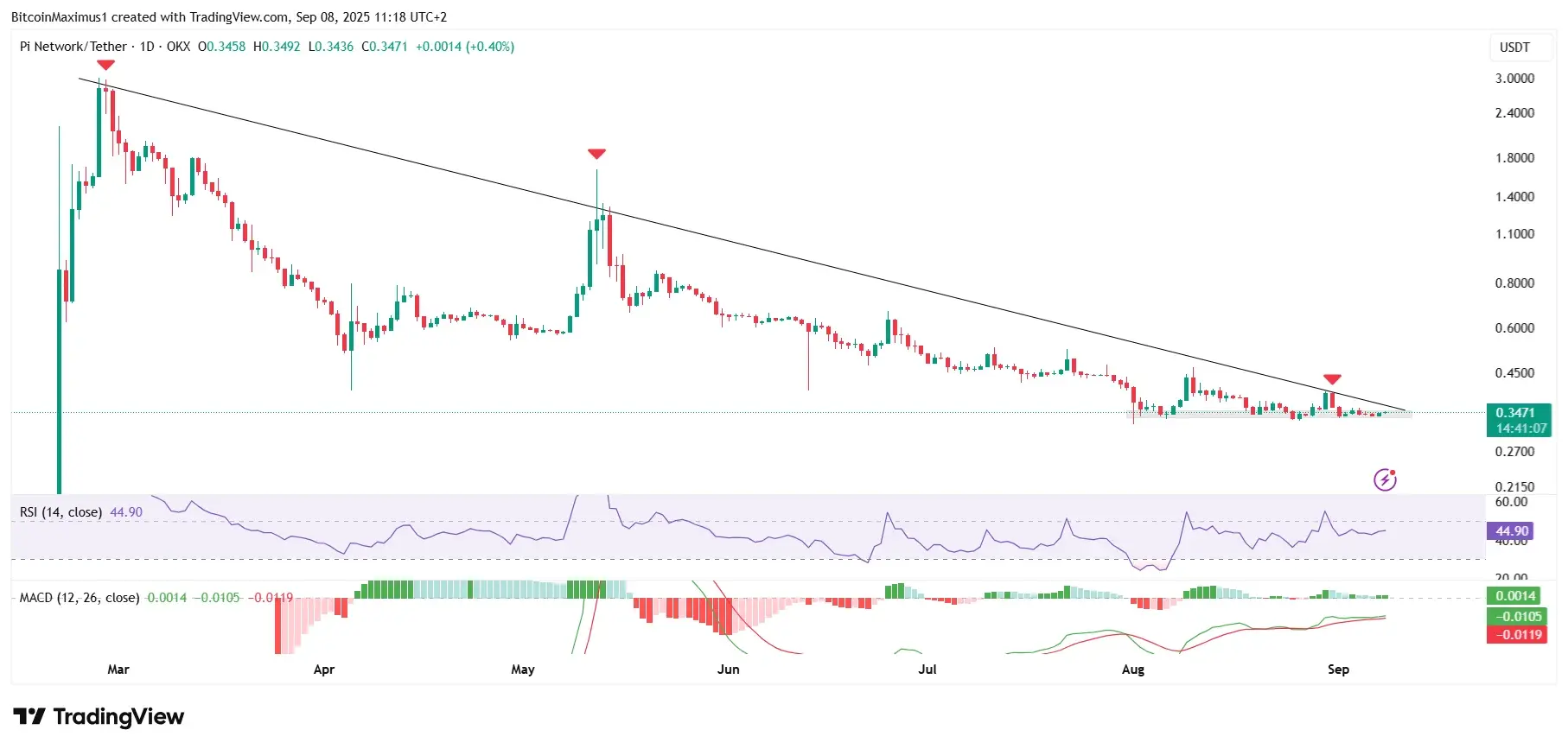
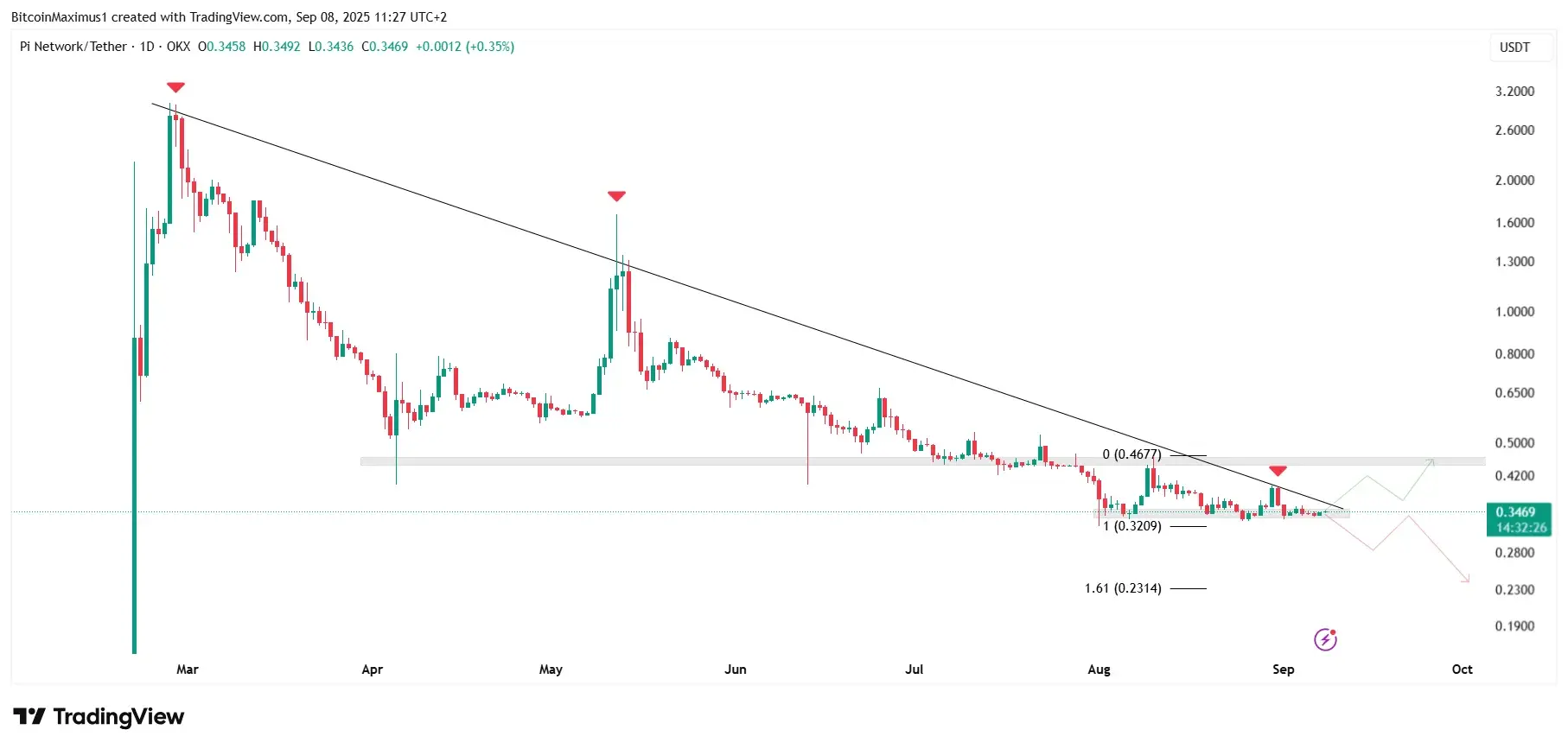
The PI price has fallen significantly since its launch, decreasing under a descending resistance trend line.
The trend line has caused three rejections (red icons), the most recent last week.
Pi Network/Tether. | Credit: Valdrin Tahiri/TradingEconomics
Currently, the PI price trades inside the $0.34 horizontal support area, which is the final one before a new all-time low.
PI has traded inside this level for over a month, creating several lower highs.
The pattern of weakness is likely to lead to a breakdown, taking the PI price to a new all-time low.
However, while the price action is bearish, momentum indicators give some hope for a bullish trend reversal.
The Relative Strength Index (RSI) and Moving Average Convergence/Divergence (MACD) are both surging, though neither has moved above its bullish threshold.
Pi Coin Bullish vs Bearish Outlook
Because of the bearish price action, highlighted by the downward trend that has been ongoing for six months, a breakdown below $0.34 is the most likely future outlook.
Pi wave count. | Credit: Valdrin Tahiri/TradingEconomics
If that happens, the PI price could reach a new all-time low of $0.23, created by the 1.61 external Fibonacci retracement of the previous bounce.
Alternatively, the bullish outlook, supported by the RSI and MACD, suggests that a breakout from the diagonal resistance will occur.
Even if that is the case, the PI price would likely top at the $0.45 resistance level before moving downward.
So, a full-blown trend reversal is unlikely to follow even if a short-term breakout occurs.
Risks and Criticisms of Pi Network
Near-zero activity on both testnet and mainnet: Pi Network is under fire as both its testnet and mainnet show near-zero activity, with exchange volumes collapsing to just $20M daily. Without a clear roadmap, migration plan, or developer integration, confidence is slipping into a vicious cycle of declining use and fading trust.
Liquidity constraints and token unlock concerns: With billions of Pi coins mined, opening liquidity could flood the market and crash prices if not carefully managed.
Skepticism from crypto experts and analysts: Many experts dismiss Pi as overhyped, pointing to its lack of technical breakthroughs compared to existing blockchains.
Data privacy and user trust issues: As Pi collects personal information for KYC, concerns about data handling, storage, and compliance with privacy regulations have grown.
🚨 $Pi Network: 13x more supply locked than $KAS, yet marketed as "mobile mining" — a corporate PoS illusion with no real decentralization.
Meanwhile, Kaspa: fully decentralized PoW, almost mined out, and its chart actually reflects organic demand.
A Pi Pioneer shared on X that they keep buying Pi at every dip, from $1.60 down to $0.34, seeing each drop as a “long-term opportunity.” They’ve even shifted funds from their monthly pension into weekly Pi buys.
Their conviction comes from “research and a strong belief” that the future lies in crypto, Web3, and AI, with Pi Network as a leader. While avoiding trading and accepting the risk of loss, they remain at peace, driven by faith in Pi’s long-term potential.
I bought Pi at $1.60, $1.00, $0.60, $0.40, $0.35 and now at $0.34.
Every time I see a drop in Pi price, I see it as a long term investment opportunity. I even stopped contributing to my monthly pension and now buy Pi on a weekly basis instead.
Future of Pi Network: Can Hype Turn Into Real Value?
Scenarios for Mainstream Adoption
Pi Network’s biggest asset is its enormous user base, often touted as one of the largest in crypto. If the project can secure listings on major exchanges, encourage merchant adoption, and foster a strong ecosystem of decentralized applications (dApps), it could evolve into a viable payment and utility network.
With millions of “Pioneers” already onboard, Pi has a ready-made community that could give it a launchpad many projects lack. Merchant partnerships, even in niche markets, would validate real-world use cases, while dApps built around payments, gaming, or social applications could anchor daily engagement.
Challenges That Could Stall Momentum
But growth comes with pitfalls. The project has already faced delays, sparking criticism from skeptics who view it as long on hype and short on delivery. Governance concerns also linger: without clear, transparent decision-making structures, trust may erode over time.
Perhaps the biggest risk is token supply—if a large number of Pi coins flood the market when listings go live, it could depress prices and discourage adoption. Without practical use cases beyond speculation, Pi risks being relegated to the growing list of inactive or forgotten tokens.
Balanced Outlook: Hype vs. Execution
Pi Network has excelled at what most projects struggle with—building hype and attracting a loyal community. Yet its future hinges on execution. If it transitions smoothly into real-world utility with clear governance, careful tokenomics, and credible partnerships, Pi could become a genuine case study in mass adoption.
If not, it risks being remembered as a cautionary tale of overpromising and underdelivering in the crowded crypto landscape.
Conclusion
Pi Network represents a fascinating paradox in the crypto world: a project shrouded in uncertainty that still commands global attention and loyalty.
By building a massive community, leveraging social engagement, and positioning itself as a mobile-first movement, Pi has sustained momentum far longer than many skeptics expected.
Yet, enthusiasm alone cannot guarantee success. Until Pi demonstrates liquidity, real-world utility, and transparent governance, its future will remain speculative.
For now, Pioneers and observers alike are left balancing hope, hype, and hard questions—waiting to see whether Pi will evolve into genuine value or remain a digital experiment fueled by community belief.
Yes. Since Pi Network’s Open Network launch on Feb 20, 2025, PI has a live market price and trades on KYB-verified exchanges and onramps (e.g., OKX, Bitget, Gate.io, MEXC, Banxa, Onramp.money). Always use services listed on Pi’s official KYB page.
How much is 1 Pi worth now?
As of Sep 8, 2025, 1 PI trades around $0.34–$0.35 on market trackers/exchanges (examples below). Prices move by the minute.
Does Pi give real money?
You can convert PI to other crypto or fiat via the Open Network integrations with KYB-verified CEXs/onramps—availability depends on your region and account verification (KYC/KYB). Avoid unlisted services to reduce scam risk.
How much is $100 in Pi?
At $0.345 per PI, $100 ≈ 290 PI (range 289.6–290.2 PI depending on the quoted price). This is illustrative; check your exchange’s live rate at the time of trading.
Disclaimer:
The information provided in this article is for informational purposes only. It is not intended to be, nor should it be construed as, financial advice. We do not make any warranties regarding the completeness, reliability, or accuracy of this information. All investments involve risk, and past performance does not guarantee future results. We recommend consulting a financial advisor before making any investment decisions.
Giuseppe Ciccomascolo began his career as an investigative journalist in Italy, where he contributed to both local and national newspapers, focusing on various financial sectors.
Upon relocating to London, he worked as an analyst for Fitch's CapitalStructure and later as a Senior Reporter for Alliance News. In 2017, Giuseppe transitioned to covering cryptocurrency-related news, producing documentaries and articles on Bitcoin and other emerging digital currencies. He also played a pivotal role in establishing the academy for a cryptocurrency exchange website. Crypto remained his primary area of interest throughout his tenure as a writer for ThirdFloor.


 Easy
Easy