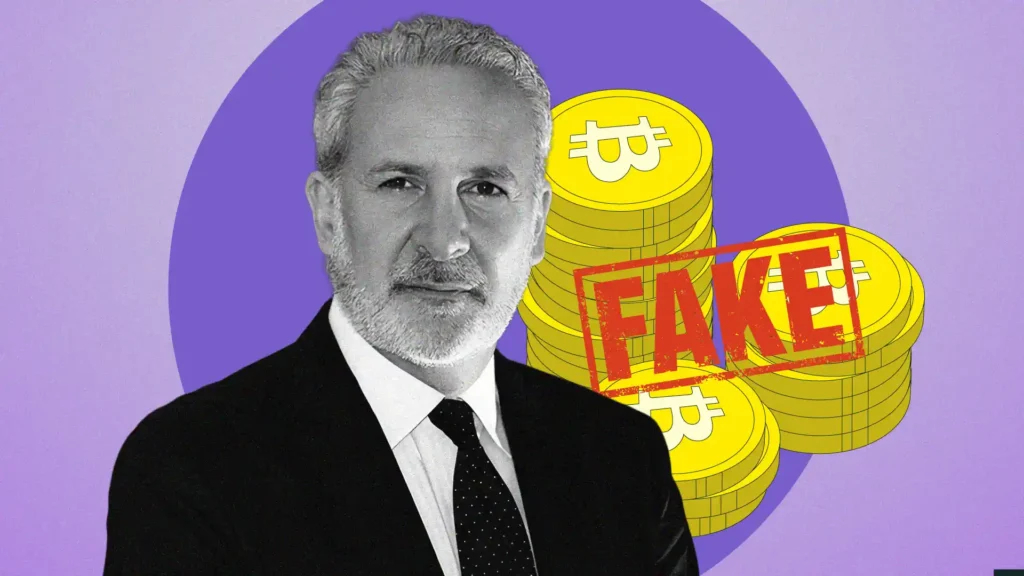
CZ debated Peter Schiff at Binance Blockchain Week | Source: Binance
Share
Key Takeaways
In a fierce on-stage debate, Peter Schiff doubled down on his claim that Bitcoin is a speculative bubble.
CZ defended Bitcoin’s value, citing global usability and mass adoption.
Schiff called out Michael Saylor’s extreme price predictions.
The long-anticipated clash between gold advocate Peter Schiff and Binance founder Changpeng “CZ” Zhao took place today at Binance Blockchain Week, where the two repeatedly butted heads over the future of money, the legitimacy of Bitcoin, and the rise of tokenized gold.
Before a crowd largely composed of crypto supporters, Schiff and CZ didn’t hold back in their extremely differing opinions.
Try Our Recommended Crypto Exchanges
Sponsored
Disclosure
We sometimes use affiliate links in our content, when clicking on those we might receive a commission at no extra cost to you. By using this website you agree to our terms and conditions and privacy policy.
Schiff opened with a broadside against Bitcoin’s fundamentals, calling it “a speculative digital asset” with no intrinsic value.
“What makes Bitcoin worthless, as far as I’m concerned, is not the fact that I can’t touch it,” he said
“It’s that you can’t do anything with it. It doesn’t have utility beyond the fact that… I can transfer it to you, and you can transfer it to somebody else.”
He contrasted Bitcoin with tokenized gold:
“When I transfer tokenized gold to you, I’ve transferred gold. I’ve transferred the ownership of the gold.”
The debate stayed lighthearted, but little common ground was reached.
Schiff repeatedly argued that Bitcoin behaves like a mass speculative scheme:
“More people are gambling in Bitcoin today than were gambling in it a couple of years ago,” he said.
He later accused CZ of running “a pretty big casino.”
Schiff also questioned Bitcoin’s long-term value, noting that in gold terms, it has declined:
“Bitcoin today buys 40% fewer ounces of gold than it did four years ago.”
He described Bitcoin’s rise as hype-driven:
“We had ETFs… celebrity endorsements… the NFT craze… El Salvador. We’ve had all of this promotion… and the price has gone down.”
Bitcoin Has Real Utility
CZ pushed back, arguing that virtual assets can hold real value.
“When you use X, X is completely virtual. There’s nothing physical about it. But X has value,” he said. “The Internet is virtual… but it has value.”
“I moved to different countries all the time. With this piece of gold, it’s not easy for me to take it across countries. Whereas Bitcoin… has actually gone up in value over the last 15 years.”
Responding to Schiff’s accusation that Binance users are gamblers, he replied:
“When you reach this level of like hundreds of millions of people, it’s no longer a casino.”
Schiff Calls Out Michael Saylor’s Bitcoin Outlook
Schiff also targeted MicroStrategy chairman Michael Saylor, criticizing the company’s leveraged Bitcoin strategy and Saylor’s extreme long-term price predictions.
Referencing Saylor’s public claims of extraordinary valuations, Schiff said:
“Michael Saylor is coming out here — Bitcoin is going to be $10 million a Bitcoin.”
He argued that if Saylor’s predictions were credible, the market would already reflect them:
“Well, why isn’t it there now? If it’s really that valuable, the market would adjust the price now.”
Schiff added that MicroStrategy intensified Bitcoin’s bull cycle by acquiring massive amounts with borrowed capital:
“We got… Strategy that borrowed $40 billion to buy Bitcoin, or issued stock and debt to buy $40 billion.”
He said Saylor portrays Bitcoin as a guaranteed windfall:
“He acts like you just buy Bitcoin and you’re guaranteed to make all this money. It’s a sure thing. Go out, mortgage your house… put everything you have.”
“If it was a sure thing, the price would already be there.”
Tokenized Gold
Schiff used the debate to highlight his own tokenized-gold initiative.
“Right now… you can buy physical gold and silver, and we store it for you… it’s allocated gold,” he explained.
He said gold-backed digital tokens remove historical limitations without needing government involvement:
“Any private entity that has a good reputation and is trustworthy can tokenize gold… they’re all fungible because gold is gold.”
Although the atmosphere remained cordial and lighthearted, the two never approached common ground.
Schiff insisted Bitcoin’s future is bleak:
“Young people will like gold more because their friends will have lost a lot of money in Bitcoin.”
CZ countered with user-growth figures and adoption momentum:
“Three hundred million people on Binance alone have some kind of Bitcoin.”
Kurt Robson is a London-based reporter at CCN, specialising in the fast-moving worlds of crypto and emerging technology. He began his career covering local news in Cornwall after graduating from Falmouth University with First Class Honours in Journalism. There, he cut his teeth on everything from council meetings to missing swans.
He quickly rose through the ranks to become a frontline journalist at several of the UK’s leading national newspapers. Over the years, he has interviewed musicians and celebrities, reported from courtrooms and crime scenes, and secured multiple front-page exclusives.
Following the upheaval of the COVID-19 pandemic, Kurt shifted his focus to technology journalism—just ahead of the AI boom. With a natural curiosity and a trained eye for emerging trends, he has found a new rhythm in reporting on innovation.
At CCN, Kurt's work focuses on the cutting edge of crypto, blockchain, AI, and the evolving digital world. Drawing on his background in people-first reporting and his deep interest in disruptive tech, Kurt delivers stories that are insightful, entertaining, and human-centric.