Japan’s Bond Yields Hit Record High — What It Means for the Bitcoin Price
Share
Key Takeaways
Japan’s bond yields just hit their highest levels in decades, ending an era of almost “free” yen.
Rising Japanese yields make borrowing in yen more expensive and force traders to unwind the Yen Carry Trade.
As that cheap-money trade unravels, investors often sell riskier assets first, including Bitcoin.
Bitcoin now moves with global interest rates and liquidity, not just crypto news, so BoJ decisions can directly affect its price.
In early December 2025, Japan’s long-term government bond yields spiked to their highest levels since before the 2008 financial crisis, and markets expect the Bank of Japan (BoJ) to spike rates again later this month.
At around the same time, Bitcoin dropped below $87,000, and around $150 billion disappeared from the total crypto market value. How are these events related?
Let’s dive in.
What is a Bond Yield?
Think of a government bond as an IOU. You lend money to the government, and it promises to pay you interest every year, plus your initial investment at the end.
Bond price: What you pay today.
Bond yield: The interest return per year, a percent of that price.
If a bond pays a fixed rate but its price falls, the yield goes up. If the bond’s price rises, the yield goes down.
A simple example:
A bond pays $3 a year with a $100 buy-in. If it remains at $100, the yield remains 3%.
If investors get nervous and only want to buy at $75, the same $3 interest now becomes 4% of the $75.
If a bond price drops, you’d be getting the same $3 per year but for $75 instead of $100. Price down, yield up.
Yields usually rise when:
Investors want to counter inflation, so they demand a higher return.
Policy changes cause investors to sell bonds, which pushes the bond price down and bond yields up.
Basically, bond yields are just interest rates that the government must pay. Japan’s low yields were vital to the global economy, as they allowed investors to borrow yen for cheap, convert it to US stocks or, for some investors, crypto, and make a lot of money as a result. This process is known as the Yen Carry Trade.
When rates go up, other assets have to re-price in return.
Try Our Recommended Crypto Exchanges
Sponsored
Disclosure
We sometimes use affiliate links in our content, when clicking on those we might receive a commission at no extra cost to you. By using this website you agree to our terms and conditions and privacy policy.
Japan has been paying near-zero interest rates on Japanese government bonds (JGBs) for decades, meaning investors were putting money into other inflation-countering assets, such as Bitcoin.
This just changed.
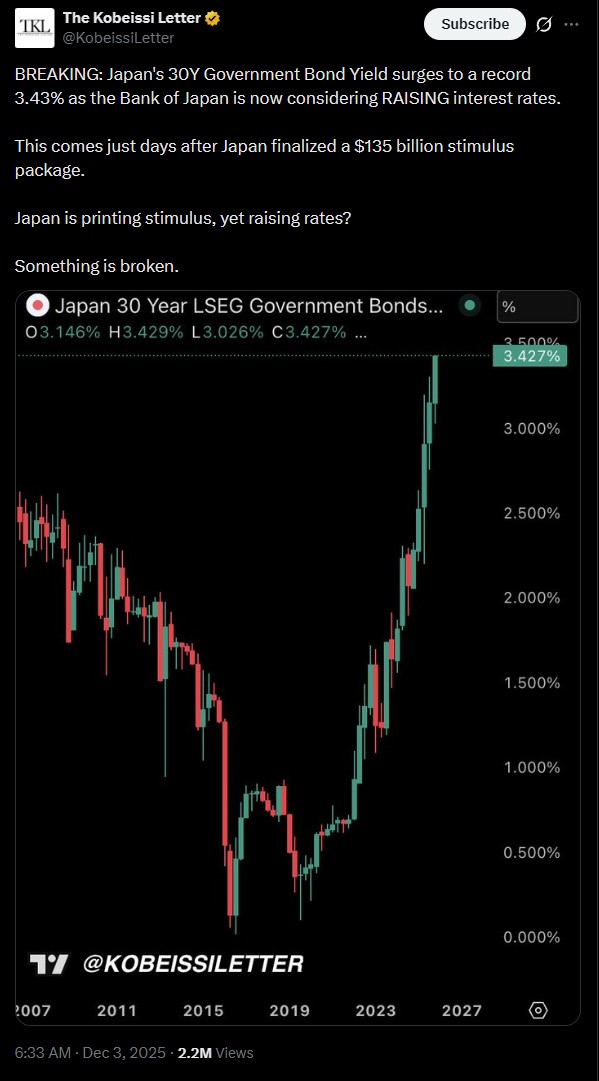
Japan’s 30-year JGB just hit a 3.43% bond yield, and even spiked to 3.77% for a quick period after news of a $110 billion stimulus plan. At the same time, Japan’s 10-year yield jumped to around 1.9%, its highest level since before the 2008 financial crisis. The 2-year yield went higher than 1% as well.
For a country that lived with near-zero yields for around 30 years, these are huge, sudden moves.
Source: @KobeissiLetter on X
Why did these prices jump?
The government approved a massive stimulus package.
Inflation is closer to 3% than 0%.
Markets expect the BoJ to raise rates yet again later this month.
In other words, Japan’s bonds will finally pay “real” interest, but this also means borrowing in yen becomes more expensive. And now, interest rates for anyone who participated in the Yen Carry Trade go up. To counter rising borrowing interest rates, investors sell whatever they can, including Bitcoin.
What Japan’s High Bold Yield Could Mean for Bitcoin’s Price
Nobody, not even Tom Lee, can give a precise Bitcoin price target from Japanese yields alone. But there are a few angles to approach how movements might play out:
If Yields Stay High
Should JGB yields remain high:
The Yen Carry Trade will continue to unravel.
Bonds, cash, and “safer” assets than Bitcoin will look more attractive to investors.
Bitcoin might experience some choppier movements as traders look for the best moment to cash out.
If Yields Spike Unexpectedly
Yields may spike once again with little warning:
A spike in yields could trigger a second wave of forced liquidations across crypto.
In that scenario, price becomes more about “I need to sell right now to mitigate losses” rather than any long-term Bitcoin fundamentals or strategy.
If Yields Cool Off After December Decision
Yields might stabilize if the BoJ sticks with one rate increase:
In that case, the worst of the Yen Carry Trade unraveling may pass, and Bitcoin could stabilize and even recover related losses.
All this to say, Bitcoin is affected by Japanese yields because it’s now considered a macro asset, similar to stocks and bonds. When global fiat is harder to come by, Bitcoin and alternative assets are sure to feel the effects first.
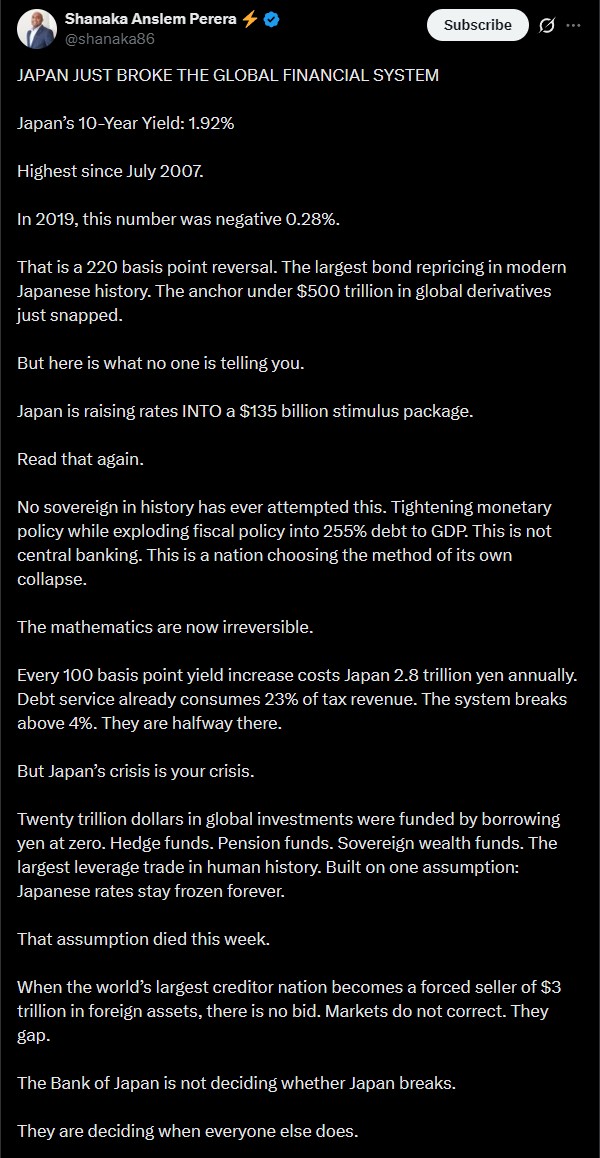
Source: Shanaka86 on X
How You Should Prepare for Bitcoin Investment
If you hold Bitcoin, be wary of the following:
Pay attention to Japanese yield rates and the yen in general. Big jumps in the 10-year and 30-year JGB yields, or a sudden spike in yen’s value, can warn you that riskier assets like Bitcoin might feel the effects.
Think in cycles, not just headlines. Remember that Japan’s bond shift is part of a bigger story, with the world moving away from ultra-cheap money. Bitcoin may still win out in the long term, but the path will have some ups and downs.
Japan’s record bond yields mark the end of an age of almost free yen.
As all of that “free money” fades from the market, note that Bitcoin no longer exists as an alternative to the financial system. The digital asset is a part of everyday financials now, and is affected by global interest rates, bond markets, and central-bank decisions.
If Japanese yields stay high or climb further, Bitcoin’s price might remain under pressure. If the BoJ manages a controlled move and the yen liquidity stays reasonable, Bitcoin can recover just fine.
Either way, Japan’s bond market just reminded the world that Bitcoin no longer moves in a vacuum. It exists amongst the world’s biggest money flows.
Max Moeller is a Chicago‑based writer and video editor passionate about games, tech, and crypto. Whether it’s crafting clear, insightful articles or piecing together engaging video retrospectives, he’s driven by curiosity and takes pride in keeping things human. Since 2017, Max has been published in a variety of notable crypto magazines.


 Intermediate