Grayscale says Fed policy could determine Bitcoin’s next move.
Regulation and corporate leverage remain major risks.
Analysts remain divided on Bitcoin’s bottom.
Bitcoin’s price could face further downside if the US Federal Reserve raises interest rates, according to asset manager Grayscale, as analysts continue to debate whether it has already reached its cycle low.
Bitcoin was trading around $59,783 at the time of writing, down roughly 8% on the day and more than 50% below its October peak near $125,000.
While Grayscale said the current decline appears consistent with previous cyclical pullbacks, it warned that several developments could drive it lower.
Try Our Recommended Crypto Exchanges
Sponsored
Disclosure
We sometimes use affiliate links in our content, when clicking on those we might receive a commission at no extra cost to you. By using this website you agree to our terms and conditions and privacy policy.
Grayscale Says Fed Rate Hikes Could Push Bitcoin Lower
In a research report published June 26, Grayscale said the biggest headwind for Bitcoin in recent months has been a sharp shift in expectations for US monetary policy.
The firm said investors had previously expected President Donald Trump to nominate a relatively dovish Federal Reserve chair, but instead appointed Kevin Warsh, who has adopted a more hawkish stance amid persistent inflation.
“As a result, the Fed is now expected to hike rates rather than cut rates this year,” Grayscale wrote.
According to the asset manager, the changing rate outlook has weakened what it described as the “debasement trade” that previously supported both Bitcoin and gold.
Grayscale said a more aggressive Fed could weigh further on Bitcoin if inflation remains stubborn and policymakers are forced to continue tightening financial conditions.
Under its downside scenario, the firm said Bitcoin could “fall moderately further” if the Federal Reserve raises rates.
However, it noted that it does not expect declines as severe as previous bear markets.
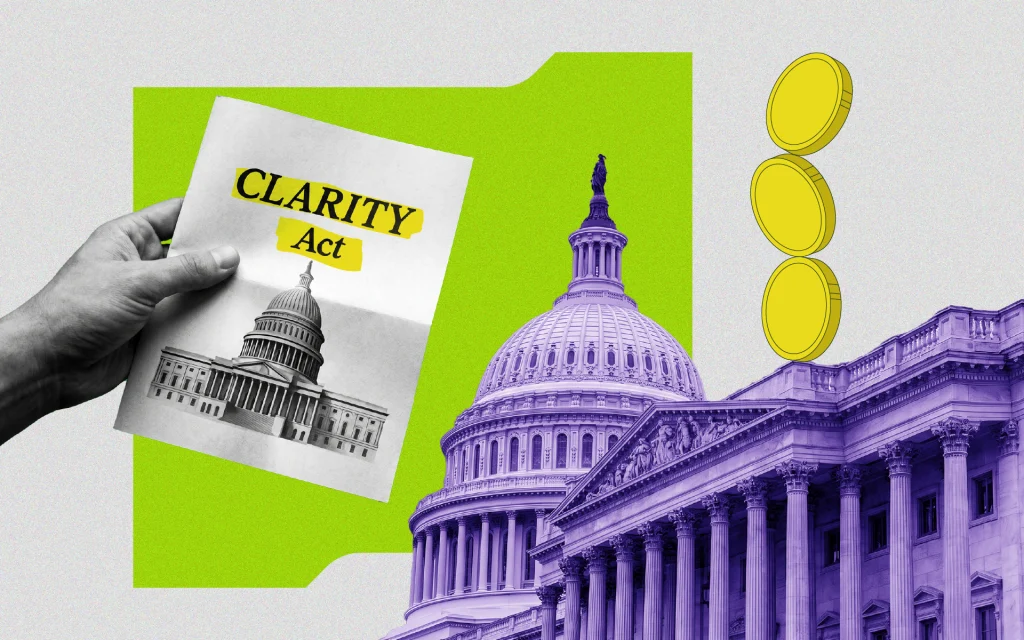
CLARITY Act Among Key Risks Facing Bitcoin
Beyond monetary policy, Grayscale identified several crypto-specific catalysts that could influence Bitcoin’s next move.
The firm said uncertainty surrounding the proposed CLARITY Act, continued pressure on Strategy’s leveraged balance sheet, and growing investor concerns around quantum computing risks have all contributed to weaker sentiment.
Grayscale outlined two possible paths for the market.
In its base-case scenario, the CLARITY Act passes the US Senate, and Strategy strengthens its balance sheet — potentially meaning Bitcoin is already close to its cyclical bottom.
However, if the legislation stalls and corporate Bitcoin holders continue deleveraging, Grayscale said Bitcoin could experience additional downside before recovering.
Despite the near-term risks, the firm maintained a bullish long-term outlook.
“We see many structural positives for the crypto asset class and believe current valuations offer compelling entry points for investors with longer-term horizons,” Grayscale wrote.
Bitcoin Finds Buyers Despite Sharp Correction
Bitcoin was trading at approximately $60,582 at the time of reporting, down around 6% in the last week.
Joel Kruger, market strategist at LMAX Group, told CCN that recent price action continues to reinforce Bitcoin’s longer-term investment case despite the steep correction.
“The latest price action in crypto may feel discouraging at first glance, but beneath the surface it continues to reinforce what is becoming an increasingly compelling medium and longer-term investment case,” Kruger said.
He noted Bitcoin found “another wave of strong buying” around the $59,000 level after briefly breaking below its yearly low.
From a technical perspective, Kruger said the recent rebound increased the likelihood that Bitcoin is forming a major double-bottom pattern.
“A move back above the recent high near $63,200 would reinforce that view,” he said.
Kruger added that a break above resistance near $67,300 could open the way toward $80,000 while bringing “$100,000 and a retest of the record high back into focus.”
Potential Bitcoin Price Bottom Near $44,488?
Not everyone believes Bitcoin has reached its low.
Jason Williams, host of the Going Parabolic podcast, has argued that historical market cycles suggest Bitcoin could still decline to around $44,488.
Williams said Bitcoin’s realized price—the average on-chain acquisition cost of all holders—has historically marked an important reference point during every bear market.
“Bitcoin has NEVER bottomed in a cycle without trading below the Realized Price,” Williams wrote on X.
According to Williams, Bitcoin traded at:
58% below the realized price during the 2011 bear market
49% below in 2015
47% below in 2018
34% beneath the metric during the 2022 cycle.
A long post on why the bottom for Bitcoin is not in
Bitcoin's Realised Price is the average cost basis for all holders
Currently it is $53.6k
Bitcoin has NEVER bottomed in a cycle without trading below the Realised Price
— Jason Ai. Williams (@GoingParabolic) June 9, 2026
He argued the progressively smaller drawdowns suggest diminishing downside across successive cycles.
Applying that trend to today’s realized price, Williams estimated Bitcoin could bottom roughly 17% below the metric, implying a price near $44,488.
Gary Cardone Warns Bitcoin Price Could Fall Toward $30,000
Investor Gary Cardone has also cautioned that Bitcoin could experience substantially deeper losses if demand fails to improve.
“Bitcoin needs Buyers….. Without buyers, Sellers will get pushy,” Cardone wrote on X.
He has repeatedly argued that weakness across the broader digital asset market, particularly Ethereum and projects built around it, continues to weigh on investor confidence.
While Cardone has said he remains a long-term Bitcoin buyer, he has warned that prices could fall significantly before stronger institutional demand emerges.
In previous comments, Cardone said Bitcoin could revisit levels as low as $30,000 if selling pressure intensifies.
Kurt Robson is a London-based reporter at CCN, specialising in the fast-moving worlds of crypto and emerging technology. He began his career covering local news in Cornwall after graduating from Falmouth University with First Class Honours in Journalism. There, he cut his teeth on everything from council meetings to missing swans.
He quickly rose through the ranks to become a frontline journalist at several of the UK’s leading national newspapers. Over the years, he has interviewed musicians and celebrities, reported from courtrooms and crime scenes, and secured multiple front-page exclusives.
Following the upheaval of the COVID-19 pandemic, Kurt shifted his focus to technology journalism—just ahead of the AI boom. With a natural curiosity and a trained eye for emerging trends, he has found a new rhythm in reporting on innovation.
At CCN, Kurt's work focuses on the cutting edge of crypto, blockchain, AI, and the evolving digital world. Drawing on his background in people-first reporting and his deep interest in disruptive tech, Kurt delivers stories that are insightful, entertaining, and human-centric.