The Grayscale Dogecoin Trust ETF (GDOG) began trading in November 2025, offering investors regulated, spot exposure to Dogecoin.
Bitwise Asset Management’s proposed Dogecoin ETF (BWOW) is expected to launch around late November 2025.
Earlier launches, the REX-Osprey DOJE and the leveraged 21Shares TXXD, have provided additional DOGE-linked exposure.
While Dogecoin ETFs simplify access, investors should treat DOGE allocations as small, tactical positions within diversified portfolios.
The memecoin era has entered a new phase as Dogecoin (DOGE) gains regulated altcoin ETF exposure. With GDOG (the Grayscale Investments Dogecoin Trust ETF) now trading, and BWOW from Bitwise Asset Management in line for approval, investors have new pathways into DOGE, without holding the coin directly.
These offerings reflect growing institutional interest in altcoins, and offer regulated alternatives for gaining exposure. Still, volatility and crypto-asset risks remain front and centre.
Try Our Recommended Crypto Exchanges
Sponsored
Disclosure
We sometimes use affiliate links in our content, when clicking on those we might receive a commission at no extra cost to you. By using this website you agree to our terms and conditions and privacy policy.
Grayscale’s Dogecoin Trust ETF, GDOG, represents one of the first spot-style DOGE vehicles in the U.S. It allows investors to access Dogecoin performance via a regulated fund structure, rather than managing wallets or using unregulated exchanges.
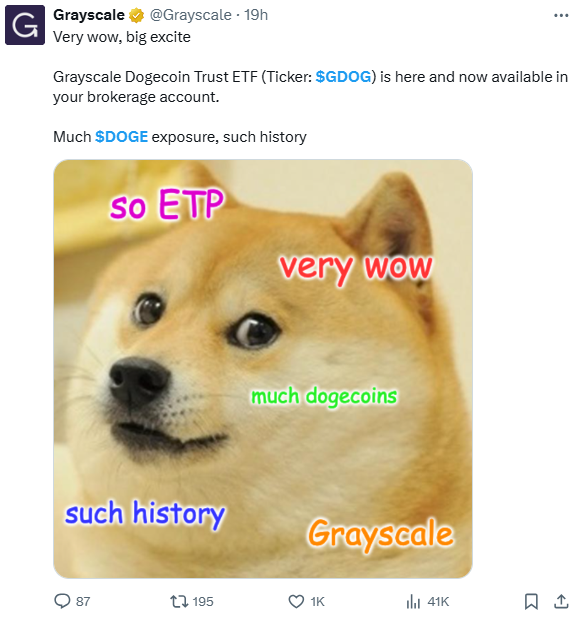
Grayscale announces its GDOG ETF launch. | Credit: Grayscale X profile
Key features include:
Exposure to DOGE through a brokerage-accessible fund.
Simplified access compared to direct crypto custody.
However: it retains the same underlying risk profile of Dogecoin (high volatility, speculative asset).
For investors considering GDOG: treat this as a high-risk investment in a single digital asset, not a broad crypto portfolio.
BWOW — Bitwise Dogecoin ETF (Pending)
Bitwise’s upcoming ETF (tentatively ticker BWOW) is positioned as a next wave in DOGE ETF offerings. Key aspects to watch:
Regulatory approval status and listing date.
Fee structure and how the fund holds or tracks DOGE.
Timing: once live, it may further widen investor access to DOGE via regulated markets.
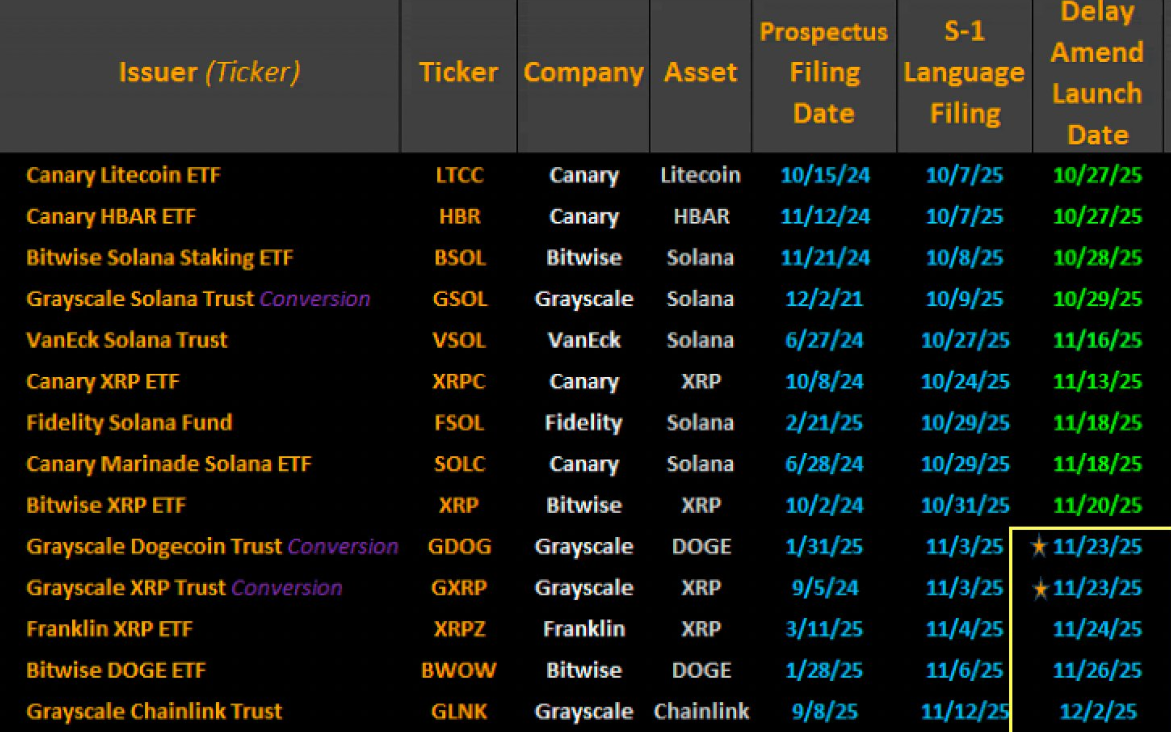
Upcoming ETFs include Bitwise’s DOGE ETF. | Credit: Bloomberg Intelligence
Investors evaluating BWOW should monitor the SEC filing process, listing exchange, and how the fund’s structure (spot vs synthetic) compares to GDOG.
Structure: Offers exposure to DOGE using a mix of direct holdings and derivatives.
Highlights: Marked the first U.S.-listed “memecoin” ETF to include DOGE exposure in a regulated vehicle.
Since its debut, DOJE has seen moderate investor interest, accumulating around $24 million in assets under management. As of late November 2025, the ETF’s net asset value was approximately $14.36 per share, trading slightly below that at $14.14.
This represents a decline of roughly 17% from its launch levels, reflecting the broader pullback in DOGE prices during the same period. Despite this, the ETF remains a milestone product, establishing Dogecoin as a viable asset class for regulated U.S. investors.
TXXD – 21Shares 2× Long Dogecoin ETF
Issuer: 21Shares (partnered with the Dogecoin Foundation’s House of Doge).
Launch date: November 20, 2025.
Structure:A leveraged ETF designed to deliver roughly twice the daily performance of DOGE, before fees and expenses.
Highlights: Suited to advanced traders rather than long-term investors because of compounding effects and heightened volatility.
This leveraged product is designed to deliver twice the daily performance of Dogecoin’s price. Issued by 21Shares in partnership with the Dogecoin Foundation’s House of Doge, TXXD carries a management fee of 1.89% and initially traded near $20.76 per share.
Because it resets daily, performance over longer periods can diverge significantly from DOGE itself, making it suitable mainly for short-term traders or speculative strategies.
How to Invest in Grayscale Investments Dogecoin Trust ETF (GDOG)
The Grayscale Dogecoin Trust ETF (ticker: GDOG) offers a regulated gateway for investors seeking exposure to Dogecoin (DOGE) without directly managing digital wallets or navigating crypto exchanges.
Launched in late November 2025 on the NYSE Arca, GDOG is the first U.S.-listed product to provide spot Dogecoin access through a traditional ETF structure.
1. Understanding What GDOG Is
GDOG is a spot Dogecoin exchange-traded fund. This means the fund’s price is designed to mirror the real-time value of Dogecoin by holding the cryptocurrency directly in secure custody. Grayscale manages the underlying DOGE holdings, providing institutional-grade storage and regular reporting.
Unlike futures-based or synthetic crypto funds, GDOG is backed by actual DOGE tokens, making it a transparent vehicle for investors who prefer regulated access to a volatile digital asset.
2. Where and How to Buy GDOG
Investors can buy and sell GDOG through any brokerage account that supports U.S.-listed ETFs, just as they would purchase shares of an S&P 500 or Bitcoin ETF.
Ticker symbol: GDOG
Exchange: NYSE Arca
Trading hours: Standard U.S. market hours (9:30 a.m. – 4:00 p.m. ET) Orders can be placed through online brokers such as Fidelity, Charles Schwab, Robinhood, or interactive trading platforms that provide ETF access. GDOG can be bought in fractional or whole shares, depending on broker policies.
3. Minimum Investment and Accessibility
Because GDOG trades like any ETF, there is no official minimum investment, investors can purchase as little as one share.
However, brokerage minimums or trading fees may apply. The ETF’s price per share typically tracks the market value of Dogecoin, multiplied by its share conversion ratio, minus management expenses.
4. Fees and Fund Structure
According to Grayscale’s documentation, GDOG is a single-asset exchange-traded product that is not registered under the Investment Company Act of 1940 (the “40 Act”), and therefore does not offer all of the regulatory protections of a 40-Act registered ETF.
In terms of fees, Grayscale advertises a gross expense ratio of 0.00% for the first three months or until the fund reaches US$1.0 billion in assets under management (AUM). After that period or asset threshold is met, the management fee becomes 0.35% per annum.
The fund’s structure is as follows: it is solely and passively invested in DOGE, with the objective of reflecting the value of DOGE held by the Fund, less expenses and other liabilities. Grayscale uses an institutional custodian to hold the cryptocurrency and offers access via a traditional brokerage account, thereby allowing investors to gain exposure to DOGE without direct token custody.
Because it is a single-asset vehicle with direct exposure to Dogecoin, the fund’s value may experience more significant fluctuations than broad-based funds. Given this structure, investors should pay close attention to the fee transition (from 0.00% to 0.35%) and the implications of direct cryptocurrency exposure, including storage, liquidity and volatility risk.
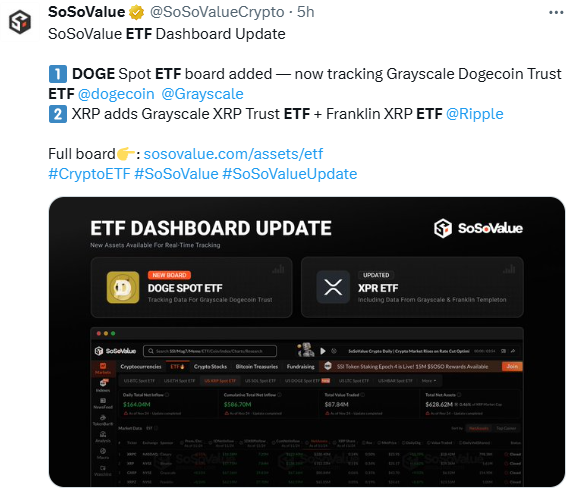
SoSoValue ETF dashboard update. | Credit: SoSoValue X profile
5. What to Expect in Terms of Performance and Risk
GDOG’s performance will rise and fall in direct correlation with DOGE’s movements, offering investors a transparent yet highly volatile exposure to one of the most unpredictable digital assets.
At the time of launch in late November 2025, GDOG’s net asset value (NAV) was approximately $18.02 per share, with trading prices moving slightly above that level in early sessions. Given that the fund holds DOGE directly, any price rally or correction in the underlying cryptocurrency will immediately reflect in GDOG’s share price.
Dogecoin’s historical performance shows periods of extreme volatility, driven by social sentiment, macro trends in crypto markets, and media coverage. Over the past two years, DOGE’s price has surged more than 170%, though it has also experienced sharp declines.
Grayscale notes that Dogecoin has shown relatively low correlation with traditional equity indices such as the S&P 500 and Nasdaq 100, suggesting it can serve as a speculative diversifier, but only for investors willing to tolerate substantial swings.
The main risks for GDOG stem from its single-asset concentration and market volatility. Because it holds a single volatile asset, GDOG should be viewed as a high-risk, high-beta component within a diversified portfolio. It is not designed to generate income or provide downside protection.
Operationally, GDOG’s Dogecoin holdings are secured by an institutional custodian, reducing but not eliminating risks related to digital asset custody, cybersecurity, or infrastructure failures. If disruptions occur in custody or trading operations, the ETF’s value and liquidity could be affected. Grayscale also cautions that while the fund uses institutional-grade controls, cryptocurrency assets remain exposed to broader regulatory, technology, and market risks.
Looking ahead, GDOG’s near-term performance will depend heavily on Dogecoin’s market dynamics and investor sentiment surrounding altcoin ETFs. Investors should also remember that crypto-specific factors, such as liquidity shifts, regulatory news, or market sentiment on memecoins, can significantly impact short-term performance.
6. Portfolio Considerations
Financial advisors typically suggest limiting exposure to single-asset crypto funds to a small portion of overall portfolio allocation, often 1–5% of total investable assets for risk-tolerant investors. GDOG may suit those looking for tactical exposure to Dogecoin or for diversification within a broader digital-asset strategy.
7. Tracking and Tax Implications
Like other ETFs, GDOG issues a standard annual 1099 form, simplifying tax reporting compared to direct crypto trading. Gains or losses from GDOG shares are treated as capital gains, following standard U.S. securities tax rules. However, investors should consult a tax professional about individual circumstances.
GDOG’s market price may trade at a slight premium or discount to its underlying NAV (net asset value), especially during high-volatility periods, so monitoring that spread can help optimize entry or exit points.
Risks of Investing in the Grayscale Dogecoin Trust ETF (GDOG)
While the Grayscale Dogecoin Trust ETF (GDOG) provides an accessible and regulated path to Dogecoin exposure, investors should understand that it carries the same fundamental risks as the underlying cryptocurrency and a few that are unique to the ETF structure itself.
1. Market Volatility
Dogecoin remains one of the most volatile digital assets on the market. Its price is heavily influenced by social sentiment, speculative trading, and broader trends in the crypto ecosystem.
Sharp intraday swings are common and can significantly affect the value of GDOG shares. Investors should be prepared for potentially large price fluctuations in short periods.
2. Single-Asset Concentration
GDOG invests exclusively in Dogecoin, meaning there is no diversification within the fund. Unlike broad-based crypto or equity ETFs, performance depends entirely on the movements of a single, high-risk digital asset. Concentration risk makes GDOG unsuitable as a core portfolio holding for most investors.
3. Crypto-Specific Regulatory and Market Risks
Cryptocurrencies operate in a rapidly evolving regulatory environment. Changes in U.S. or global crypto regulations, taxation policies, or exchange rules could materially impact the DOGE market and, by extension, GDOG’s value.
Additionally, liquidity on crypto exchanges can vary, sometimes leading to tracking discrepancies between the ETF’s market price and its underlying assets.
4. Premium and Discount to NAV
Because GDOG is a single-asset trust traded on an exchange, its market price may trade at a premium or discount relative to its net asset value (NAV). During periods of strong demand or panic selling, this spread can widen, meaning investors might pay more, or receive less, than the true value of the underlying DOGE holdings.
5. Custody and Operational Risks
Although Grayscale uses institutional-grade custodians for DOGE storage, all digital assets face operational risks such as cybersecurity threats, private key management failures, or potential disruptions in custody infrastructure.
While the ETF structure mitigates these through insurance and internal controls, these risks cannot be fully eliminated.
6. Tracking and Liquidity Risks
In volatile markets, GDOG’s share price may not perfectly track the spot price of Dogecoin due to market inefficiencies or limited liquidity. Trading volumes, bid-ask spreads, and market-maker participation can all influence the ETF’s real-time performance.
7. Regulatory Status and Investor Protections
GDOG is not registered under the Investment Company Act of 1940, meaning it lacks some of the investor protections afforded to traditional mutual funds or ETFs. This includes differences in governance, redemption processes, and oversight standards.
When Will BWOW Launch?
The Bitwise Dogecoin ETF (BWOW) is expected to become the next major addition to the growing lineup of Dogecoin-based exchange-traded products.
Key timing cues:
Bitwise submitted an amended registration statement in early November and removed a “delaying amendment”, triggering a 20-day wait period under Section 8(a) of the U.S. Securities Act; if the regulator does not intervene, the ETF becomes effective automatically.
Multiple industry sources point to a likely effective date of around November 26, 2025.
That said, the official launch date remains conditional on all regulatory requirements being satisfied and on the listing exchange (NYSE Arca) finalizing the listing paperwork.
Once launched, BWOW will provide spot exposure to Dogecoin, mirroring DOGE’s market price through direct holdings in the underlying asset. The ETF is expected to carry a competitive management fee, positioning it as a rival to Grayscale’s GDOG.
While enthusiasm among retail investors is high, analysts caution that the official start date remains dependent on final SEC sign-off and exchange readiness. As such, the exact launch day could shift slightly depending on final regulatory and operational steps.
Portfolio context: Treat DOGE exposure as speculative; keep allocation modest relative to core holdings.
Timing: With BWOW pending, there may be entry/launch timing implications.
Investing in GDOG or any other Dogecoin or altcoin ETF is effectively a bet on Dogecoin’s future within a regulated framework.
While the ETF simplifies access and custody, it does not reduce the inherent risks of owning DOGE. Investors should approach GDOG as a speculative position within a diversified portfolio, allocate modestly, and maintain awareness of both crypto-market and structural ETF risks.
GDOG is a spot Dogecoin ETF that holds DOGE directly in custody and trades on NYSE Arca. It provides investors with regulated access to Dogecoin’s price movements through a traditional brokerage account.
How much are the fees for GDOG?
Grayscale offers an introductory 0.00% management fee for the first three months or until the fund reaches $1 billion AUM. After that, the expense ratio becomes 0.35% per year.
When will Bitwise’s Dogecoin ETF (BWOW) launch?
Bitwise’s BWOW ETF is expected to go effective and begin trading in late November 2025, once the SEC’s 20-day review period concludes and NYSE Arca finalizes listing procedures.
Are Dogecoin ETFs safer than buying DOGE directly?
They remove technical hurdles like wallet custody and private key management, but they do not reduce market risk. GDOG, BWOW, DOJE, and TXXD still mirror Dogecoin’s volatile price and should be viewed as speculative assets.
Disclaimer:
The information provided in this article is for informational purposes only. It is not intended to be, nor should it be construed as, financial advice. We do not make any warranties regarding the completeness, reliability, or accuracy of this information. All investments involve risk, and past performance does not guarantee future results. We recommend consulting a financial advisor before making any investment decisions.
Giuseppe Ciccomascolo began his career as an investigative journalist in Italy, where he contributed to both local and national newspapers, focusing on various financial sectors.
Upon relocating to London, he worked as an analyst for Fitch's CapitalStructure and later as a Senior Reporter for Alliance News. In 2017, Giuseppe transitioned to covering cryptocurrency-related news, producing documentaries and articles on Bitcoin and other emerging digital currencies. He also played a pivotal role in establishing the academy for a cryptocurrency exchange website. Crypto remained his primary area of interest throughout his tenure as a writer for ThirdFloor.
Onkar Singh has three years of experience as a digital finance content creator. Throughout his career, he has collaborated with various DeFi projects and crypto media outlets. In his leisure time, he enjoys fitness activities at the gym and watching movies across different genres. Balancing his professional and personal interests, Onkar continues to contribute to the digital finance landscape while pursuing his hobbies.


 Easy
Easy