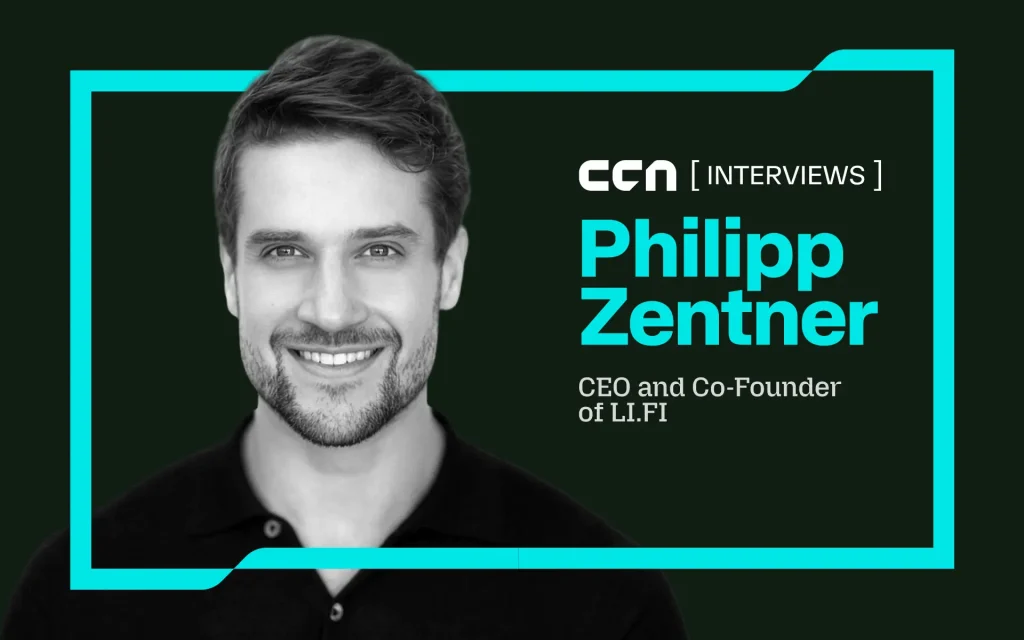
At Consensus 2026 in Miami, LI.FI CEO and co-founder Philipp Zentner laid out a vision for crypto that sounds almost paradoxical: the industry succeeds when users stop noticing it altogether.
For Zentner, the future of blockchain isn’t about forcing users to understand bridges, gas fees, liquidity networks, or Layer-2 ecosystems. It’s about abstracting all of that complexity away until moving digital assets feels as seamless as using Apple Pay or browsing the internet.
“Chain abstraction means you don’t care where your assets are, how you access them, whatsoever,” Zentner told CCN. “All of that comes out of the box.”
Infrastructure Layer Powering Crypto Behind the Scenes
Founded in 2021, LI.FI has quietly become one of the most embedded pieces of infrastructure in crypto.
Zentner describes the company as “Stripe for crypto”, an orchestration layer that aggregates exchanges, bridges, decentralized exchanges, and liquidity providers into a single API. Instead of applications integrating hundreds of separate blockchain services, they can plug into LI.FI once and access a broad multi-chain ecosystem through a unified interface.
“We aggregate all kinds of data service providers, exchanges, cross-chain bridges, and we build an orchestration layer on top of all of that,” Zentner explained.
The company’s reach is already significant. According to Zentner, LI.FI powers infrastructure for major platforms including MetaMask, Phantom, Robinhood, Binance, Coinbase, and Kraken. The protocol has processed roughly $80 billion in transaction volume overall, including $44 billion in the past year alone.
“We are kind of everywhere, but you don’t see us,” he said. “Like a sound editor in a film.”
That invisibility, he argues, is precisely the point.
Why Cross-Chain Crypto Is Still So Complicated
The core problem LI.FI is trying to solve stems from what Zentner calls “exponential fragmentation.”
New chains are launching constantly, each with different gas systems, token standards, bridging architectures, and liquidity environments. On top of that, developers must navigate a rapidly expanding landscape of interoperability protocols including LayerZero OFTs, Wormhole NTTs, Chainlink CCIP systems, and Axelar interoperability standards.
The fragmentation compounds quickly.
“There are mint-and-burn bridges, liquidity networks, intent systems, different DEXs, DEX aggregators, and all of them have different trade-offs,” Zentner said.
Some systems prioritize speed but sacrifice capital efficiency. Others minimize liquidity requirements but introduce latency or finality risks. Intent-based systems rely on market makers that may not consistently provide coverage across all chains.
For developers building wallets or applications, the result is overwhelming.
“If you’re Robinhood entering blockchain, you’re looking at hundreds of APIs to implement,” Zentner said. “We’ve already done the job.”
LI.FI’s role is to route assets from one chain to another, and even into a specific smart contract, through a single transaction flow.
“The API is really simple,” he explained. “It’s asset A on chain X, I want asset B on chain Y, and then we find the best route across everything.”
Crypto’s Biggest UX Problem
Despite ongoing innovation across DeFi, Zentner doesn’t believe the industry has fundamentally “failed” on user experience. Instead, he views today’s complexity as a natural byproduct of trying to decentralize financial infrastructure at a global scale.
“What we are trying to accomplish here is extremely complicated,” he said. “We are trying to decentralize the system.”
In his view, fragmentation isn’t necessarily evidence of dysfunction. It’s a symptom of scaling a new technological paradigm.
Still, Zentner believes the industry’s long-term success depends on removing nearly all visible blockchain complexity from the user experience.
“You don’t care which server you’re operating on, which DNS layer you’re using,” he said. “You want to use the internet.”
Crypto, he argues, must evolve similarly.
Users should interact with applications, games, payments, and financial products without needing to think about chains, bridges, or wallets.
“As long as users care about that, we haven’t done our job.”
Could Wallets Eventually Disappear?
One of Zentner’s more provocative predictions is that crypto wallets themselves may eventually become obsolete.
Today, wallets like MetaMask serve as the gateway to blockchain ecosystems. But if chain abstraction becomes fully mature, traditional consumer platforms could simply integrate crypto rails directly into existing payment interfaces.
“There could be a day where Google Pay and Apple Pay say, actually, you can import your assets now very easily,” Zentner said. “And then MetaMask is done.”
While such a scenario would disrupt crypto-native wallet providers, Zentner believes it would represent a major victory for adoption.
“That would be the best for the industry,” he said. “You get adoption of billions immediately.”
The comparison to Web3 gaming is instructive. Successful blockchain games increasingly avoid emphasizing tokenization or crypto mechanics. Players simply play games, while blockchain infrastructure operates invisibly underneath.
“Crypto should just dilute in the background,” Zentner argued.
AI Agents May Accelerate Blockchain Adoption
Beyond cross-chain infrastructure, Zentner sees artificial intelligence as a major catalyst for blockchain adoption, particularly through agentic commerce and autonomous payments.
According to him, AI systems are evolving too quickly to wait for traditional banking rails to modernize.
“AI cannot wait for the financial system to open up their rails,” he said.
Because blockchain systems are permissionless, borderless, and programmable, Zentner believes they are naturally suited for AI-driven financial interactions.
LI.FI has already positioned itself to serve that emerging market by building infrastructure and tooling for AI agents.
“We have positioned ourselves as that multi-chain transaction rail for AI agents very early on,” Zentner said.
The challenge for AI systems, however, mirrors the same problem human developers face: navigating thousands of edge cases across dozens of chains and liquidity environments.
“The actual challenge is not implementing another API,” Zentner explained. “It’s covering thousands of edge cases and leveraging data to optimize the routes.”
That accumulated routing intelligence has become one of LI.FI’s biggest competitive advantages.
A Winner-Takes-Most Market
Zentner believes interoperability infrastructure naturally tends toward consolidation.
“Any fragmented market has a structural winner,” he said, comparing LI.FI’s position to Stripe in payments or Twilio in messaging.
The reasoning is simple: developers prefer simplicity. Rather than managing hundreds of integrations, they adopt middleware providers that abstract away complexity.
LI.FI currently has around 1,000 active integrators, according to Zentner, and he believes the company is already emerging as the dominant orchestration layer for crypto interoperability.
The next wave of fragmentation may make that role even more important.
Real-world asset tokenization (RWAs), for example, is already spreading across ecosystems including Solana, Avalanche, Provenance, Plume, Canton Network, and private institutional chains launched by firms such as JPMorgan and Stripe.
“So you have natural fragmentation from day one,” Zentner said. “This market hasn’t even started yet.”
For LI.FI, that fragmentation represents opportunity.
Crypto That Nobody Notices
Five to ten years from now, Zentner believes blockchain infrastructure should matter about as much to users as internet servers do today.
“It just doesn’t matter,” he said.
There will still be companies building the underlying infrastructure, routing transactions, coordinating liquidity, and abstracting complexity, but users themselves won’t think about chains at all.
If Zentner is right, the ultimate success of crypto may come when the technology finally disappears from view.


 Easy
Easy