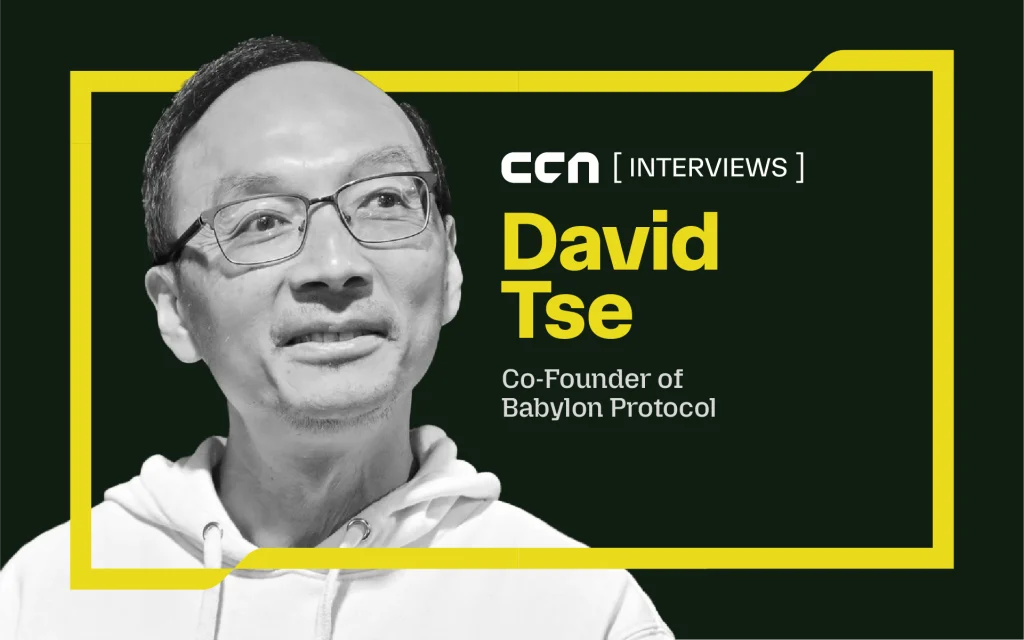
David Tse has spent decades studying information theory at Stanford, but today he’s focused on a very different problem: how to make Bitcoin more useful without changing what makes it valuable.
As co-founder of Babylon, Tse is helping lead a shift in how the industry thinks about Bitcoin, not just as a passive store of value, but as a foundational layer for decentralized finance.
For Tse, this evolution isn’t a departure from Bitcoin’s origins, but a continuation of them.
“Bitcoin as a security layer was an idea originally invented by Nakamoto himself,” he tells CCN’s Max Moeller at Consensus in Miami, referring to merge mining in 2010. That concept allowed Bitcoin miners to secure additional blockchains. Babylon builds on this by extending the idea into the proof-of-stake world, using Bitcoin not just to secure networks computationally, but financially.
“We realized Bitcoin as an asset is so valuable that it can be used to provide security to other blockchains,” Tse explains. This insight led to the development of Bitcoin staking, where BTC acts as collateral to secure proof-of-stake systems. Today, that system underpins Babylon Genesis, a live network with around $4 billion in total value locked, already ranking among the top staking ecosystems globally.
Bitcoin as Collateral: Unlocking Dormant Value
At the center of Babylon’s thesis is the idea that Bitcoin’s biggest untapped use case is as collateral. “Bitcoin is actually the most pristine collateral,” Tse says. “It’s the largest asset by far, it won’t go to zero tomorrow,” he adds, contrasting it with more volatile or speculative assets.
Just as important is user behavior. “Bitcoin holders do not want to sell,” Tse notes. This creates a natural tension: vast amounts of capital sitting idle. Babylon’s solution is to put that capital to work without forcing users to part with it.
“Collateral is a very natural way you can use it without selling, there’s no taxable event, and you can hold it for a long, long time.”
This approach reframes Bitcoin from something static into something productive, without compromising its long-term holding narrative.
From Theory to DeFi Applications
Babylon is already translating this idea into real-world applications. The team first demonstrated Bitcoin-backed lending through a pilot with Morpho, and is now focusing on a larger-scale integration with Aave, one of the biggest DeFi lending platforms.
“Lending is actually the biggest DeFi application, so we want to focus on that first,” Tse says, emphasizing a pragmatic rollout strategy.
Rather than reinventing DeFi, Babylon plugs Bitcoin into existing ecosystems, allowing it to function as native collateral.
Crucially, this is done without relying on wrapped assets or centralized custodians.
“You can do the same thing without wrapping, without going through centralized systems,” Tse explains. That distinction is key in a space where many Bitcoin users are wary of counterparty risk.
Adoption Challenges and the “1% Starting Point”
Despite the potential, Tse is realistic about adoption hurdles. Bitcoin’s user base is famously conservative, and many have held their BTC untouched for years.
Still, Babylon doesn’t need to convert everyone at once. “Let’s start with the 1% first,” Tse says, referring to the share of Bitcoin already used in DeFi. That amounts to roughly $16 billion out of a $1.6 trillion market cap, a small percentage, but a massive absolute number.
This existing user base, currently relying on wrapped Bitcoin solutions like WBTC, represents Babylon’s initial target.
By offering a trustless alternative, the protocol aims to expand from there through organic growth. “1% is already a huge amount,” Tse notes, highlighting the scale even incremental adoption can bring.
Drawing the Line: Preserving Bitcoin’s Core Values
As Bitcoin becomes more integrated into DeFi, a key question is how far it can evolve without losing its identity. For Tse, the answer is straightforward.
“The line is very simple: not your keys, not your coin.”
This principle defines Babylon’s approach. Users must retain control of their private keys at all times. Any system that requires handing over custody crosses the line.
By keeping Bitcoin self-custodied, Babylon aims to ensure that increased utility does not come at the cost of decentralization.
Expanding Use Cases: From Lending to Payments
While lending is the immediate focus, Babylon’s roadmap extends much further. The team is actively exploring additional applications where Bitcoin can serve as trustless collateral.
These include:
“These are more tangible applications,” Tse says, noting that the team is already working with partners to bring some of these ideas to market. The goal is to move beyond theory and into everyday financial tools powered by Bitcoin.
Babylon is also building out its ecosystem through partnerships. Tse points to a recent collaboration with a major Bitcoin platform that could contribute up to 1,000 BTC, signaling growing institutional interest in the model.
Bitcoin as DeFi Infrastructure
Ultimately, Tse sees Babylon as infrastructure rather than a single product.
“The goal is to be the default platform for decentralized finance in Bitcoin,” he says.
To explain this, he draws a comparison to Chainlink. “Chainlink provides data, Babylon provides trustless Bitcoin collateral,” Tse explains.
Just as oracles are essential for most DeFi applications, he believes Bitcoin collateral could become a foundational building block across the ecosystem.
In this vision, Babylon functions like an API layer, an underlying system that developers can build on. Through what Tse calls “trustless Bitcoin vaults,” developers could create a wide range of financial products, from lending and staking to insurance and payments, all powered by Bitcoin.
“The idea is that you have this infrastructure and any developer can build protocols on top of that,” he says.
If that vision takes hold, Bitcoin’s role could expand dramatically. No longer just a passive store of value, it could become an active engine for decentralized finance, powering a new generation of applications while staying true to its core principles.


 Easy
Easy