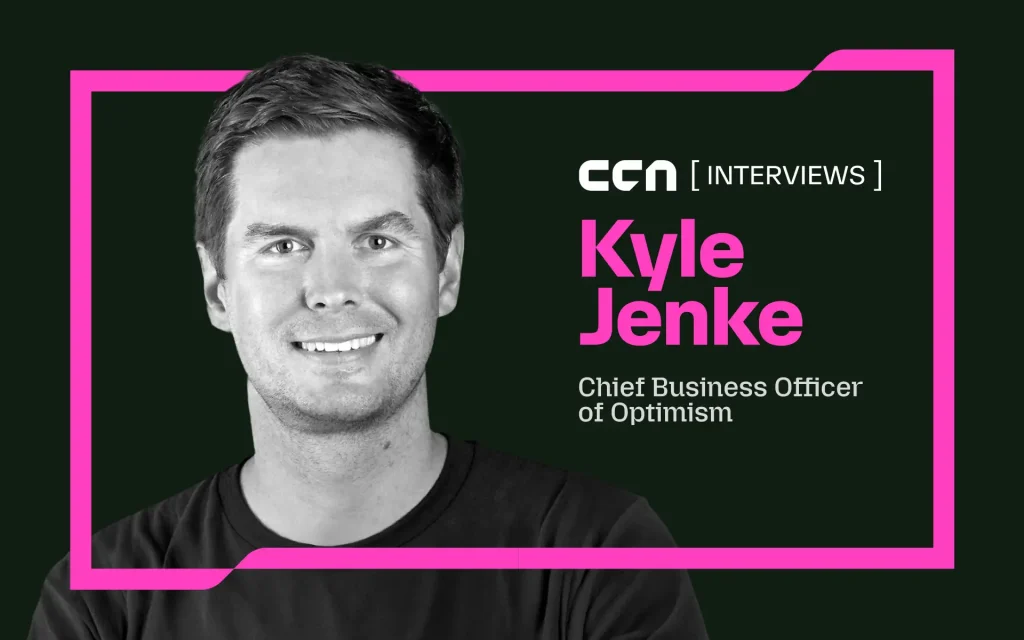
“I think we’re on that path right now. We’re just very early in that path.” | Image credit: CCN
Share
Key Takeaways
Enterprise demand is pushing blockchain adoption forward as financial institutions, fintech firms, exchanges, and payment companies compete for the same users and require customizable infrastructure.
Owning blockchain infrastructure allows companies to differentiate products, improve security, and tailor services, rather than relying on shared layer-1 networks.
Optimism focuses on onboarding enterprises and building profitable business models, rather than relying on token-driven growth.
Regulation supports industry expansion by providing clarity, reducing risk, and giving institutions the confidence to invest in blockchain infrastructure.
Blockchain adoption is entering a new phase as enterprises look beyond experimentation and toward scalable infrastructure.
Financial institutions, fintech firms, and crypto-native companies are increasingly competing for the same users, pushing demand for customizable blockchain solutions that align with regulatory frameworks.
In an interview with CCN journalist Max Moeller at Consensus 2026, Optimism Chief Business Officer Kyle Jenke said enterprise demand, infrastructure control, regulatory clarity and long-term profitability will define how blockchain technology scales across global markets.
Enterprise Demand Drives Blockchain Customization
Jenke said companies across industries are converging as they compete for the same user base.
“You have Robinhood, which is a FinTech, offering crypto, you have Coinbase, which is a crypto company offering US equities and you have Fidelity going into crypto,” he said.
This overlap is forcing companies to differentiate their products, expand across jurisdictions, strengthen their branding and refine their business models.
“And so they’re looking at how do we differentiate and how do we win,” he said.
Jenke outlined three main strategies companies use to compete:
Product differentiation: Companies develop unique features or services to stand out in a crowded market.
Regulatory or geographic expansion: Firms enter new markets or operate across jurisdictions to access different user bases and opportunities.
Marketing and branding: Companies strengthen their positioning to attract and retain users.
To achieve this, companies increasingly need control over their infrastructure.
“If you want to differentiate your product, you’re gonna need to be able to customize your infrastructure,” he said.
Jenke argued that relying on shared infrastructure limits innovation.
“You can’t do that if you’re renting infrastructure from someone else, basically deploying on an L1 chain,” he said.
Owning blockchain infrastructure allows companies to tailor features to specific use cases.
“A FinTech could customize their blockchain to say levered transactions execute first,” he said.
This level of control enables firms to build differentiated products and market them effectively.
“That’s a differentiated product in the market and it’s only possible if you’re able to customize your infrastructure,” he added.
Focus Shifts From Market Share to Enterprise Adoption
While Optimism’s OP Stack processes a significant share of crypto transactions, Jenke said the company does not focus on increasing market share alone.
“We don’t sit around thinking about how to get our percentage higher,” he said.
Instead, the focus remains on onboarding enterprises and supporting their success.
“How do we bring enterprises on chain… how do we build the best financial infrastructure for them… how do we make them successful and profitable,” he said.
Jenke added that most enterprises want exposure to Ethereum while maintaining flexibility.
“They want to be in the Ethereum ecosystem, but they want to be able to customize,” he said.
From Pilot to Production: Why Enterprise Blockchain Is Scaling
Enterprise blockchain projects have historically struggled to move beyond pilot stages. Jenke pointed to Optimism’s track record as a key differentiator.
“We have 50 chains out there that are operating in production successfully,” he said.
The company’s OP Enterprise offering combines infrastructure with operational support.
“We can run the chain for you… or you can run it with our support,” he said.
Support services include service-level agreements (SLAs), engineering resources, and security oversight.
“We’ll work alongside their engineering team… and actually help them launch the chain,” he said.
Partnerships Show Flexibility, Not Lock-In
Jenke highlighted Optimism’s relationship with Base as an example of flexibility.
“Base absolutely built on the OP Stack… and they made the decision… that they wanted to fork from the core OP Stack,” he said.
Despite that shift, the partnership continues through enterprise support.
“We do have that OP enterprise relationship with them,” he said.
Jenke argued that this flexibility is important for large institutions.
“I don’t want to be stuck with a vendor and not be able to change,” he said.
Revenue Models Take Priority Over Tokenomics
Jenke said crypto companies need to prioritize sustainable business models over token-focused strategies.
“This isn’t like a new model… build a great product, sell it to customers, grow revenue,” he said.
The focus remains on delivering value through products and services.
“We’re building… the best financial technology… and then we’re making them successful and profitable over time,” he said, adding that this is how companies have operated around the world throughout history.
Token value, he added, should follow business performance.
“The tokens are important but the most important thing is you’re building a vibrant business that’s profitable,” he said.
Regulation Provides Clarity for Growth
Jenke described regulation as a positive force for the industry.
“We think regulation is a good thing because it gives our customers and partners clarity on how to operate,” he said.
He pointed to Europe and Japan as examples where regulatory frameworks have encouraged adoption.
“Having that regulatory framework allowed BitPanda to want to make the investment to build their chain,” he said.
In the United States, he said clearer rules could unlock further institutional participation.
“They’re looking to CLARITY as something to give them confidence to really make these investments,” he said.
Global Partnerships Signal Expansion
Optimism continues to expand through global partnerships, including a recent collaboration in South Korea.
“They are building on the OP Stack… and they’re going to be launching their chain later this year,” Jenke said.
The partnership focuses on compliance and scalability in regulated markets.
“We’re really bullish and excited about this partnership,” he added.
Enterprise Adoption Defines the Next Phase
Jenke said the path forward remains clear, even if early.
“I think we’re on that path right now. We’re just very early in that path,” he said.
The strategy centers on onboarding key enterprises, building strong infrastructure, and supporting long-term success.
“If we can do those things, then I think we can be one of the best companies in crypto,” he said.
Disclaimer:
The information provided in this article is for informational purposes only. It is not intended to be, nor should it be construed as, financial advice. We do not make any warranties regarding the completeness, reliability, or accuracy of this information. All investments involve risk, and past performance does not guarantee future results. We recommend consulting a financial advisor before making any investment decisions.
Dr. Lorena Nessi is an award-winning journalist and media technology expert with 15 years of experience in digital culture and communication. Based in Oxfordshire, UK, she combines academic insight with hands-on media practice.
She holds a PhD in Communication, Sociology, and Digital Cultures, and an MA in Globalization, Identity, and Technology.
Lorena has taught at Fairleigh Dickinson University, Nottingham Trent University, and the University of Oxford. She is a former producer for the BBC in London, with additional experience creating television content in Mexico and Japan.
Her research focuses on digital cultures, social media, technology, capitalism, and the societal impact of blockchain innovation.
She has written extensively on digital media and emerging technologies, with her work featured in both academic and media platforms. Her Web3 expertise explores how blockchain technologies shape culture, economics, and decentralized systems.
Outside of work, Lorena enjoys reading science fiction, playing strategic board games, traveling, and chasing adventures that get her heart racing. A perfect day ends with a relaxing spa and a good family meal.
Max Moeller is a Chicago‑based writer and video editor passionate about games, tech, and crypto. Whether it’s crafting clear, insightful articles or piecing together engaging video retrospectives, he’s driven by curiosity and takes pride in keeping things human. Since 2017, Max has been published in a variety of notable crypto magazines.


 Easy
Easy