Crypto card spending has surged 500% to $600M monthly. Discover how stablecoins like USDC and USDT are driving crypto payments growth. | Credit: CCN.
Share
Key Takeaways
Crypto card spending surged 500% to $600 million monthly by 2026.
Stablecoins bridge crypto volatility with everyday TradFi spending.
Card volumes rise in lockstep with booming USDC/USDT adoption.
Crypto has long promised to change how people spend money. Now, it finally looks like it might be happening.
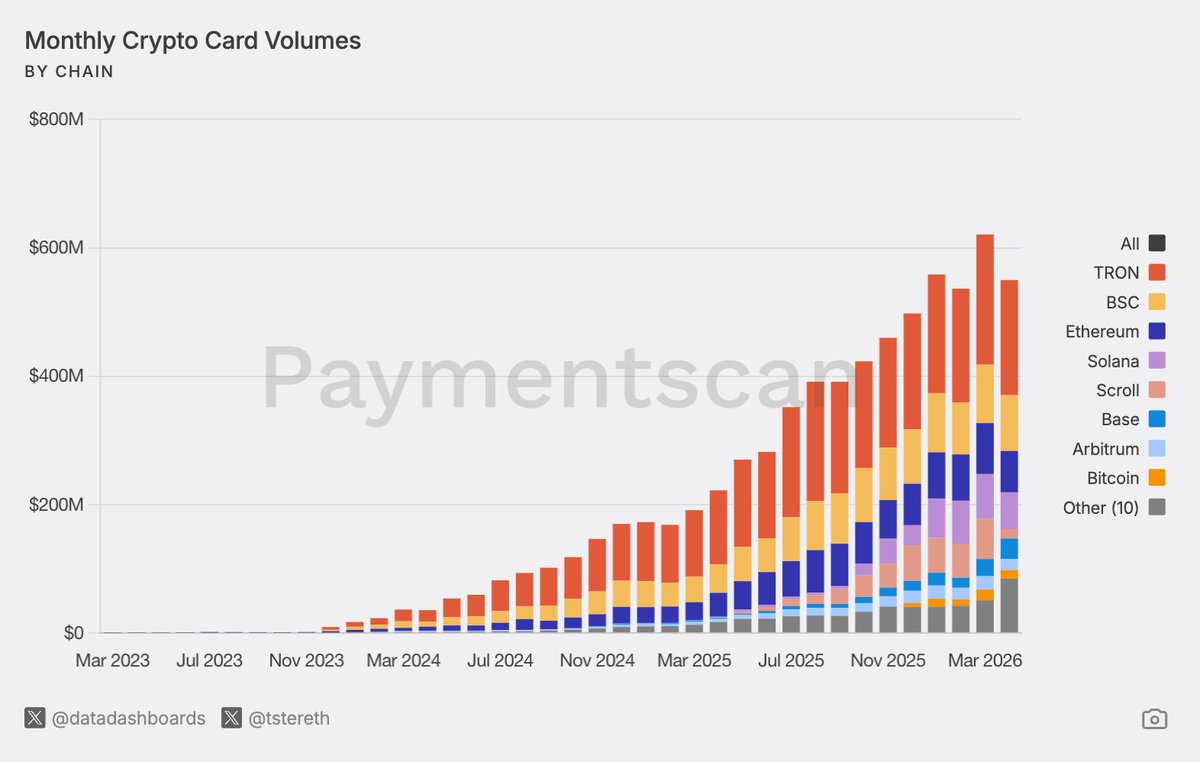
Crypto card usage has surged more than 500% since September 2024, with monthly volumes reaching roughly $600 million as of April 2026.
What was once a niche tool for early adopters is quickly becoming a practical payments option, driven by one key shift: the rise of stablecoins.
Sponsored
Disclosure
We sometimes use affiliate links in our content, when clicking on those we might receive a commission at no extra cost to you. By using this website you agree to our terms and conditions and privacy policy.
In early 2023, monthly crypto card volumes hovered around $100 million.
By late 2025, some reports showed volumes exceeding $1.5 billion, while Visa-backed programs alone recorded a 525% year-over-year increase in net spending—from $14.6 million in January 2025 to $91.3 million by December.
Today, volumes have stabilized around $600 million per month, with occasional spikes above that level. The pattern suggests not just experimentation, but sustained usage.
Rather than relying on traditional banking rails, the company has partnered directly with crypto-native issuers, enabling faster, more cost-efficient card launches that settle in stablecoins.
Programs such as Jupiter Global are accelerating adoption further, offering cashback incentives between 4% and 10%.
In April 2026 alone, Jupiter reported a 660% month-over-month increase in volume.
Users aren’t just testing the waters anymore; they’re spending real money, billions annually, because the experience finally feels seamless.
Vugar Usi Zade, CEO of MEXC, highlighted this to CCN,
“The crypto industry has spent a decade enabling people to hold digital assets, but only assets that can be freely used are truly valuable. Expanding real-world use cases is the next major trend, and this is translating to the issuance of more crypto cards.”
Stablecoins Bridge the Gap
At the center of this hype are stablecoins. Especially, USDC and USDT, which have become the unsung heroes.
Unlike Bitcoin or Ethereum, which swing wildly in price, these dollar-pegged tokens hold steady. That stability makes them perfect for spending.
Here’s how it works in practice: Users hold USDC in their crypto wallet and link it to a Visa card through a partner like EtherFi, Cipher, or emerging players.
When the user taps to pay, the system converts (or settles) instantly on the backend, often using stablecoin rails, while the merchant sees a normal fiat transaction.
No gas fees at checkout. No waiting for bank transfers. Just a card in your Apple Pay or physical wallet that spends crypto without the hassle.
This is the gap crypto struggled with for years.
Holding digital assets was easy. Spending them was not.
Stablecoins have changed that by turning crypto balances into usable money.
And the numbers back it up: stablecoin transaction volumes hit $33 trillion in 2025 alone, rivaling (and in some cases surpassing) traditional card networks like Visa’s annual totals.
This rapid expansion has also been fueled by improving regulatory clarity.
As Zade told CCN:
“Stablecoin’s growth saw a significant upsurge around March this year, riding on the signing of the GENIUS Act into law,” highlighting how regulatory backing is accelerating adoption across the ecosystem.
“With regulatory backing for the crypto industry, blockchain protocols are scaling up to enable easy deployment of stablecoins. To cap this, fintech giants are also making their way into the sector to tap into the value chain,” he added.
Parallel Rise: Crypto Card Spending and Stablecoin Adoption
The rise in crypto card spending and stablecoin adoption has not happened in isolation. The two trends are tightly linked.
Visa has leaned heavily into this model. The company is expanding stablecoin-linked cards to more than 100 countries, experimenting with real-time blockchain settlement, and piloting USDC-based systems in the United States.
Other networks are beginning to follow, but Visa’s early lead shows in the data, where it continues to control the vast majority of transaction volume.
Incentives also play a role. Cashback programs (such as Jupiter’s 4% to 10% rewards) encourage users to treat these cards as primary spending tools rather than occasional alternatives.
The growth is significant, but not without challenges.
Regulatory clarity still varies widely across regions, and not all card programs offer full non-custodial control.
Infrastructure remains uneven, and compliance requirements continue to evolve.
Even so, the trajectory is clear.
With stablecoin volumes still rising and more issuers building directly on-chain, analysts expect crypto card spending to continue expanding.
Some projections suggest annualized volumes could reach $30 billion or more by the end of 2026.
This shift is also redefining where competition happens. As Zade put it:
“The next battleground for stablecoins is not on-chain, but in everyone’s wallet,” pointing to a future where usability and real-world spending matter more than infrastructure alone.
Crypto payments are no longer theoretical. They are becoming routine—one transaction at a time.
Prashant Jha is a seasoned crypto journalist based in Delhi, India, with a Bachelor’s Degree in Computer Science Engineering. Passionate about the evolving world of blockchain and cryptocurrencies, he has been a dedicated voice in the industry since 2018. Prashant’s expertise lies in regulatory reporting, where he unravels complex legal and financial developments with clarity and precision. Before joining CCN in 2024, he honed his craft at Cointelegraph, establishing himself as a trusted name in crypto journalism.
His coverage spans major industry events, including the high-profile collapses of FTX, Three Arrows Capital (3AC), and LUNA, offering readers insightful analyses of their regulatory and market implications. Prashant’s technical background enables him to bridge the gap between intricate blockchain technology and its real-world applications, making his work accessible to novices and experts.
Beyond his professional pursuits, Prashant is an avid music enthusiast, often exploring diverse genres to unwind. A sports lover, he has a particular passion for cricket and frequently engages in discussions about the game. His multifaceted interests and sharp journalistic instincts make him a valuable contributor to CCN, where he continues shaping the crypto landscape's narrative.