DEX vs DeFi Aggregators: Which Offers Better Crypto Prices?
Share
Key Takeaways
Whether a DEX or an aggregator offers better pricing depends on trade size, liquidity depth, and network conditions at the time of execution.
Liquidity in DeFi is spread across multiple exchanges, pools, and chains. Aggregators improve pricing by combining this fragmented liquidity into a single execution path.
Their advantage comes from splitting trades and routing across multiple pools, which reduces slippage and price impact, especially for larger trades.
Small trades often perform just as well on a single DEX, while larger trades benefit more from aggregation due to reduced price movement across multiple pools.
The question of whether decentralized exchanges or DeFi aggregators offer better crypto prices is not straightforward. Both operate within the same decentralized infrastructure, yet they approach liquidity, routing, and execution differently.
As decentralized finance matured, liquidity became fragmented across multiple protocols, chains, and pools. This fragmentation changed how prices form and made aggregation increasingly relevant.
To understand which approach typically produces better pricing, it is necessary to examine how decentralized markets work, how liquidity is distributed, and how trade execution affects price outcomes.
How Pricing Works in Decentralized Finance
Unlike traditional financial markets, decentralized exchanges rely primarily on automated market makers rather than order books. These systems allow users to trade against liquidity pools instead of matching with another trader. Liquidity providers deposit tokens into pools, and algorithmic formulas determine pricing based on pool balances.
When a trade occurs, the pool balance changes. That change directly affects price. This mechanism creates price impact, which becomes more significant when:
Liquidity is shallow
Trade size is large
Token pairs are less liquid
Academic research into decentralized exchange liquidity confirms that market depth and price spreads vary across pools and influence execution quality for fixed trade sizes.
Because liquidity exists across many exchanges and chains, the same token may trade at slightly different prices at the same time. This fragmentation creates arbitrage opportunities and execution differences.
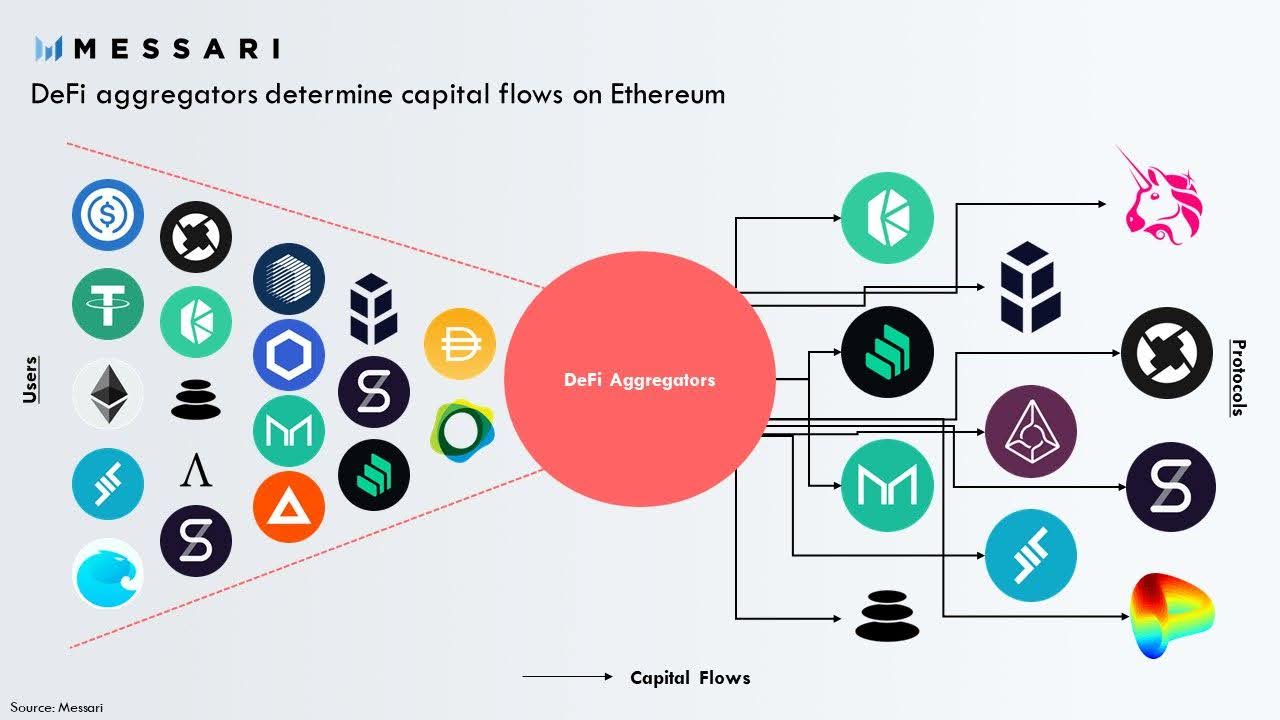
DeFi aggregators determine capital flows on Ethereum. | Credit: Messari
Research into arbitrage between decentralized markets shows measurable price deviations between venues. One empirical study observed cumulative arbitrage opportunities of approximately $104,960 over a short period for a single token pair, demonstrating that prices across decentralized venues do not remain perfectly aligned.
This fragmented price discovery is the reason aggregators emerged.
What a DEX Actually Does
A decentralized exchange offers direct access to liquidity pools. When a user swaps tokens, the trade executes within that platform’s liquidity.
This creates a simple execution model:
One exchange
One liquidity environment
One pricing source
The simplicity of this model offers advantages such as transparency and predictable execution. However, it also introduces limitations. If better liquidity exists elsewhere, a direct DEX trade may not capture it.
As decentralized finance expanded, liquidity spread across multiple exchanges, layer two networks, and chains. Research into DeFi execution shows that liquidity fragmentation increases slippage and execution costs when traders rely on a single venue.
This fragmentation is the core limitation of relying on one DEX.
What DeFi Aggregators Do Differently
DeFi aggregators act as routing engines that search multiple decentralized exchanges simultaneously. They analyze available liquidity and determine the best execution path.
Modern aggregator systems perform three core tasks:
Discover liquidity across exchanges
Calculate optimal routing
Execute split orders
These systems decide how much of a trade should be routed through each pool and in what order. This process is not simply price comparison. It involves evaluating trade size, slippage, and fees simultaneously.
Because automated market makers sell tokens progressively at worse prices during large trades, aggregators reduce price impact by distributing trades across multiple pools.
For example, if a large trade is executed in a single pool, the price moves significantly. If that trade is divided across multiple pools, price movement is reduced. This often results in better execution pricing.
Recent research also confirms that aggregators can improve execution outcomes. Academic evidence indicates that DEX aggregators provide price improvements for traders by combining liquidity across venues.
Aspect
DEX (Decentralized Exchange)
DeFi Aggregator
Core Function
Executes trades using its own liquidity pools
Routes trades across multiple DEXs to find best execution
Liquidity Access
Single exchange liquidity
Combined liquidity from multiple exchanges
Execution Model
One trade → one pool (or internal pools)
One trade → split across multiple pools/routes
Price Source
Based on internal pool pricing only
Based on aggregated prices across platforms
Routing Logic
Fixed and simple
Dynamic and optimized in real time
Slippage Handling
Higher for large trades due to single pool impact
Lower due to trade splitting across pools
Trade Efficiency
Efficient for small trades
More efficient for large or complex trades
Gas Costs
Lower due to simpler transactions
Higher due to multi route execution
Transparency
Direct and easy to track
More complex but optimized behind the scenes
Limitation
Cannot access better prices outside its ecosystem
May incur higher gas and routing complexity
Are DeFi Aggregators and DEX Aggregators the Same?
In most contexts, DeFi aggregators and DEX aggregators refer to the same category of tools. Both describe protocols that scan multiple decentralized exchanges and route trades to achieve better execution.
The term DEX aggregator is more precise. It specifically refers to systems that aggregate liquidity from decentralized exchanges for token swaps.
The broader term DeFi aggregator can sometimes include other types of aggregation, such as yield aggregation, lending rate comparison, or portfolio optimization across protocols. However, in trading discussions, it is generally used interchangeably with DEX aggregator.
In practical terms, when discussing pricing, routing, and slippage, both terms point to the same function: optimizing trade execution by accessing multiple liquidity sources instead of relying on a single exchange.
Why Aggregators Often Deliver Better Execution Prices in Fragmented Liquidity Markets
A consistent body of research and market analysis shows that DeFi aggregators frequently deliver better execution prices than single decentralized exchanges, particularly in fragmented liquidity environments. This advantage stems from how aggregators access, combine, and route liquidity rather than from any fundamental change in pricing models.
Academic research provides quantitative backing. A 2025 study on token routing shows that splitting trades across multiple routes reduces slippage and increases trader profitability compared to single route execution. This is critical evidence because it demonstrates that the core mechanism used by aggregators, multi route execution, leads to measurable economic gains rather than just theoretical improvements.
Evidence from DeFi infrastructure and routing models further explains why this happens. In automated market makers, prices worsen as more of a trade is executed within a single pool. This means execution cost increases non linearly with trade size. Routing research shows that aggregators counter this by distributing trades across pools so that no single pool absorbs the full price impact. Instead of pushing one pool deep into unfavorable pricing, the trade is spread across multiple liquidity sources, each experiencing smaller shifts.
Empirical research on decentralized exchanges confirms that liquidity is not concentrated in a single optimal pool. For example, analysis of Uniswap data shows that a large share of liquidity sits in pools that do not process proportional trading volume. One study finds that high fee pools can hold over half of liquidity but execute a much smaller share of trades, indicating that liquidity is unevenly distributed and not efficiently utilized.
This imbalance has direct consequences for pricing. When liquidity is fragmented across pools that are not equally active, traders interacting with a single pool face higher price impact than necessary. In other words, better pricing may exist elsewhere in the system but remains inaccessible without routing across pools.
Execution level guidance from DEX environments reinforces this. Slippage is identified as one of the main costs in decentralized trading, particularly in low liquidity or volatile conditions. Practical trading frameworks explicitly recommend using aggregators to route orders across multiple pools to minimize slippage and improve execution efficiency. This reflects observed behavior in live markets, where routing across pools consistently produces better outcomes than relying on a single liquidity source.
From a market structure perspective, fragmentation acts as what some research calls an “execution tax.” Liquidity split across chains and venues widens slippage and reduces efficiency for individual trades.
This is where aggregators become relevant. Their role is not to create better prices independently, but to reconnect fragmented liquidity into a single execution layer. By routing trades across multiple pools, they allow traders to access the combined depth of the market rather than a single slice of it.
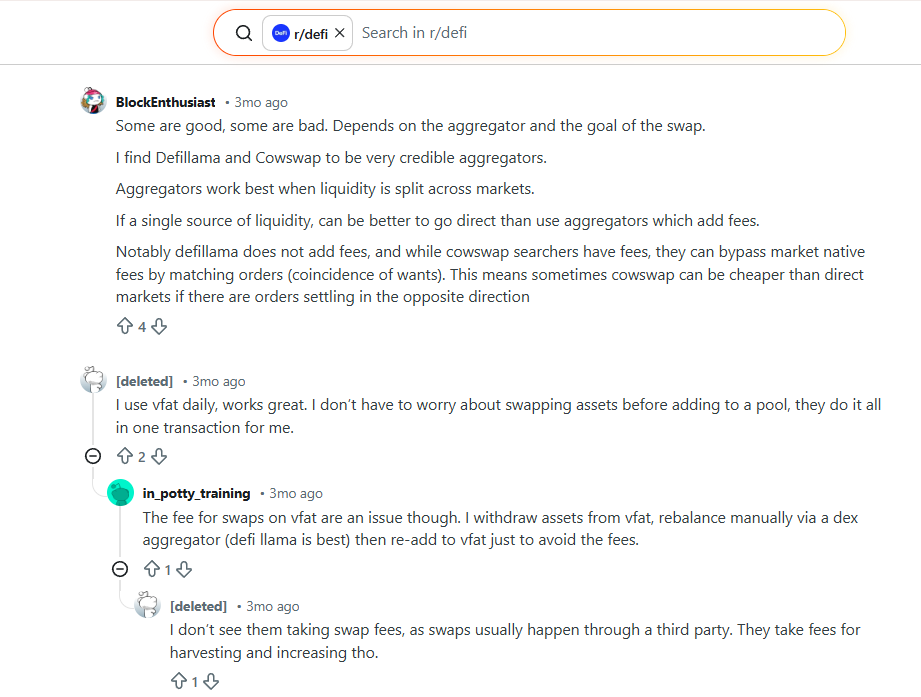
Aggregators reduce slippage by splitting trades across multiple pools. | Source: Reddit
Additional academic modeling of decentralized exchanges shows that liquidity distribution across pools directly affects price dynamics and arbitrage opportunities. When liquidity is dispersed, price differences emerge across pools, and execution outcomes depend heavily on which pool is used.
Finally, simulation based and routing optimization studies show that aggregators behave like “perfect traders” that always search for the best distribution of trades across pools. By accounting for liquidity depth, fees, and slippage simultaneously, they direct volume toward higher liquidity pools where price impact is lower. This dynamic routing is what allows aggregators to systematically outperform static, single pool execution.
Trade Size Plays a Major Role
Trade size is one of the most decisive factors in determining whether a direct decentralized exchange or an aggregator produces better pricing.
In smaller transactions, the difference is often negligible. When a trade represents only a tiny fraction of a pool’s liquidity, price impact remains low, and slippage is minimal. In these situations, executing directly on a DEX can already provide near optimal pricing, since there is little inefficiency for an aggregator to correct.
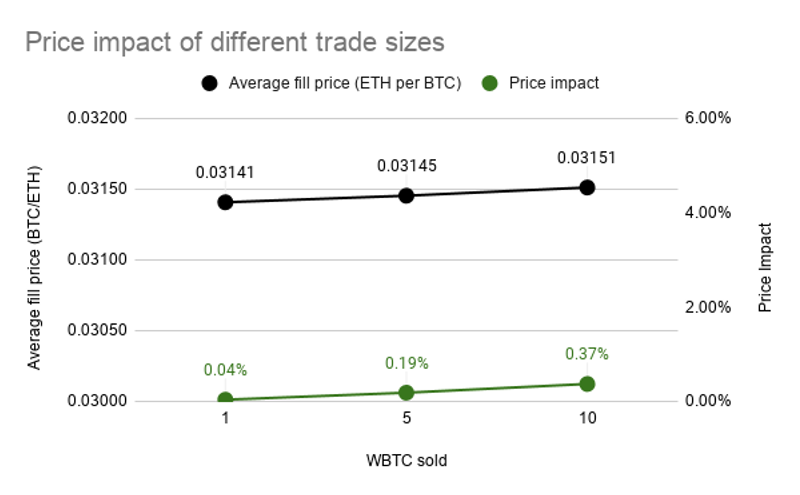
As trade size increases, however, the dynamics change significantly. Automated market makers adjust prices continuously as trades move through a pool. Larger trades push the price further along the curve, increasing execution cost at a non linear rate.
Price impact of different trade sizes. | Source: Paradigm
This is where aggregators begin to show clear advantages. By splitting a large order into smaller portions and routing them across multiple pools, they reduce the overall price movement experienced during execution. Instead of one pool absorbing the full impact, several pools share it, leading to a better average price.
This is why the pricing advantage of aggregators tends to scale with trade size. The larger the order relative to available liquidity, the more valuable routing and order splitting become.
Gas Fees and Routing Tradeoffs
While aggregators can improve pricing, they also introduce additional complexity. Each route or pool interaction requires smart contract execution, which increases gas usage. A simple swap on a single DEX typically involves fewer steps, while an aggregated trade may involve multiple interactions within the same transaction.
This creates a practical tradeoff between execution quality and transaction cost. For smaller trades, the gas overhead can outweigh any marginal price improvement gained through routing. In such cases, a direct swap may result in a better net outcome. For larger trades, the reduction in slippage often compensates for the higher gas cost, making aggregation more efficient overall.
Because of this balance, traders often evaluate both price impact and transaction fees rather than focusing on quoted price alone.
Liquidity Fragmentation Is Increasing
The broader structure of DeFi also influences this comparison. Liquidity is no longer concentrated in a few pools or platforms. It is distributed across multiple decentralized exchanges, layer two networks, and different pool configurations. This fragmentation means that no single venue consistently offers the best execution.
As liquidity spreads, relying on one DEX becomes less efficient, especially for larger or less liquid trades. Aggregators address this by connecting these separate liquidity sources into a single execution path. At the same time, major DEXs continue to deepen liquidity in key trading pairs, which ensures that direct swaps remain competitive in certain scenarios.
When Each Approach Tends to Perform Better
Direct DEX execution often performs well when liquidity is deep and concentrated, trade size is small, and minimizing gas costs is important. In these cases, the simplicity of a single pool swap can outweigh the benefits of routing.
Aggregators tend to perform better when liquidity is fragmented, trade size is large, or tokens are less liquid. In these environments, accessing multiple pools and distributing trades leads to lower slippage and improved execution quality.
Taken together, these patterns show that pricing efficiency in DeFi is not fixed. It depends on how trade size interacts with liquidity distribution and execution costs at the moment of the swap.
What is the main difference between a DEX and a DeFi aggregator?
A decentralized exchange executes trades using its own liquidity pools, while an aggregator searches across multiple DEXs and routes trades through the most efficient combination of pools. The difference lies in access to liquidity rather than pricing models.
Do aggregators always give better prices?
No. Aggregators often provide better pricing for large trades or in fragmented markets, but for small trades or highly liquid pairs, a direct DEX swap may offer similar or even better net results due to lower gas costs.
Why does trade size affect pricing so much in DeFi?
In automated market makers, prices change as trades move through a pool. Larger trades shift prices more significantly, increasing slippage. Aggregators reduce this effect by splitting trades across multiple pools, which improves the average execution price.
When should someone use a DEX instead of an aggregator?
A direct DEX may be preferable when trading small amounts, when liquidity is already deep in a single pool, or when minimizing transaction costs is a priority. Aggregators are generally more useful for larger trades or less liquid tokens.
Disclaimer:
The information provided in this article is for informational purposes only. It is not intended to be, nor should it be construed as, financial advice. We do not make any warranties regarding the completeness, reliability, or accuracy of this information. All investments involve risk, and past performance does not guarantee future results. We recommend consulting a financial advisor before making any investment decisions.
She is a fintech writer based in Canada with an academic background in psychology and project management. She has previously contributed to crypto media platforms, including Cointelegraph. Her professional experience includes work as a relationship manager in the telecommunications industry, and her writing since 2020 has focused on digital assets, blockchain technology, and artificial intelligence, with attention to their interaction with traditional finance.


 Easy
Easy