Key Takeaways
- As AI agents replace user interfaces, APIs are becoming the core infrastructure layer for financial services.
- Most tokenized assets remain backed by fiat held within regulated brokerage and custody systems.
- Regulators will always require human responsibility, limiting full autonomy of AI agents.
- Cross-border payments and access to capital markets are the biggest drivers of on-chain adoption.
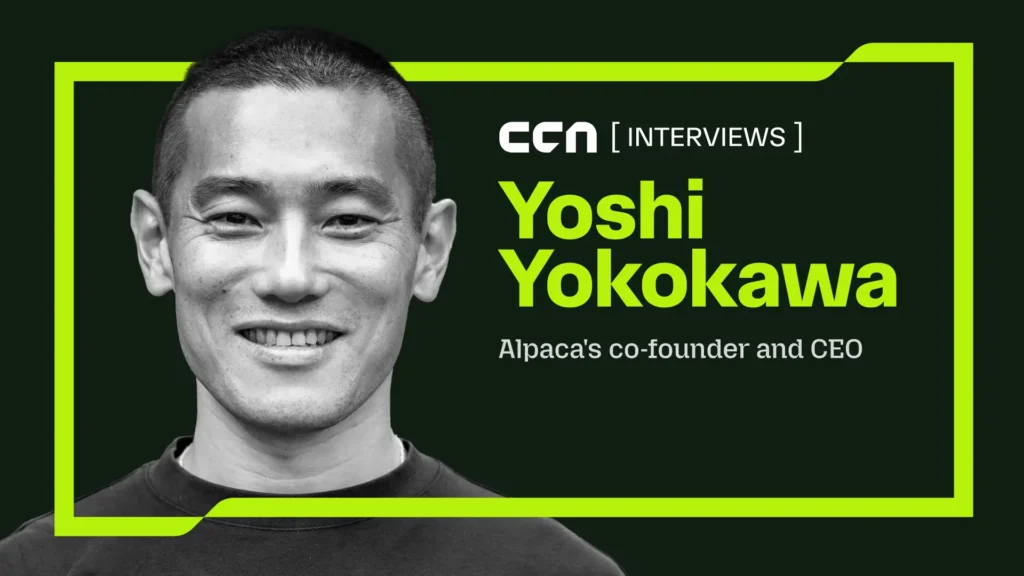
At DC Summit 2026 in Washington, D.C., one of the key themes dominating conversations was the convergence of traditional finance, blockchain infrastructure, and artificial intelligence. Against this backdrop, Crypto Citizen Netwtork (CCN) Senior Editor Dr. Guneet Kaur spoke with Alpaca co-founder and CEO Yoshi Yokokawa about how these forces are reshaping global markets.
In a wide-ranging discussion, Yokokawa shared his perspective on the evolution of brokerage infrastructure, the real role of tokenization, and why APIs, not user interfaces, are becoming the core layer of modern financial systems. He also addressed the growing influence of AI agents, the limits of borderless investing, and the practical realities that continue to anchor innovation to traditional finance.
His message was clear: while the financial system is steadily moving on-chain, the transition will not be disruptive in the way many expect, it will be incremental, infrastructure-driven, and deeply rooted in existing regulatory and operational frameworks.
How Tokenized Assets Still Depend on Traditional Brokerage Infrastructure
While tokenized assets are gaining traction, Yokokawa emphasized that today’s models remain deeply tied to traditional finance (TradFi). Most tokenized assets are still backed 1:1 by fiat collateral held within regulated brokerage and clearing systems.
“That continued role of brokerage infrastructure doesn’t go away,” he said. “That’s a role we are playing.”
Rather than replacing legacy systems, tokenization is layering on top of them, at least for now.
APIs vs DeFi: Why They Serve Different Roles in Financial Infrastructure
Yokokawa pushed back on the idea that API-driven platforms like Alpaca are in direct competition with decentralized finance (DeFi).
He framed APIs as the backbone of an emerging “AI-first, agent-first” financial system. As AI agents increasingly interact with financial services, the importance of machine-readable interfaces, APIs, will grow significantly.
“Agents don’t use user interfaces, they use APIs,” he noted. “So their importance goes up with AI.”
By contrast, DeFi represents a trustless infrastructure layer. While powerful, it comes with trade-offs around accountability and real-world usability. In Yokokawa’s view, the two serve fundamentally different purposes and will likely coexist.
AI in Trading and Finance: Why Accountability Matters More Than Ethics
On AI, Yokokawa reframed the conversation from ethics to accountability, especially in a regulated industry like finance.
“Regulators care about customer protection. When something goes wrong, someone has to be accountable, and that won’t be the AI,” he said.
He expects humans to remain firmly in the loop, even in AI-driven systems. The key challenge will be managing permissions and controls, ensuring AI agents operate within clearly defined boundaries.
As AI adoption accelerates, Yokokawa predicts a near-term focus on governance and safeguards, followed by rapid improvements in AI-powered financial products.
Why Borderless Blockchain Investing Faces Regulatory Challenges
Despite crypto’s promise of borderless finance, Yokokawa was pragmatic about the challenges. Differing national regulations and priorities make true global interoperability difficult.
“Unless there’s one global regulator, which won’t happen, it will always be complex,” he said.
Incremental cooperation, such as recent coordination between the SEC and CFTC, could help reduce friction, but fragmentation is likely to persist.
The Shift to On-Chain Finance: Biggest Opportunity for Developers
Still, Yokokawa sees a massive opportunity in the long-term migration of financial systems to blockchain infrastructure.
He compared the shift to earlier transitions, from paper-based systems to digital platforms, and described on-chain finance as the next natural evolution.
“The entire financial system is moving on chain. It will take time, but that direction is clear.”
For developers, this represents a generational opportunity to build tools and infrastructure that support this transformation.
Key Lessons from Traditional Finance for Web3 Builders
Despite the innovation in Web3, Yokokawa stressed that foundational lessons from traditional finance remain essential.
Rules around customer fund segregation, market integrity, and compliance exist for a reason, and human behavior hasn’t changed.
“Regardless of Web3 or TradFi, human nature is the same. We have to respect the frameworks built over history.”
Alpaca’s Strategy: Bridging Traditional Finance and On-Chain Systems
Looking ahead, Alpaca’s strategy is to bridge traditional and on-chain systems by connecting fiat assets through APIs, enabling easier tokenization.
The company’s long-term vision remains anchored in its mission: opening financial services to everyone globally. But the path forward involves doubling down on infrastructure, especially within TradFi, to accelerate the transition.
“We need to build more in TradFi to lead in on-chain finance,” Yokokawa said.
What Will Drive Mainstream Adoption of On-Chain Finance and AI in Trading
For mainstream adoption, Yokokawa believes the industry must focus less on ideology and more on solving real problems, particularly cross-border payments and access to capital markets.
“If there’s no real pain, people won’t adopt,” he said. “Cross-border access is where we’re seeing real traction.”
At the same time, as AI agents become more prevalent, APIs will become even more central, quietly powering the next generation of financial interactions behind the scenes.
The information provided in this article is for informational purposes only. It is not intended to be, nor should it be construed as, financial advice. We do not make any warranties regarding the completeness, reliability, or accuracy of this information. All investments involve risk, and past performance does not guarantee future results. We recommend consulting a financial advisor before making any investment decisions.

Giuseppe Ciccomascolo began his career as an investigative journalist in Italy, where he contributed to both local and national newspapers, focusing on various financial sectors.
Upon relocating to London, he worked as an analyst for Fitch's CapitalStructure and later as a Senior Reporter for Alliance News. In 2017, Giuseppe transitioned to covering cryptocurrency-related news, producing documentaries and articles on Bitcoin and other emerging digital currencies. He also played a pivotal role in establishing the academy for a cryptocurrency exchange website. Crypto remained his primary area of interest throughout his tenure as a writer for ThirdFloor.


 Easy
Easy