Key Takeaways
- SEC and CFTC are presenting a united front on crypto rules.
- They agree on future direction, but differ on the past.
- The shift is still early, and much depends on what comes next.
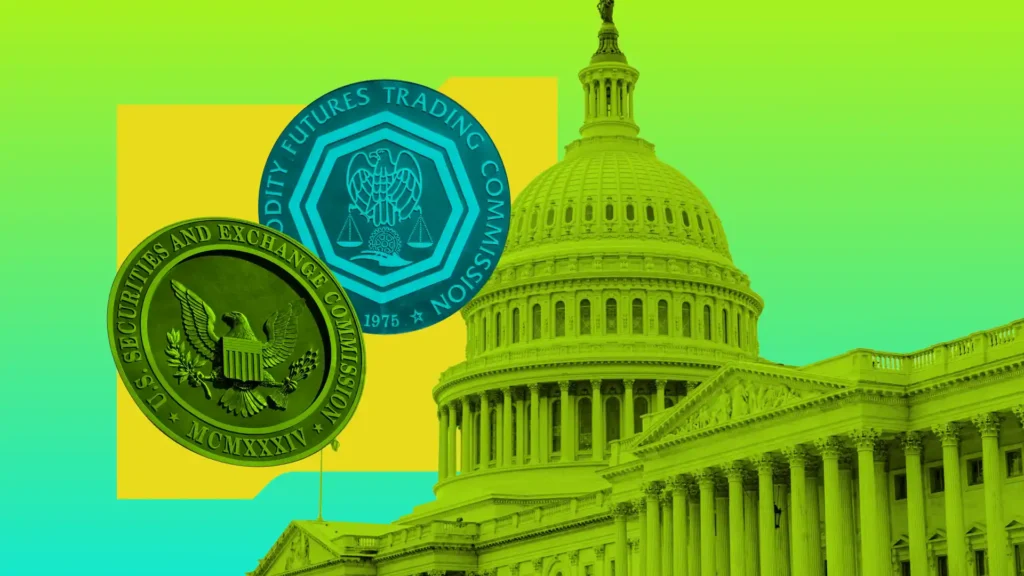
U.S. financial regulators signaled a shift toward clearer and more coordinated oversight of crypto on Monday, as the heads of the Securities and Exchange Commission (SEC) and Commodity Futures Trading Commission (CFTC) outlined new frameworks while offering differing views on past policy.
SEC And CFTC Crypto ‘Harmony’
Speaking at the DC Blockchain Summit, SEC Chair Paul Atkins and CFTC Chair Michael Selig cast their new approach as an attempt to end years of friction between the two agencies.
Speaking in a joint keynote, the two legislators said overlapping jurisdiction had left products stalled and firms facing inconsistent treatment.
Atkins described the relationship between the agencies as “two fortresses with the no man’s land in between and crossfire between the fortresses,” adding that the no man’s land had been “riddled with the dead carcasses of the financial products” that never made it to market.
“We’re out to change that,” Atkins said, adding that the SEC was now “working closely with CFTC to harmonize definitions” so that “people do have clarity, and then investors are not harmed by the big gaps.”
Selig struck a similarly conciliatory tone, saying the agencies had “for too long” been unable to work together on “basic things like definitions” and interpretations.
“We’ve got to cooperate. We’ve got to figure out how to work better together,” Selig said, pointing to enforcement, surveillance and closer staff coordination as areas for joint work.
He added that the agencies had already agreed on a common taxonomy for digital assets.
“That’s harmonization,” Selig said. “I don’t know when that’s happened before.”
Selig said the new memorandum of understanding was “just beginning,” and described the effort as a broader push to reduce duplication for firms overseen by both agencies.
He said the new understanding would allow both agencies to apply the “minimum effective dose of regulation.”
Regulators Align on Rules
Atkins said in a previous solo keynote that the agency is moving to resolve longstanding uncertainty over how securities laws apply to digital assets.
“The SEC’s persistent failure to provide clarity on this question is over,” Atkins said.
Selig, speaking in a keynote before him, emphasized broader changes in financial systems driven by blockchain technology, calling the shift toward decentralized systems “profound.”
Atkins said the SEC’s new approach would narrow its focus to crypto assets that fall clearly within its remit.
“We’re not the Securities and everything Commission,” he said.
The SEC is introducing a “token taxonomy and investment contract interpretation” that defines categories of crypto assets not considered securities, including “digital commodities,” “digital collectibles,” and “payment stable coins.”
Only “digital securities,” or tokenized traditional assets, would remain under securities laws.
Differences in Past Policy
While both regulators agreed on the need for clearer rules, they diverged in how they characterized past U.S. policy toward crypto.
Selig delivered a pointed critique of earlier regulatory approaches, arguing that enforcement-led actions had harmed innovation.
“For decades, we’ve seen regulatory agencies weaponized against innovative sectors like crypto, regulating through enforcement and driving American builders overseas,” he said.
He added that such policies had contributed to a broader loss of confidence in financial institutions.
Atkins, by contrast, framed the issue as one of regulatory uncertainty rather than overreach.
“For over a decade, market participants have operated without clear guidance on a fundamental question,” he said.
“It’s way past time for us to stop diagnosing the problem and start delivering the solution,” he added.
New SEC Framework
Atkins said the SEC’s new interpretation also clarifies when crypto assets may fall outside securities laws, particularly after an investment contract has ended.
“A key tenet of our interpretation is that the project team clearly disclose the representations or promises that they make,” he said.
He added that the SEC is considering additional measures, including exemptions and safe harbors, to support capital raising by crypto projects.
Such proposals could give developers a “regulatory runway” of several years to build and scale projects while meeting disclosure requirements.
Blockchain and the Future of Trust
Selig framed decentralized technologies as a response to declining trust in traditional systems.
“Clearly something needs to be done to rebuild our faith in the system,” he said.
He described decentralized finance as “democratization of finance, where trust emerges from verifiable code and consensus, rather than opaque institutions.”
Selig also highlighted prediction markets as tools for information discovery, calling them “a forum for decentralized truth” where “prices, not political biases, signal the likelihood of a future outcome.”
What Comes Next For Crypto Under SEC/CFTC?
Both regulators said further work lies ahead, including rulemaking, industry consultation and potential congressional action.
“Only Congress can ensure that regulation in this area is future proofed through comprehensive market structure legislation,” Atkins said.
He added that the SEC expects to release proposed rules for public comment in the coming weeks.
Selig said regulators must strike the right balance between innovation and oversight as financial markets evolve.
“Our role as regulators is not to resist that shift,” he said, “but to provide a balanced framework for this shift to flourish.”
Top Trending Crypto Articles

Kurt Robson is a London-based reporter at CCN, specialising in the fast-moving worlds of crypto and emerging technology. He began his career covering local news in Cornwall after graduating from Falmouth University with First Class Honours in Journalism. There, he cut his teeth on everything from council meetings to missing swans.
He quickly rose through the ranks to become a frontline journalist at several of the UK’s leading national newspapers. Over the years, he has interviewed musicians and celebrities, reported from courtrooms and crime scenes, and secured multiple front-page exclusives.
Following the upheaval of the COVID-19 pandemic, Kurt shifted his focus to technology journalism—just ahead of the AI boom. With a natural curiosity and a trained eye for emerging trends, he has found a new rhythm in reporting on innovation.
At CCN, Kurt's work focuses on the cutting edge of crypto, blockchain, AI, and the evolving digital world. Drawing on his background in people-first reporting and his deep interest in disruptive tech, Kurt delivers stories that are insightful, entertaining, and human-centric.