(Right) Jonathan Steinberg, Founder and CEO, WisdomTree Investments | (Inner Right) Amy Oldenburg, Head of Digital Asset Strategy, Morgan Stanley | (Inner Left) Teddy Fusaro, President, Bitwise Asset Management | Source: CCN
Share
Key Takeaways
Bitwise President Teddy Fusaro said blockchain technology is “10x better” than existing financial infrastructure.
But adoption is still in early stages, he said.
It comes after Bitwise CIO Matt Hougan said Bitcoin could reach $1 million.
Bitwise President Teddy Fusaro said on Tuesday that blockchain technology is “10x better” than the current financial system, arguing that decades-old infrastructure is due for a major upgrade.
Try Our Recommended Crypto Exchanges
Sponsored
Disclosure
We sometimes use affiliate links in our content, when clicking on those we might receive a commission at no extra cost to you. By using this website you agree to our terms and conditions and privacy policy.
Speaking at the DC Blockchain Summit, Fusaro said existing financial rails were built “50 years ago” and are no longer fit for purpose in a digital economy.
“The financial infrastructure that we have was built 50 years ago. It’s old. It needs to be upgraded,” he said, highlighting comments from former CFTC Chairman Chris Giancarlo on stage earlier.
“In our view, the blockchain-related technologies are the upgrade that we need.”
Fusaro, talking on stage in a keynote titled “ETFs Were Step One: What Comes Next,” said investors should distinguish between crypto assets and the underlying technology, which he described as fundamentally more efficient.
“There are actually two things going on here,” he said.
“There’s the investment in the assets … and then there’s the technology itself. They’re related, of course, but they’re different.”
He pointed to developments such as tokenized money market funds, 24/7 trading and near-instant settlement as evidence of blockchain’s advantages.
“There’s no question in my mind that the technology … is better,” Fusaro said.
“And it’s not just a little bit better, it’s many times better. It’s probably 10x better than what we have now.”
Adoption Is Early
While the technological case is clear, Fusaro said adoption is still in its early stages.
“It’s hard to predict how quickly that will roll out,” he said.
On the investment side, he added that access to crypto exposure through mainstream financial platforms only began to expand meaningfully in late 2025.
“It was really not until late 2025 that [major advisory platforms] started to make products available … so that their financial advisors could put it into client accounts,” Fusaro said, noting that asset allocation to crypto remains “really early.”
He compared the current stage of crypto markets to the early days of gold exchange-traded funds, suggesting there is significant room for growth.
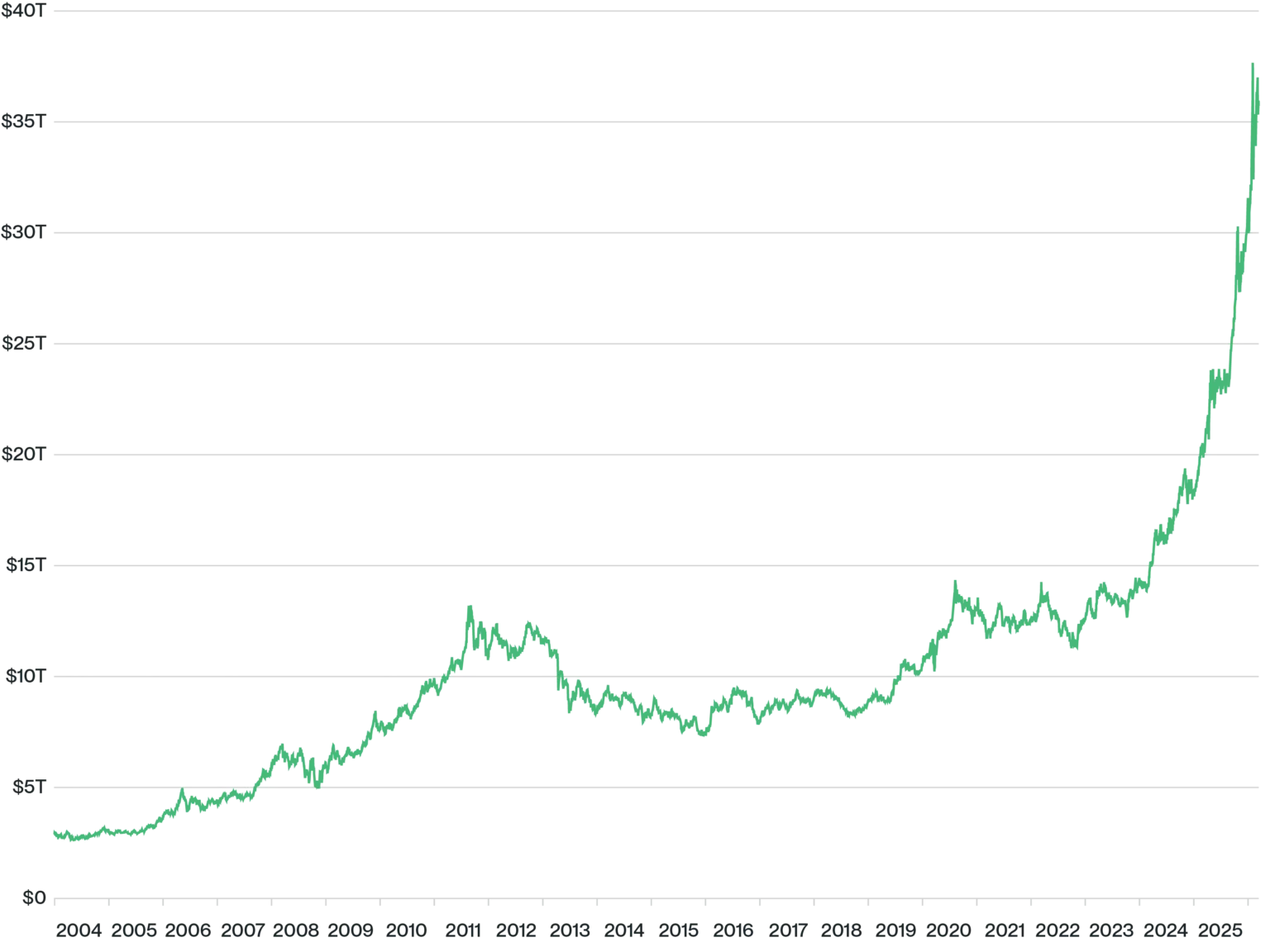
“When Gold ETFs launched in 2004, the market cap was just $2.5 trillion, and it’s now over $40 trillion,” he said.
“The size of crypto’s market cap is about $2 trillion, so when we talk about where it could go, those are the types of ranges we talk about.”
Fusaro said separating the evolution of blockchain technology from the development of crypto as an asset class is key to understanding the sector’s trajectory.
Long-Term Upside
The comments follow recent predictions from Bitwise Chief Investment Officer Matt Hougan, who said Bitcoin could reach $1 million within the next decade if it captures a modest share of a growing global store-of-value market.
In a recent investor memo, Hougan said Bitcoin should be evaluated primarily as a store-of-value asset competing with Gold, rather than as a payments network or speculative instrument.
Under that framework, he said Bitcoin’s potential price depends on the size of the overall store-of-value market and its fixed supply of 21 million tokens.
Bitwise estimates the current store-of-value market at just under $38 trillion, including roughly $36 trillion in Gold and about $1.4 trillion in Bitcoin, implying the cryptocurrency accounts for less than 4% of the total.
Gold market cap | Source: Bitwise Asset Management with data from World Gold Council and Bloomberg.
At the current market size, Bitcoin would need to capture more than half of that market to reach $1 million per coin, an outcome Hougan acknowledged would be difficult.
However, he said the key variable is the growth of the market itself.
Hougan pointed to the expansion of Gold over the past two decades, noting that the market has grown from around $2.5 trillion in 2004 — when the first U.S. gold exchange-traded fund launched — to nearly $40 trillion today.
If the store-of-value market continues to expand at a similar pace, Hougan estimated it could reach about $121 trillion within 10 years.
In that scenario, Bitcoin would need to capture roughly 17% of the market to reach $1 million.
Kurt Robson is a London-based reporter at CCN, specialising in the fast-moving worlds of crypto and emerging technology. He began his career covering local news in Cornwall after graduating from Falmouth University with First Class Honours in Journalism. There, he cut his teeth on everything from council meetings to missing swans.
He quickly rose through the ranks to become a frontline journalist at several of the UK’s leading national newspapers. Over the years, he has interviewed musicians and celebrities, reported from courtrooms and crime scenes, and secured multiple front-page exclusives.
Following the upheaval of the COVID-19 pandemic, Kurt shifted his focus to technology journalism—just ahead of the AI boom. With a natural curiosity and a trained eye for emerging trends, he has found a new rhythm in reporting on innovation.
At CCN, Kurt's work focuses on the cutting edge of crypto, blockchain, AI, and the evolving digital world. Drawing on his background in people-first reporting and his deep interest in disruptive tech, Kurt delivers stories that are insightful, entertaining, and human-centric.