A $50M USDT swap on Aave returned only 324 AAVE after extreme slippage and low liquidity, allowing MEV bots to extract nearly $47M in profit. | Credit: CCN.com
Share
Key Takeaways
A $50 million USDT swap returned only 324 AAVE tokens, worth roughly $36,000, due to extreme slippage during the trade.
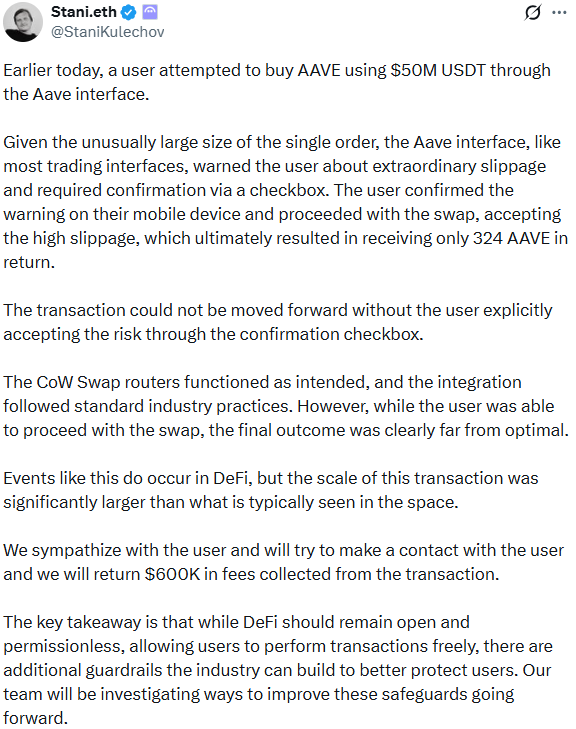
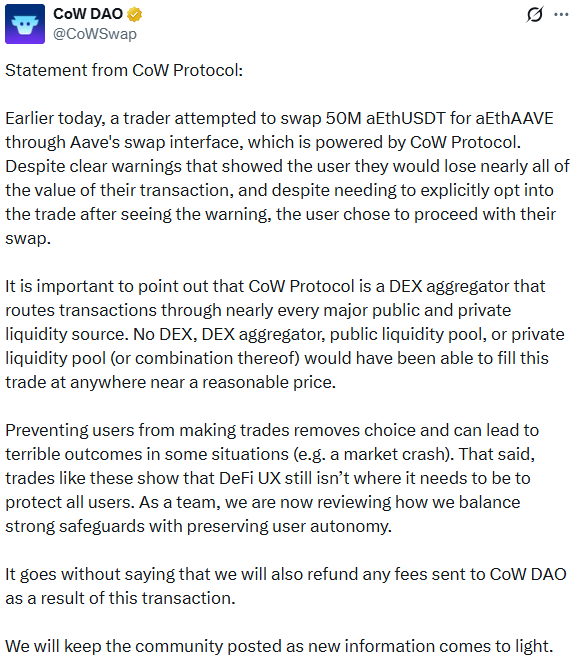
The Aave interface warned the user about high slippage, requiring manual confirmation before the transaction could proceed.
Low liquidity in the trading pools caused the price to skyrocket during execution, leading to an extremely unfavorable exchange rate.
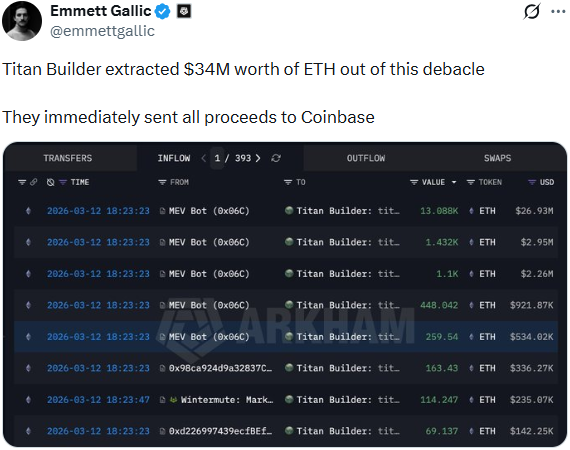
MEV bots captured massive profits from the trade, with one builder reportedly extracting around $34 million in ETH.
A massive decentralized finance (DeFi) trade recently stunned the crypto industry after a user attempted to swap more than $50 million in USDT for AAVE tokens but ended up receiving only about 327 AAVE worth roughly $36,000.
The trade, executed through the Aave V3 interface using CoW Protocol routing, resulted in a staggering 99.93% loss in value. The transaction triggered intense debate about slippage, liquidity depth, MEV (Maximal Extractable Value), and whether the event was a mistake or something more complex.
What makes the story even stranger is that 20 days before the swap, a newly created wallet had received $50.4 million USDT from Binance, raising further questions about the origin and purpose of the trade.
The incident has become one of the most dramatic real-world examples of how liquidity mechanics in DeFi can produce extreme outcomes when very large trades hit shallow pools.
The trade was initiated through the Aave interface, which uses CoW Protocol’s batch auction system to find the best trade route across decentralized exchanges.
The user accepted the risk, Aave’s Kulechov said. | Credit: Stani Kulechov X profile
Before execution, the interface displayed warnings about extraordinary price impact, and the user had to manually confirm the trade. The system also applied a suggested slippage tolerance of 1.21%.
However, the critical problem was not slippage.
The initial quote itself was already extremely unfavorable, showing that the user would receive around 328 AAVE tokens for the $50 million order, equivalent to paying over $150,000 per AAVE.
The trade route chosen by the solver involved several steps:
The SushiSwap AAVE/WETH pool contained only about $73,000 of total liquidity. Yet the solver pushed 17,958 WETH (roughly $37 million) into a pool that contained only 17.65 WETH in reserves.
Titan Builder extracted $34 million worth of ETH out of this debacle. | Credit: Emmett Gallic X profile
This was more than 1,000 times the pool’s size.
The constant-product formula used by decentralized exchanges automatically adjusted the price.
The bot generated around 17,912 ETH in profit, roughly $37 million. The same bot then executed 18 additional arbitrage trades across multiple exchanges including Uniswap, SushiSwap, Bancor, DODO, and Fluid.
In total, the bot extracted about 22,676 ETH ($46.8 million) from the opportunity. A second bot managed a smaller arbitrage trade, earning about $35,000.
Where the $50M Went: MEV Bots, Block Builders and Fees
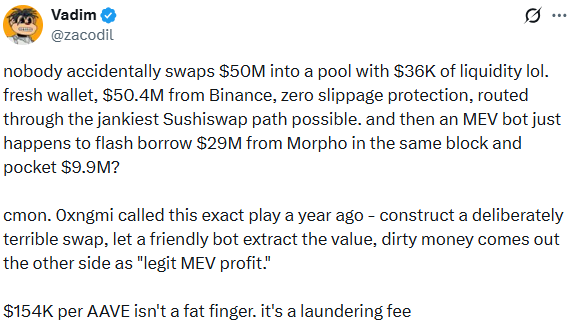
Some researchers suggest the trade may have been deliberately constructed to create MEV profit, potentially allowing funds to be transformed into what appears to be legitimate arbitrage income.
One analyst described the swap as potentially functioning like a “laundering fee”, where funds are intentionally lost in a trade so bots can capture profits that later appear legitimate.
However, no definitive proof of this theory has emerged.
Aave and CoW Protocol Respond to the $50M Slippage Trade
A user attempted to swap about $50 million worth of USDT for AAVE tokens using the Aave interface. Due to extremely high slippage caused by low liquidity in the trading pools, the user received only 324 AAVE, worth around $36,000, despite spending tens of millions of dollars.
What is slippage in DeFi?
Slippage is the difference between the expected price of a trade and the final execution price. In decentralized exchanges, prices change automatically based on liquidity pools. When a trade is very large compared to the available liquidity, the price can move dramatically during the transaction.
Why did the user receive so little AAVE?
The trade size was far larger than the available liquidity in the pools used for the swap. As the transaction executed, each portion of the trade pushed the price higher, causing the buyer to pay increasingly worse prices for AAVE.
What are liquidity pools?
Liquidity pools are smart contract reserves of tokens used by decentralized exchanges to facilitate trading. Users deposit tokens into these pools, allowing others to swap assets without relying on traditional order books.
Disclaimer:
The information provided in this article is for informational purposes only. It is not intended to be, nor should it be construed as, financial advice. We do not make any warranties regarding the completeness, reliability, or accuracy of this information. All investments involve risk, and past performance does not guarantee future results. We recommend consulting a financial advisor before making any investment decisions.
Giuseppe Ciccomascolo began his career as an investigative journalist in Italy, where he contributed to both local and national newspapers, focusing on various financial sectors.
Upon relocating to London, he worked as an analyst for Fitch's CapitalStructure and later as a Senior Reporter for Alliance News. In 2017, Giuseppe transitioned to covering cryptocurrency-related news, producing documentaries and articles on Bitcoin and other emerging digital currencies. He also played a pivotal role in establishing the academy for a cryptocurrency exchange website. Crypto remained his primary area of interest throughout his tenure as a writer for ThirdFloor.


 Easy
Easy