Ethereum explores encrypted mempools to combat toxic MEV attacks like sandwiching and front-running, aiming to protect traders. | Credit: CCN.com
Share
Key Takeaways
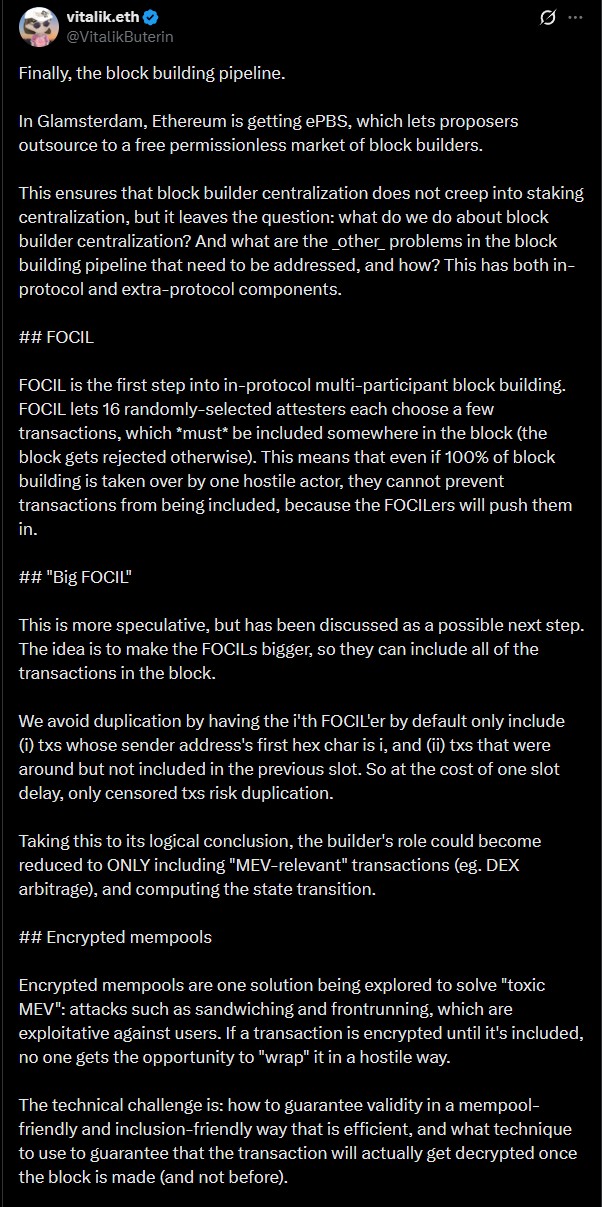
Vitalik Buterin says Ethereum is exploring encrypted mempools to fight “toxic MEV,” including sandwich attacks and front-running that exploit users.
MEV is not just a trading problem. It is also a user trust problem, because people can get worse prices even when their transactions succeed.
Ethereum is already pushing block-building reforms like enshrined proposer-builder separation, or ePBS, in its 2026 roadmap.
Ethereum’s own roadmap says MEV can create a centralizing force by favoring large, specialized operators over smaller stakers.
Ethereum developers have spent the last year talking about scale, lower costs, and a better user experience. These are all solutions that every network should work toward, but Ethereum creator Vitalik Buterin has pointed out a smaller problem that needs addressing: toxic MEV, or maximal extractable value. An issue that’s easy to miss, especially for traders who assume a successful transaction is also a fair one.
In simple terms, MEV is the profit made by a validator changing the natural order of transactions in a block. This can happen through reordering, including, or excluding transactions. However, toxic MEV involves bots manipulating public transactions to create profit at the expense of everyday traders.
Say you want to swap $5,000 of ETH for a smaller token on a decentralized exchange (DEX). Your trade will appear in the public mempool. A bot sees your order, buys the token first, pushes the price up, lets your trade clear at a worse price, then the bot sells its token right after. You still get your token, but at a worse deal.
That is a sandwich attack, and it’s one of a few issues Buterin notes in a recent X post regarding toxic MEV.
Source: @VitalikButerin
New Trending Crypto Wallet Offers
Sponsored
Disclosure
We sometimes use affiliate links in our content, when clicking on those we might receive a commission at no extra cost to you. By using this website you agree to our terms and conditions and privacy policy.
Toxic MEV matters because these attacks can go unnoticed. They don’t always break your transaction, but rather make you pay more for a trade. So it’s a fairness issue alongside a trading one. Ethereum can get faster and cheaper, but users can still feel the system is stacked against them when bots react before a trade is complete. These bots apply a hidden fee, even though it doesn’t appear as a normal gas charge.
Ethereum’s 2026 roadmap is prioritizing scale, user experience, and other layer-1 improvements, focusing on security as well as speed. Vitalik’s mentioning of toxic MEV and his solution in encrypted mempools shows action toward Ethereum’s proposed values.
Public mempools are Ethereum-standard, and let you see pending trades before they’re confirmed. Such visibility is great for transparency on an open blockchain, but it also gives bots a chance to exploit traders.
This is why Buterin specifies toxic MEV vs standard MEV. Some forms of MEV, like certain kinds of arbitrage, can help ensure token prices remain similar across exchanges. But toxic MEV directly takes value from traders.
Centralization concerns come from the fact that maximizing MEV takes special software and a deep understanding of the market. Bigger validators with more money and power behind them are more likely to utilize MEV, winning out over solo validators or hobbyist participants.
So not only will toxic MEV drain value from traders, but it can push power to a smaller group of highly specialized block builders, converting MEV from a smaller decentralized finance (DeFi) problem into a network health issue.
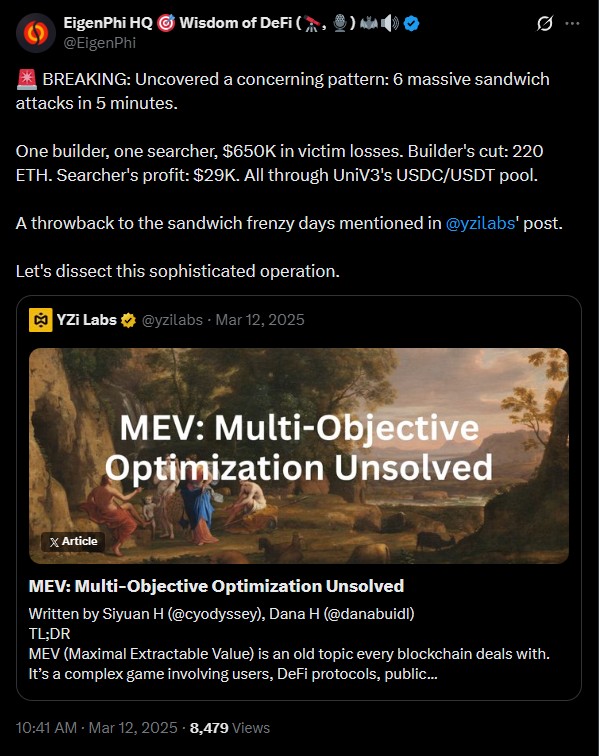
Source: @EigenPhi
Ethereum is already recognizing the problem and presents PBS as a solution. It splits the job of building blocks from the job of proposing blocks. Under PBS, buildings assemble blocks while proposers choose from transaction bids. The goal is to reduce the pressure on validators to run their own MEV systems and lower the centralization risk around block production.
When paired with encrypted mempools, Ethereum might have a chance at stopping the problem.
Why Encrypted Mempools Matter
Encrypted mempools aim at the root of the problem. Instead of showing pending transaction details to everyone right away, like in public pools, encrypted pools hide details until a transaction is completed. This would make sandwiching and front-running much harder because bots could no longer preview of a trader’s actions. Note that the upgrade wouldn’t remove MEV entirely, but it could shut down some of the clearest forms of abuse against regular traders.
However, these pools do not mean Ethereum has solved the issue. In fact, the road toward a solution still looks complex. The Ethereum Foundation’s January 2026 Checkpoint notes that fork-choice inclusion lists (FOCIL), a censorship-resistance mechanism, was moved out of the upcoming Glamsterdam upgrade. This delay shows Ethereum agrees that block building needs more protections, but it is also being careful about how much complexity it adds at once.
And such caution makes sense. MEV has an effect on censorship resistance, validator incentives, and transaction privacy. A rushed fix could create new problems, after all. But a slow fix means prolonging the problem, so a balanced approach, if possible, is key.
This story matters more than ever in 2026 because Ethereum has already made progress elsewhere. The Ethereum Foundation rolled out the Pectra upgrade in May 2025 and the Fusaka upgrade in December 2025. Pectra helped the network handle more data, and Fusaka raised Ethereum’s gas limit.
These changes were meant to help Ethereum scale and support lower fees, especially on layer-2 networks. They’re real improvements, but it’s important to note that lower fees do not automatically solve toxic MEV. Cheaper transactions can still be exploited.
Ethereum’s public mempool gives MEV bots room to scan for front-running and sandwich opportunities, despite privacy-focused DeFi dApps trying to reduce these risks at a dApp layer.
All this to say, Ethereum’s next big phase isn’t just about doing more. It’s about making sure users are not quietly taxed by the order flows around them. Vitalik’s war on toxic MEV is really a fight over whether Ethereum can remain open while combating exploitation.
Toxic MEV is the kind of MEV that directly hurts users, usually through front-running or sandwich attacks. It takes value from a user because their transaction is visible before it is confirmed.
What is a sandwich attack?
A sandwich attack happens when a bot places one trade before your swap and one after it. The bot pushes the price against you, lets your trade clear, then closes its position for a profit.
What is an encrypted mempool?
An encrypted mempool is a design where pending transaction details are hidden before block inclusion. The goal is to stop bots from reading a user’s trade in advance and exploiting it.
What is proposer-builder separation?
Proposer-builder separation splits block construction from block proposal. Specialized builders assemble blocks, and proposers choose the winning bid. Ethereum sees this as one way to reduce MEV’s centralizing effects
Disclaimer:
The information provided in this article is for informational purposes only. It is not intended to be, nor should it be construed as, financial advice. We do not make any warranties regarding the completeness, reliability, or accuracy of this information. All investments involve risk, and past performance does not guarantee future results. We recommend consulting a financial advisor before making any investment decisions.
Max Moeller is a Chicago‑based writer and video editor passionate about games, tech, and crypto. Whether it’s crafting clear, insightful articles or piecing together engaging video retrospectives, he’s driven by curiosity and takes pride in keeping things human. Since 2017, Max has been published in a variety of notable crypto magazines.


 Easy
Easy