Inside 1inch: The Cross-Chain Aggregator Fueling $400M/Day in DeFi
Share
Key Takeaways
Through its partnership with Ondo Finance, 1inch routed more than $2.5 billion in tokenized stock and ETF trades by March 2026.
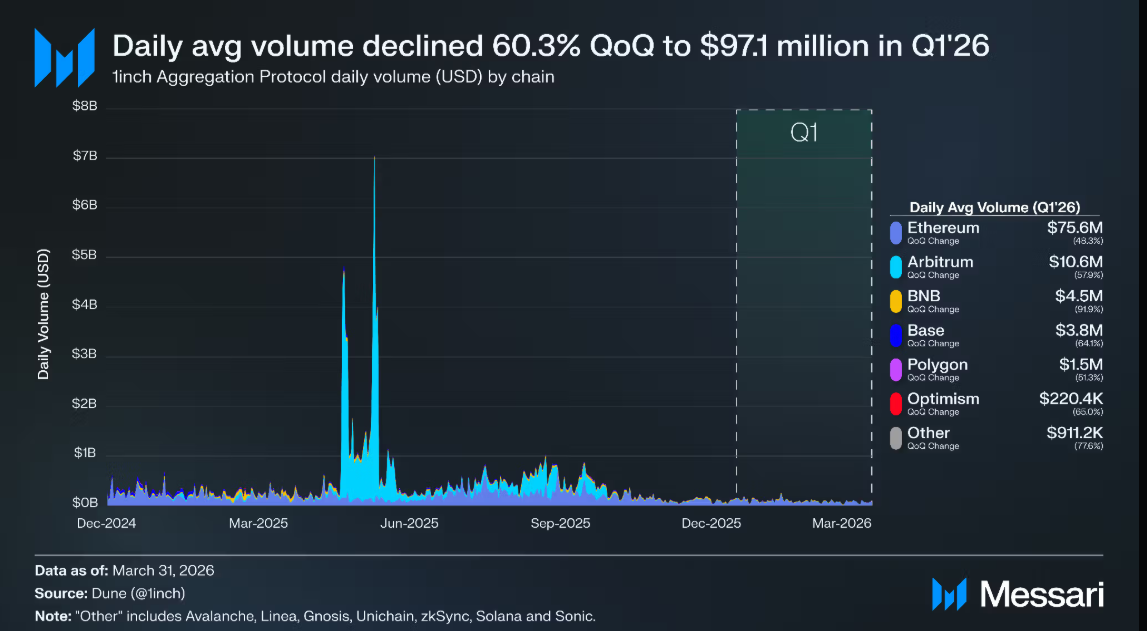
While 1inch’s Aggregation Protocol volume fell 60.3% and Limit Order Protocol volume dropped 30.1%, Fusion volume declined only 26.5%.
Aqua’s shared-liquidity architecture allows capital to be deployed across multiple strategies instead of sitting in a single pool.
The launch of Model Context Protocol (MCP) integration allows AI agents to access 15 different 1inch APIs, enabling automated portfolio management, trading, and execution workflows.
Q1 2026 was a difficult quarter for nearly every decentralized exchange aggregator. Daily DEX aggregator volume across the sector fell 40% quarter-over-quarter from $4.6 billion to $2.7 billion as the broader crypto market contracted.
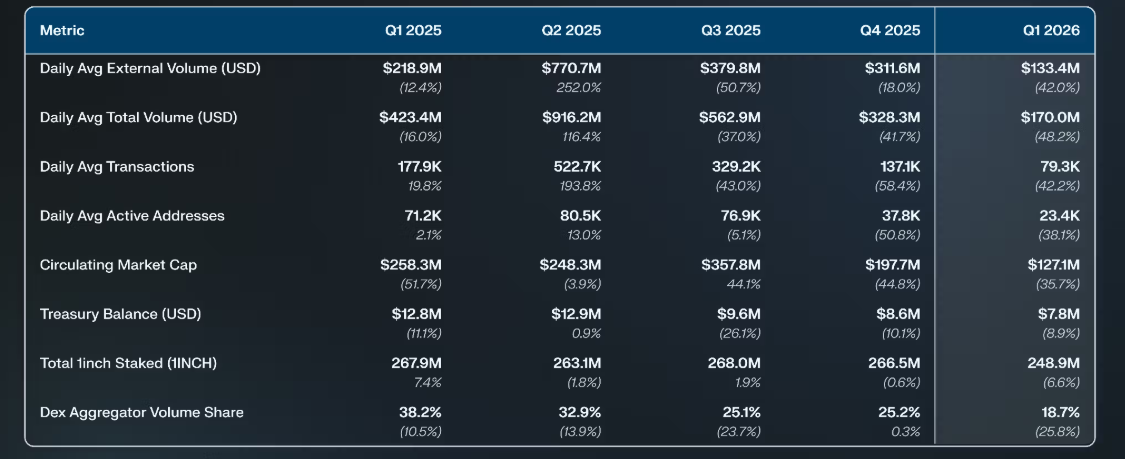
1inch was not immune: its flagship Aggregation Protocol posted a 60.3% volume decline, its market share dropped from first to fourth place, and the 1INCH token’s circulating market cap shrank 35.7% from $197.7 million to $127.1 million between December 31 and March 31.
1inch key metrics overview (as of March 2026). | Source: Messari
Against that backdrop, three developments stand out as genuinely structural rather than cyclical: the $2.5 billion in tokenized stock trades routed through the Ondo Finance partnership, the launch of Aqua’s shared liquidity protocol and its accompanying DAO incubator, and the March 30 release of Model Context Protocol access enabling AI agents to execute swaps directly on 1inch infrastructure. Each of those moves addresses a limitation in 1inch’s existing architecture rather than simply extending what already worked.
How Tokenized Stocks Changed 1inch’s Limit Order Protocol
On December 5, 2025, Ondo Finance partnered with 1inch to route tokenized stock and ETF swaps on BNB Chain through the 1inch Swap API. By March 5, 2026, cumulative tokenized stock volume routed through 1inch had crossed $2.5 billion, making RWA trading the fastest-growing category on the platform.
The numbers inside that headline figure are worth examining closely because they reveal how the Ondo partnership structurally reshaped 1inch’s Limit Order Protocol (LOP).
Overall LOP daily average volume fell 30.1% quarter-over-quarter from $104.4 million in Q4 2025 to $72.9 million in Q1 2026.
BNB Chain was the only chain to grow, rising 52.7% from $15.8 million in Q4 to $24.0 million in Q1, which lifted its share of total LOP volume from 15.1% to 33%. BNB Chain active addresses on the LOP grew 340.8% quarter-over-quarter from 600 to 2,700.
In Q1 2026, daily average volume declined 60.3% QoQ to $97.1 million from $244.9 million in Q4 2025. | Source: Messari
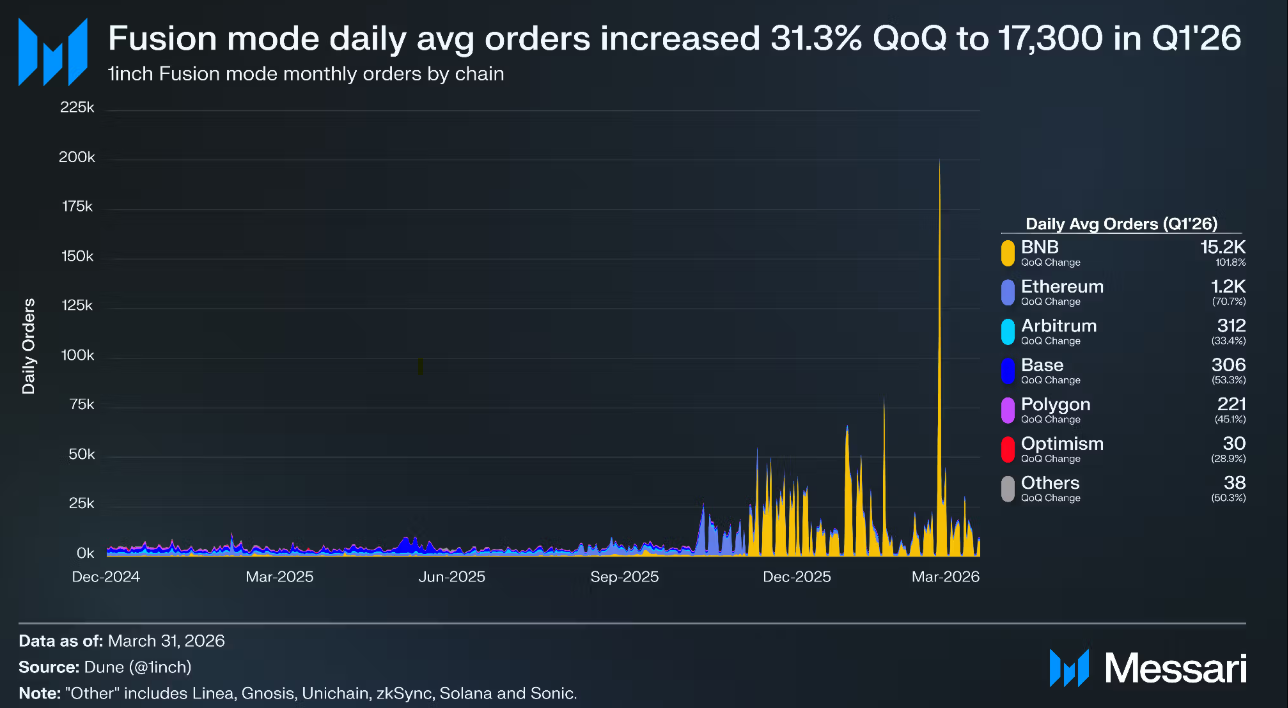
What drove those numbers was the volume and order structure of tokenized RWA trades specifically. Average order size on BNB Chain came to $1,500 per order in Q1, compared to $7,500 on Ethereum. High-frequency, smaller-ticket orders for tokenized stocks pushed daily average orders on the LOP up 16.8% quarter-over-quarter from 22,800 to 26,600, even as total volume fell.
The pattern reflects a different user behavior from standard crypto trading: institutional and retail buyers of tokenized equities trade more frequently in smaller increments than traders swapping native crypto assets.
Tokenized real-world assets have passed $1 billion in on-chain value, and 1inch’s Ondo partnership is the clearest example in its ecosystem of what execution infrastructure for tokenized finance actually looks like in practice. Unlike crypto market cycles, demand for tokenized equities runs on equity market cycles, which gives 1inch a volume source that does not move in lockstep with BTC or ETH price action.
Fusion Protocol: Why Gasless, MEV-Protected Swaps Outperformed in a Down Market
Before examining what is new, understanding why one existing protocol held up better than the others matters for reading what 1inch is building toward.
Fusion mode routes volume through both the Aggregation Protocol and the Limit Order Protocol using an intent-based system. Users post orders with price-and-time presets. Market makers called Resolvers then compete via a Dutch auction mechanism to fill those orders. Crucially, Resolvers cover execution gas costs rather than users paying them directly, making Fusion swaps effectively gasless from the user’s perspective. The Dutch auction structure simultaneously protects against MEV extraction by preventing front-running bots from inserting transactions ahead of user orders.
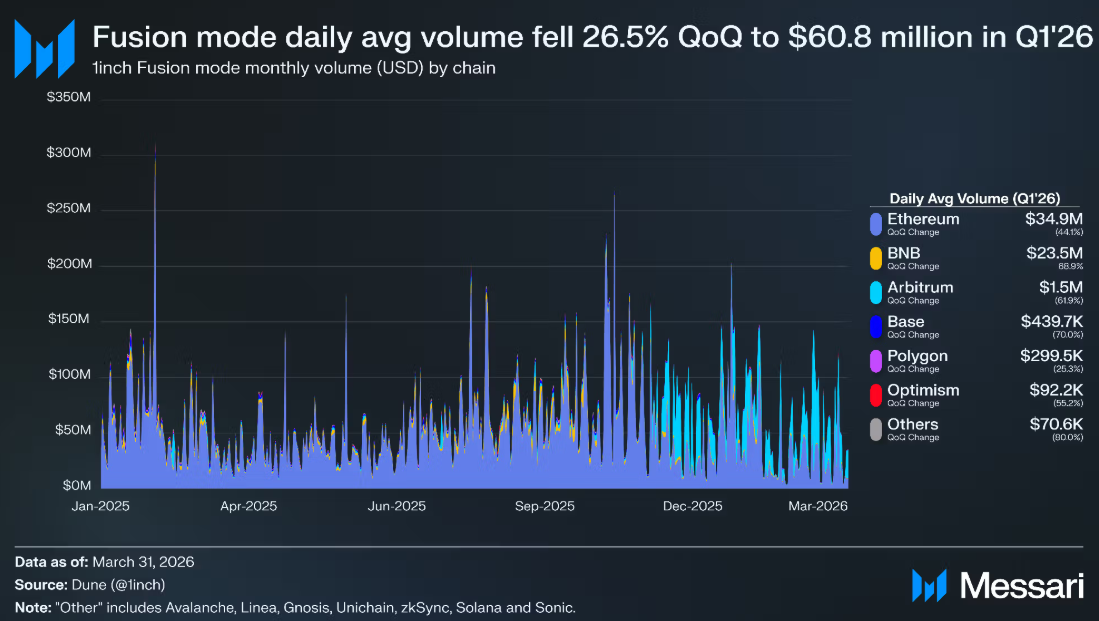
In Q1 2026, daily average Fusion volume fell 26.5% QoQ from $82.8 million in Q4 2025 to $60.8 million. | Source: Messari
In Q1 2026, Fusion daily average volume fell 26.5% quarter-over-quarter from $82.8 million to $60.8 million. That decline was substantially smaller than the Aggregation Protocol’s 60.3% drop and the Limit Order Protocol’s 30.1% contraction.
The relative outperformance is structurally explained: when average trade sizes shrink in a declining market, gas fees consume a larger percentage of each trade’s value. A $200 swap paying $3 in gas at normal market conditions becomes economically unattractive at the same gas rate. Fusion’s gasless design removes that friction entirely, which made it comparatively more attractive as trade sizes compressed.
On March 3, 1inch launched Trade Mode, an updated trading interface that also delivered a meaningful execution improvement: median intent-based swap execution time through Fusion fell from 26 seconds to 14 seconds. That 46% reduction came from infrastructure-level optimization of the resolver competition and Dutch auction settlement process rather than any change to how users interact with the interface.
In Q1 2026, daily average Fusion orders increased 31.3% QoQ from 13,200 in Q4 2025 to 17,300. | Source: Messari
Aqua Protocol: Shared Liquidity and the DAO Revenue Problem
1inch Aqua, introduced in Q4 2025, addresses a structural inefficiency that has constrained liquidity providers on automated market makers since their inception. Under standard AMM architecture, a liquidity provider deposits tokens into a specific pool tied to a specific trading pair on a specific protocol. Those tokens cannot simultaneously serve a different pair or a different protocol. Capital sits idle whenever it is not being routed through its designated pool.
Aqua introduces a shared liquidity layer where liquidity providers allocate virtual balances that can be deployed across multiple trading strategies with a single token approval. Rather than committing capital to one static pool, a provider’s allocated balance can be matched dynamically to whichever strategy offers the most efficient use at any given moment. The mechanism is analogous to a money market account that actively deploys deposits across multiple lending positions rather than holding them in one fixed instrument.
On March 9, the 1inch DAO approved 1IP-93, a $400,000 Revenue Stream Incubator allocating up to $50,000 per team to external developers building revenue-generating strategies on Aqua. Teams that receive funding are contractually expected to share a portion of revenue generated through those strategies with the 1inch DAO treasury. The same governance session approved 1IP-92, which allocated $2.0 million USDC from the DAO treasury to Aave V3’s USDC market on Ethereum to generate yield on idle stablecoin reserves.
Both measures address the same underlying problem: the 1inch DAO treasury held $7.8 million as of March 31, down 8.9% quarter-over-quarter, and the token’s staking rewards lost some direct economic rationale after the DAO removed the 5% Unicorn Power threshold previously required for resolvers to access Fusion’s exclusive order flow. The Aqua incubator and Aave yield deployment are two attempts to build operating income streams that do not depend entirely on token price appreciation or market cycle-driven trading volume.
MCP for AI Agents: What Autonomous DeFi Execution Actually Means
On March 30, 2026, 1inch released Model Context Protocol integration for its Business API suite. The practical meaning of that announcement requires some unpacking because MCP as a term covers a range of capabilities.
Model Context Protocol is a standardization layer that allows AI agents, meaning software systems capable of autonomous goal-directed behavior, to interact with external tools and APIs without requiring custom integration code for each connection. Before MCP, a developer building an AI-driven trading workflow using 1inch’s infrastructure needed to write bespoke code mapping the agent’s actions to each of 1inch’s individual API endpoints. MCP provides a standardized interface that eliminates that mapping overhead.
Through the 1inch MCP integration, AI agents can access 15 APIs simultaneously including Swap, Balance, Portfolio, Token, Gas Price, and Transaction endpoints. An agent can query current market data, assess portfolio state, calculate optimal swap routes, and submit transactions for execution, all within a single goal-oriented workflow rather than through a sequence of isolated API calls. Developers set policy constraints governing which chains, token pairs, slippage thresholds, and execution limits the agent operates within, maintaining human-defined boundaries around autonomous execution.
The growth of agentic DeFi applications represents a distinct category of user from the retail trader connecting a wallet directly to a swap interface. Institutional desks building automated rebalancing systems, quantitative strategies running 24-hour execution cycles, and developers building AI-assisted portfolio management tools all require programmatic access at the infrastructure level rather than the consumer interface level. The MCP release positions 1inch’s API suite as a destination for that demand rather than requiring those builders to integrate against raw API documentation.
Initiative
What It Does
Key Result
Ondo Partnership
Routes tokenized stocks & ETFs through 1inch
$2.5B trading volume
Fusion Protocol
Gasless, MEV-protected swaps
Volume fell only 26.5%
Aqua Protocol
Shared liquidity across strategies
DAO incubator launched
MCP Integration
Enables AI-agent trading workflows
Access to 15 APIs
Market Share and the Competitive Picture
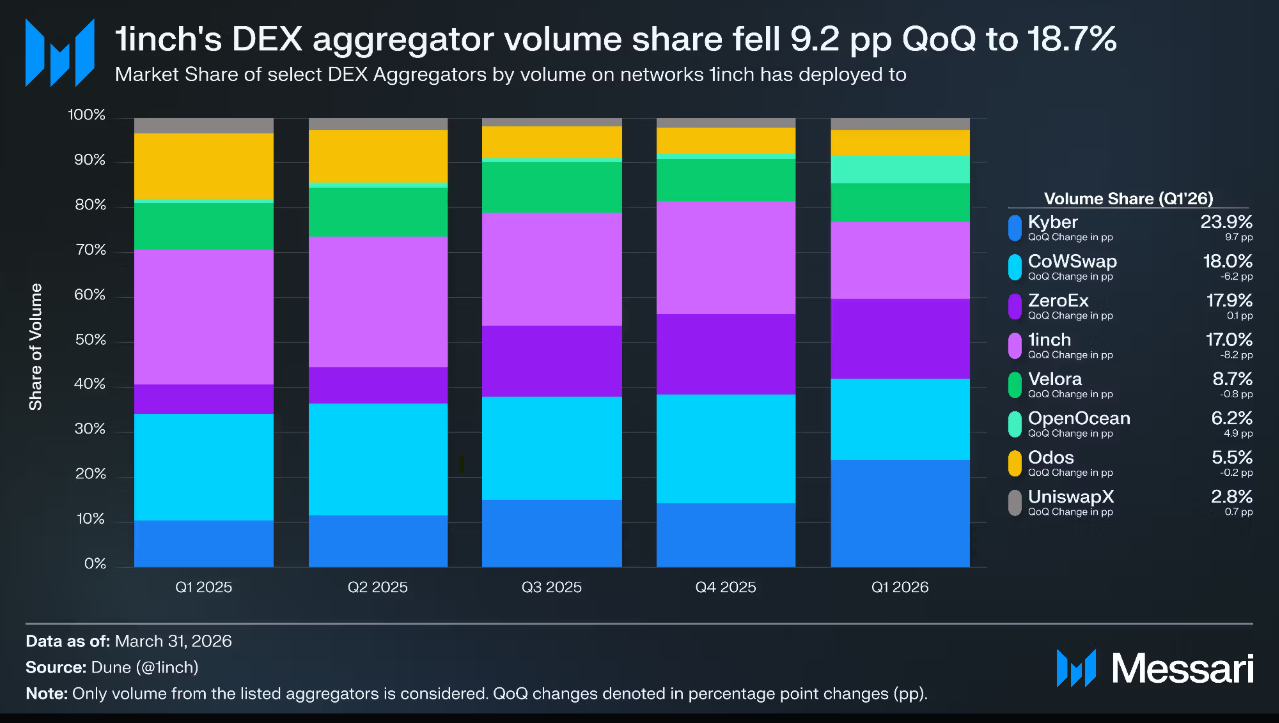
1inch’s market share on networks where it has deployed fell from 25.2% in Q4 2025 to 17.0% in Q1 2026, moving the protocol from first to fourth place among tracked aggregators:
Kyber captured the lead at 23.9% market share after running a 500,000 KNC liquidity mining program from December 17 through March 11, which inflated its volume share during the overlap period.
CoWSwap fell a comparable 6.2 percentage points to 18.0%, suggesting the Q1 contraction was broad-based rather than a 1inch-specific problem.
1inch’s DEX aggregator market share fell from 25.2% to 17.0% in Q1 2026, dropping from first to fourth place. | Source: Messari
DEX aggregator market share is structurally fluid and has shifted rapidly in both directions throughout 1inch’s history:
Kyber’s liquidity program ended March 11 and its sustained share retention into Q2 remains an open question.
The more relevant trend for reading 1inch’s trajectory is the performance divergence between protocols: Fusion’s relative outperformance in a down market, the Limit Order Protocol’s BNB Chain growth driven by RWA demand, and native execution’s rising share from 3.2% to 13.2% of routed volume all suggest the platform’s dependency on third-party DEX routing is gradually decreasing.
Risks Worth Understanding
Volume fell across every protocol and every chain except BNB Chain’s LOP in Q1. Total 1INCH staked declined 6.6% quarter-over-quarter after the DAO removed the resolver threshold requirement, weakening one of the primary incentives to hold the token. The circulating market cap at $127.1 million on March 31 remains well below cycle highs, and the team acknowledged plans to review tokenomics in 2026 to address resilience during low-liquidity periods, a review that has not yet produced a concrete proposal.
Kyber’s incentive-driven volume gain demonstrates how quickly market share can rotate in a segment where switching costs for users are low.Competition from aggregators including CoWSwap, Jupiter, and newer entrants continues to pressure margins and volume share.
Aqua’s incubator program depends on external teams successfully building and monetizing strategies, neither of which is guaranteed. MCP adoption requires developers to build agentic workflows on top of 1inch’s infrastructure before the integration generates measurable volume.
None of the Q1 2026 developments translate directly into 1INCH token price performance without either a governance change that directs protocol revenue to token holders or a sustained market cycle that raises overall DeFi trading volumes. Both conditions remain pending.
What makes 1inch different from other DEX aggregators in 2026?
Unlike competitors like Jupiter or Raydium, 1inch uses its Pathfinder algorithm to optimize trade routes across multiple blockchains, including Ethereum, Solana, and BNB Chain. Its Fusion mode offers MEV protection and gas-free swaps, while cross-chain functionality supports seamless altcoin trading, making it a versatile choice for traders seeking low-slippage deals.
What is Aqua Protocol?
Aqua is 1inch’s shared-liquidity layer that allows liquidity providers to allocate capital across multiple strategies with a single approval. The goal is to improve capital efficiency and create new revenue opportunities for both liquidity providers and the DAO.
Why did Fusion outperform other 1inch protocols in Q1 2026?
Fusion offers gasless swaps and protection from MEV through a Dutch auction mechanism. These features became more valuable during the market downturn, helping Fusion experience a smaller volume decline than the Aggregation Protocol and Limit Order Protocol.
How does MCP help AI agents use 1inch?
MCP provides a standardized interface that lets AI agents access multiple 1inch APIs, including swap, balance, portfolio, gas, and transaction data, without custom integrations. This enables automated trading, rebalancing, and portfolio management workflows.
Disclaimer:
The information provided in this article is for informational purposes only. It is not intended to be, nor should it be construed as, financial advice. We do not make any warranties regarding the completeness, reliability, or accuracy of this information. All investments involve risk, and past performance does not guarantee future results. We recommend consulting a financial advisor before making any investment decisions.
Dr. Guneet Kaur is a senior editor at CCN.com and a Science Fellow at Exponential Science. She is a fintech and blockchain expert with extensive experience in digital finance education, blockchain ecosystems, and cryptocurrency markets. She has worked with global media such as Cointelegraph, as well as education and blockchain platforms, to design and lead strategic content and learning initiatives. As an educator and assessor for top-tier executive programs, she bridges real-world fintech trends with academic insight.
Dr. Kaur is also a published researcher and peer reviewer across fintech and data science journals, including Financial Innovation Journal and International Journal of Big Data Intelligence and Applications. Her work spans data-driven analysis, Web3 innovation, and technical content development. With a strong foundation in both industry and academia, she translates complex financial technologies into practical applications, empowering learners, professionals, and institutions across the rapidly evolving digital finance landscape.
Andrew Kamsky is a chart analyst and writer with a background in economics and ACCA certification. He has held roles at a Big Four firm, a fintech bank, and a listed bank specializing in currency hedging. His work explores Bitcoin, macro trends, and market structure. Outside finance, he's passionate about music, travel, and neon design.


 Intermediate