Key Takeaways
- Crypto risk is no longer monolithic, with smart contract, credit, and duration risks increasingly being priced across DeFi products.
- Many new stablecoins function more like yield products, introducing additional risks that require clearer underwriting.
- After its 2025 exploit, Cork shifted to simpler architecture and multi-layered security beyond traditional audits.
- As on-chain finance evolves, Stone believes risk itself may emerge as a dynamic, tradeable asset class.
As crypto markets mature, investors are increasingly shifting from speculative strategies to structured risk management. New yield-bearing assets, evolving stablecoin models, and longer-duration vaults are forcing participants to understand what risks they are actually taking, and how those risks are priced.
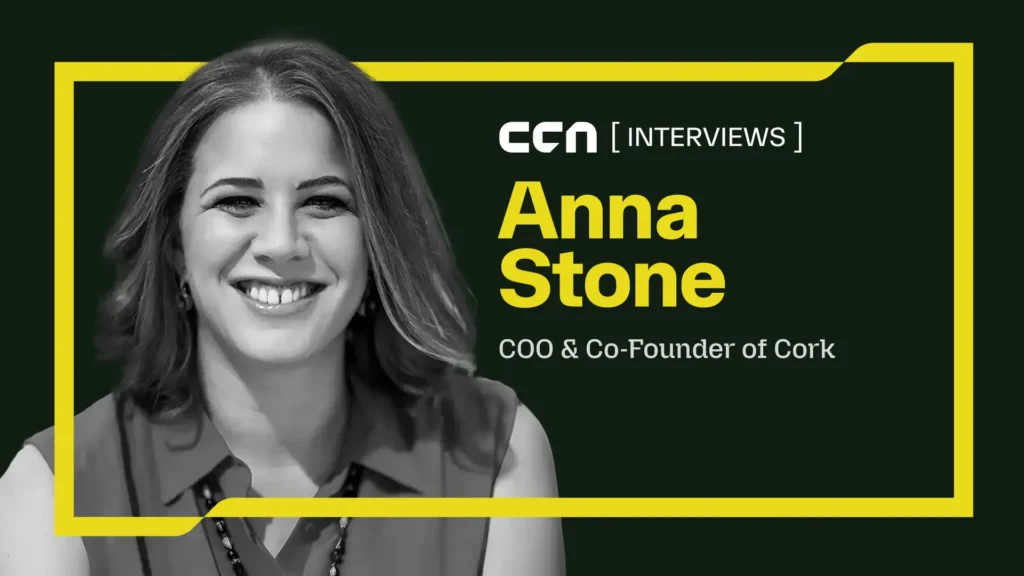
At EthCC in Cannes, CCN’s Giuseppe Fabio Ciccomascolo spoke with Anna Stone, COO and Co-Founder of Cork, about programmable risk markets, stablecoin exposure, and why she believes risk itself could become a tradeable asset class.
Risk in Crypto Is Not Monolithic
Cork is building programmable risk markets, but Stone suggests the conversation around tokenised risk misses a more fundamental issue: crypto risk is not uniform, and much of it remains poorly defined.
“First of all, when we think about risk in crypto, we need to actually map out what risk means for crypto because it’s not all monolithic,” she said, adding that part of Cork’s work involves “making different risks transparent that enable different people to price them a bit differently.”
Smart contract risk remains the most commonly recognised exposure. As Stone noted, this is “what people typically think about when they think of crypto risk,” particularly the risk of exploits, something liquidity providers and asset allocators are already implicitly pricing when deploying capital.
However, DeFi strategies are increasingly introducing additional layers of risk. Stone pointed to credit risk and duration risk emerging from long-duration vaults, where capital may be locked for “60, 90, even 180 days,” depending on the strategy.
Rather than risk becoming a single tokenised trend, Stone framed the evolution as one of transparency.
“There are different types of risks that exist throughout crypto… and one of the challenges today is that it’s not explicit which type of risk you’re taking on or which type of risk you’re paying for.”
This, she argued, is where marketplaces for risk begin to emerge, not by eliminating risk, but by pricing it more clearly.
Lower-risk products already reflect this dynamic. Stone pointed to Morpho vaults on USDC, which are “very tested in terms of smart contract risk” and therefore offer yields “right around basically the treasury rate.” By contrast, higher-yield vaults offering 20–25% APY often carry layered exposures that only become apparent when investors examine the underlying strategy.
“Risk is fine,” Stone said. “We’re all for risk, but it should be made more explicit, what are the different types of risks and what investors are actually putting capital into.”
Stablecoins Are Blurring Into Yield Products
Stablecoins, one of crypto’s largest liquidity drivers, are also becoming more complex, and in some cases, riskier.
Stone suggested that the first challenge is definitional.
“It comes to a question of how do you define a stablecoin,” she said, noting that many assets now labeled as stablecoins function more like yield-generating products.
“We refer to a lot of things as stablecoins that are actually much more like yield products.”
Some newer designs, including DeFi-native assets such as those in the Sky ecosystem, sUSDS, or Ethena, raise questions about whether they should be categorized as stablecoins at all, or as structured yield instruments.
At the same time, payment-focused stablecoins continue to exist, where yield is not part of the design. These assets, Stone noted, prioritize stability and usability over returns.
Further down the spectrum, experimental designs introduce additional complexity. Stone pointed to newer projects such as USDAI, where more innovative yield models introduce implicit risks that must be underwritten.
“The more innovative yield model, the more implicit risks exist for pricing… and what it requires to underwrite that asset.”
Rebuilding Risk Infrastructure After the 2025 Exploit
Cork’s approach to risk infrastructure was shaped by its own experience with a 2025 exploit, which prompted the team to rethink how it builds.
“Going through an exploit like that… requires you to really fundamentally rethink how you’re building end to end,” Stone said.
The first step involved simplifying smart contract infrastructure. Early versions of Cork had incorporated pioneering functionality, including building on Uniswap v4 hooks and enabling liquidity rollovers across markets. While innovative, these features introduced additional complexity.
Following the exploit, Stone said the team focused on identifying “the true primitive” and reducing reliance on experimental technologies.
The second shift involved expanding the definition of security beyond audits. Stone criticized what she described as a common industry assumption that more audits automatically translate to greater safety.
“There’s a bad habit around audits… thinking that audits are going to protect you.”
Many exploits, she noted, stem from logic, governance, or operational failures rather than purely technical vulnerabilities. Stone described this as the “stacking of Swiss cheese” approach to security, addressing multiple layers simultaneously.
As a result, Cork partnered with a security firm embedded across governance, development, and operational processes. According to Stone, this level of operational maturity is something many projects do not reach until much later.
A Shift From Retail Speculation to Institutional Risk Management
Stone believes crypto is approaching an inflection point, with markets shifting away from retail-driven speculation toward institutional-style risk management.
“We’re moving from a more retail YOLO model where it’s risk-on all the time… to a much more mature on-chain finance ecosystem,” she said.
New participants increasingly resemble traditional finance roles, including on-chain asset managers, portfolio managers, and risk managers. With institutional capital comes new expectations around downside protection and risk controls.
Stone said this demand is already visible, particularly among investors looking to deploy capital into vaults, RWAs, and yield-bearing stablecoin-like products at scale.
“To do so at size, they need to be able to limit their downside protection,” she said, adding that this creates a natural marketplace between institutions seeking hedges and capital providers willing to underwrite risk.
Beyond DeFi Insurance and Toward Tradeable Risk
Stone also distinguished Cork’s approach from traditional DeFi insurance products, which often rely on event-based claims and dispute processes that can take months.
“By that point, the depeg has already happened… the liquidity crunch has already happened,” she said.
Instead, Cork’s swaps aim to provide real-time execution, allowing holders to act immediately when risk events occur.
Looking ahead, Stone believes this evolution could lead to risk becoming a tradeable asset class in crypto.
“We’re going to see assets become much more fluid in the age of agentic finance,” she said, describing risk as a “dynamic market input” that will increasingly influence price in real time.
Traditional finance already trades risk through derivatives and structured products, but these transactions often occur privately through OTC agreements. On-chain markets, Stone argued, could make risk pricing transparent and continuous.
“Pricing around risk becomes much more real time… not a one-time swap for three months… but a variable movement like any other tradeable asset.”
As markets become faster and more flexible, Stone concluded, risk itself becomes part of the evolving financial infrastructure, not a separate category, but an integral layer of programmable finance.
The information provided in this article is for informational purposes only. It is not intended to be, nor should it be construed as, financial advice. We do not make any warranties regarding the completeness, reliability, or accuracy of this information. All investments involve risk, and past performance does not guarantee future results. We recommend consulting a financial advisor before making any investment decisions.

Onkar Singh has three years of experience as a digital finance content creator. Throughout his career, he has collaborated with various DeFi projects and crypto media outlets. In his leisure time, he enjoys fitness activities at the gym and watching movies across different genres. Balancing his professional and personal interests, Onkar continues to contribute to the digital finance landscape while pursuing his hobbies.

Giuseppe Ciccomascolo began his career as an investigative journalist in Italy, where he contributed to both local and national newspapers, focusing on various financial sectors.
Upon relocating to London, he worked as an analyst for Fitch's CapitalStructure and later as a Senior Reporter for Alliance News. In 2017, Giuseppe transitioned to covering cryptocurrency-related news, producing documentaries and articles on Bitcoin and other emerging digital currencies. He also played a pivotal role in establishing the academy for a cryptocurrency exchange website. Crypto remained his primary area of interest throughout his tenure as a writer for ThirdFloor.


 Easy
Easy