Chainlink co-founder Sergey Nazarov says RWAs have decoupled from crypto prices as institutional adoption accelerates. | Credit: CCN.com
Share
Key Takeaways
Sergey Nazarov argues that the RWA and tokenization sector has “decoupled” from crypto prices and is now growing independently through institutional demand.
The tokenized real-world asset market has grown to approximately $33.6 billion, with over $10 billion in tokenized US Treasuries alone.
Major financial institutions including JPMorgan, BlackRock, DTCC, State Street, and Fidelity International are actively exploring or deploying blockchain-based financial infrastructure.
The tokenized real-world asset (RWA) market may have reached a turning point. According to Chainlink co-founder Sergey Nazarov, the sector is no longer tied to crypto market cycles and is instead emerging as an independent financial industry driven by institutional adoption, infrastructure maturity, and real utility.
His comments come as tokenized US Treasuries surpass $10 billion and the broader RWA market climbs to roughly $33.6 billion, signaling accelerating momentum despite continued volatility in the wider crypto market.
In a lengthy post on X, Nazarov argued that “the RWA, TradFi Tokenization and Digital Assets industry has now decoupled from crypto prices as a determining factor of its success.” He pointed to growing institutional activity from firms such as DTCC, State Street, Fidelity International, and SGX, many of which are integrating Chainlink services into tokenization and interoperability initiatives.
Three key trends I am increasingly excited about…
1: Our industry has started caring much more about the security and reliability of the infrastructure, standards and oracles/dependencies that it is built on top of. This shift in focus towards security is already massively…
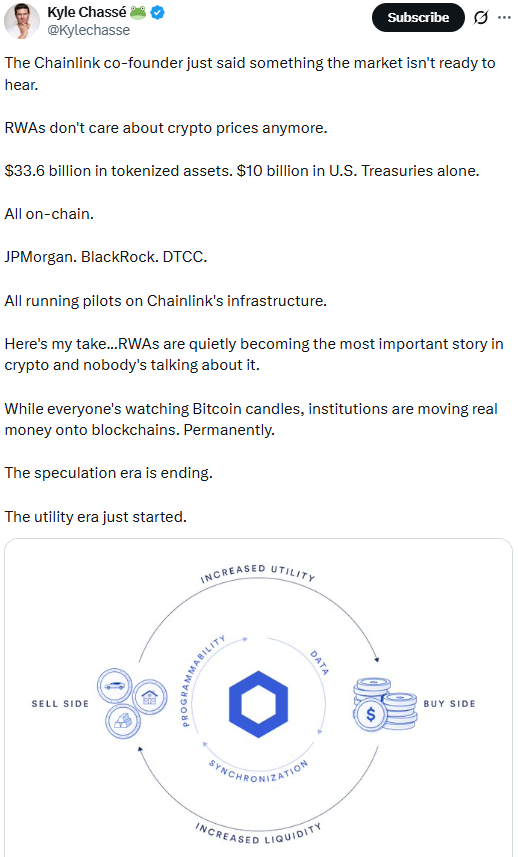
Crypto investor Kyle Chassé amplified the point, claiming that “RWAs are quietly becoming the most important story in crypto,” as institutions increasingly move traditional financial assets on-chain regardless of Bitcoin’s short-term price movements.
Try Our Recommended Crypto Exchanges
Sponsored
Disclosure
We sometimes use affiliate links in our content, when clicking on those we might receive a commission at no extra cost to you. By using this website you agree to our terms and conditions and privacy policy.
Institutional Adoption Is Fueling the RWA Narrative
The numbers increasingly support Nazarov’s thesis. While crypto markets have experienced periods of stagnation and heightened volatility in 2026, tokenized assets have continued to grow steadily. Tokenized US Treasuries alone now represent one of the fastest-growing blockchain sectors, led by products from BlackRock, Franklin Templeton, Ondo Finance, and other major asset managers.
Unlike speculative crypto tokens, RWAs generate value from underlying cash flows, government debt, commodities, or equities. That utility-driven structure has made them attractive to institutions looking for blockchain efficiency without direct exposure to volatile cryptocurrencies.
Nazarov emphasized that the shift is also being driven by infrastructure quality. According to him, institutions are prioritizing secure and compliant systems over experimental protocols. He cited Chainlink’s certifications, decentralized oracle network, and Cross-Chain Interoperability Protocol (CCIP) as reasons major financial entities are choosing its infrastructure.
Several recent partnerships appear to reinforce that trend. DTCC recently collaborated with Chainlink on plans for 24/7 collateral management, while SGX integrated Chainlink’s DataLink for market data services. State Street and Fidelity International have also been linked to tokenization initiatives powered by Chainlink technology.
For many analysts, the significance lies less in the individual partnerships and more in the type of institutions involved. Traditional financial giants entering blockchain infrastructure suggest that tokenization is increasingly being viewed as an operational upgrade rather than a speculative experiment.
Data Suggests RWAs Are Becoming a Distinct Market
Market behavior over the past year indicates that RWAs may indeed be developing independently from broader crypto sentiment. Historically, blockchain sectors moved largely in tandem with Bitcoin and Ethereum prices. However, tokenized treasury products and institutional blockchain platforms have continued attracting capital even during periods of crypto weakness.
Part of this resilience stems from the nature of the assets themselves. Tokenized Treasuries offer yield backed by US government debt, making them fundamentally different from speculative crypto assets. Investors are often purchasing exposure to stable returns rather than betting on token appreciation.
Kyle Chassé amplified Nazarov’s comments on RWAs. | Credit: Kyle Chassé X profile
Another factor is regulatory clarity. Regulators continue to scrutinize cryptocurrencies, but financial firms now integrate tokenized traditional assets into existing compliance frameworks more confidently. This has encouraged financial institutions to experiment with blockchain rails for settlement, collateral management, and fund distribution.
The rise of permissioned blockchain environments and compliance-focused infrastructure has further accelerated adoption. Institutions are less interested in decentralization ideology and more focused on reducing settlement times, increasing transparency, and lowering operational costs.
That distinction may explain why RWA growth has continued despite uneven crypto market conditions.
Chainlink’s Position in the Expanding Tokenization Economy
Nazarov’s comments also highlight Chainlink’s growing role within institutional blockchain infrastructure. Beyond price feeds, Chainlink has expanded into interoperability, identity verification, off-chain computation, and compliance tooling. These are areas increasingly critical for enterprise-grade tokenization.
Its CCIP protocol has seen rising adoption among institutions and decentralized finance platforms seeking more secure cross-chain infrastructure. Nazarov claimed more than $4 billion migrated onto CCIP in recent weeks as projects reassessed bridge security following several high-profile exploits across the industry.
Security has become a central institutional concern. Large financial firms entering blockchain markets require infrastructure that mirrors traditional finance standards, including audited systems, decentralized architecture, and operational redundancy.
Whether Chainlink ultimately dominates the RWA infrastructure stack remains uncertain, but the broader trend appears increasingly clear: tokenization is evolving beyond crypto-native speculation into a financial sector with independent momentum.
If Nazarov’s assessment proves correct, traditional financial institutions will drive the next phase of blockchain adoption by steadily moving real-world assets onto blockchain networks instead of relying on retail trading cycles.
Disclaimer:
The information provided in this article is for informational purposes only. It is not intended to be, nor should it be construed as, financial advice. We do not make any warranties regarding the completeness, reliability, or accuracy of this information. All investments involve risk, and past performance does not guarantee future results. We recommend consulting a financial advisor before making any investment decisions.
Giuseppe Ciccomascolo began his career as an investigative journalist in Italy, where he contributed to both local and national newspapers, focusing on various financial sectors.
Upon relocating to London, he worked as an analyst for Fitch's CapitalStructure and later as a Senior Reporter for Alliance News. In 2017, Giuseppe transitioned to covering cryptocurrency-related news, producing documentaries and articles on Bitcoin and other emerging digital currencies. He also played a pivotal role in establishing the academy for a cryptocurrency exchange website. Crypto remained his primary area of interest throughout his tenure as a writer for ThirdFloor.