DeFi aggregators help traders reduce slippage and optimize crypto trades on DEXs, but they also introduce risks investors should understand. | Credit: CCN.com
Share
Key Takeaways
DeFi aggregators are designed to optimize trade execution by scanning multiple DEXs and liquidity pools for the best possible price.
Aggregators reduce liquidity fragmentation, one of the biggest inefficiencies in decentralized finance.
Smart order routing and order splitting help minimize slippage, especially for large trades or illiquid tokens.
However, aggregators do not eliminate risk, as they redistribute it toward smart contracts, routing systems, bridges, and blockchain infrastructure.
Decentralized finance has evolved far beyond simple token swaps on a single decentralized exchange. Today, many traders rely on DeFi aggregators, platforms that scan multiple liquidity pools and decentralized exchanges (DEXs) to secure better execution prices, lower slippage, and improved liquidity access.
Platforms like 1inch, Matcha, ParaSwap, and OpenOcean have become core infrastructure within crypto markets, especially for high-volume traders and institutional participants seeking capital efficiency. But as aggregators become increasingly popular, an important question is emerging: are DeFi aggregators actually safer than trading directly on DEXs?
The answer is more complicated than a simple yes or no.
While aggregators can optimize execution and reduce some trading inefficiencies, they also introduce new layers of smart-contract, infrastructure, and operational risk. In many ways, aggregators do not eliminate risk, they redistribute it.
Why DeFi Aggregators Exist in the First Place
The rise of DeFi aggregators is largely a response to one major problem in decentralized finance: liquidity fragmentation.
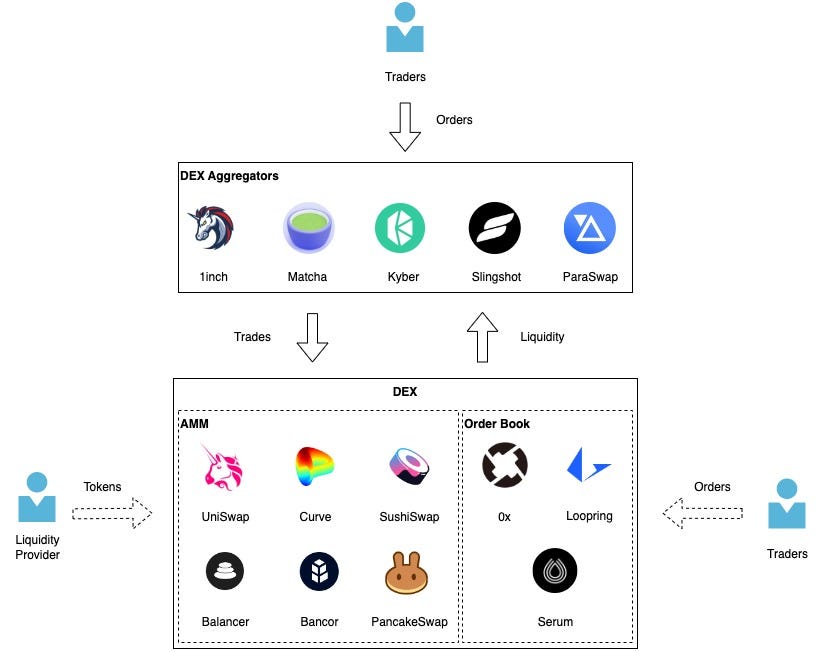
Unlike centralized exchanges (CEXs), which maintain unified order books, DeFi liquidity is scattered across multiple automated market makers (AMMs), blockchains, fee tiers, and liquidity pools. The same trading pair, such as ETH/USDC. may exist simultaneously on Uniswap V2, Uniswap V3, Curve, SushiSwap, Balancer, and various Layer-2 networks.
This fragmentation creates inefficiencies for traders.
How do DEXs work? | Credit: Medium
A user swapping directly through a single DEX only accesses one portion of available liquidity, which can lead to higher slippage and worse execution prices. Aggregators solve this problem by scanning multiple liquidity sources simultaneously and routing trades through the most efficient paths.
Instead of executing an entire trade in one pool, aggregators can split orders across several DEXs or use multi-hop routing strategies.
For example, rather than swapping USDC directly into a smaller-cap token, an aggregator may route the transaction through intermediate assets such as ETH or DAI if doing so produces a better overall execution price.
This process is known as smart order routing (SOR), and it has become one of the defining innovations in modern DeFi infrastructure.
For large traders, DAOs, and crypto funds, the savings can be substantial. Reducing slippage by even a fraction of a percentage point on repeated high-volume trades can preserve significant capital over time.
How Aggregators Can Improve Safety and Execution
From a purely execution standpoint, aggregators often provide advantages compared to trading directly on individual DEXs.
Simplified trading experience across fragmented markets
The most obvious benefit is reduced price impact. Large swaps executed in shallow liquidity pools can dramatically move prices, especially for mid-cap or long-tail tokens. Aggregators reduce this risk by splitting orders across multiple pools, lowering slippage and minimizing adverse execution.
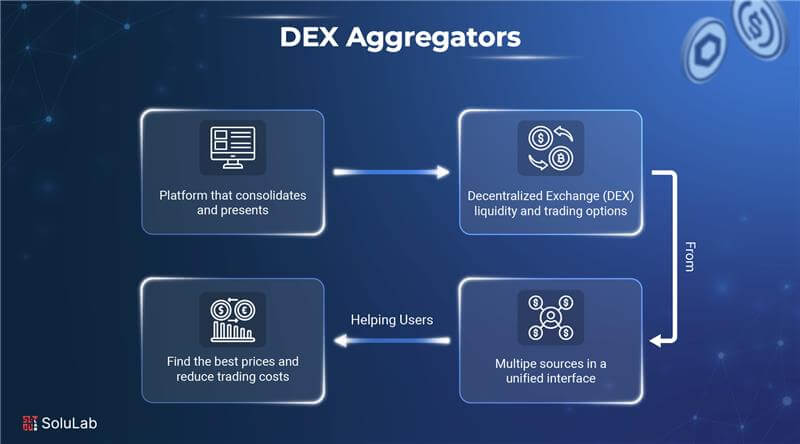
What are DEX aggregators? | Credit: SoluLab
This becomes especially valuable during volatile market conditions when liquidity fluctuates rapidly.
Aggregators also improve transparency and efficiency. Instead of manually checking prices across multiple DEX interfaces, users can access optimized execution from a single platform.
Some advanced aggregators even incorporate gas optimization into their routing calculations, balancing slippage reduction against blockchain transaction costs.
Certain protocols are also beginning to integrate MEV-aware routing systems. MEV, short for maximal extractable value, refers to the profit validators or bots can extract by manipulating transaction ordering. On public blockchains, transactions are visible before confirmation, enabling strategies such as front-running and sandwich attacks.
MEV risks aggregators attempt to reduce are:
Front-running attacks
Sandwich attacks
Transaction-order manipulation
Public mempool exposure
MEV protection mechanisms aim to reduce these risks by hiding transactions from public mempools or routing trades through protected execution systems.
In this sense, aggregators can sometimes offer safer execution environments than manually swapping on a standard DEX interface.
Unlike centralized exchanges, DeFi aggregators do not generally take custody of user assets. Traders maintain control of their wallets throughout the transaction process, reducing exposure to exchange insolvencies, frozen accounts, or custodial failures.
But Aggregators Also Introduce New Risks
Despite these advantages, aggregators are far from risk-free.
In reality, aggregators increase complexity, and in DeFi, complexity often increases attack surfaces.
Every additional routing layer introduces more smart contracts, dependencies, and infrastructure assumptions. When using an aggregator, traders are not only relying on the aggregator’s own contracts but also the underlying DEXs, liquidity pools, bridges, and blockchain validators involved in execution.
If any one of those components fails, users can be exposed.
This is particularly important because DeFi’s history is filled with smart-contract exploits, bridge hacks, governance failures, and infrastructure vulnerabilities. Billions of dollars have been lost across the ecosystem over the past several years.
Cross-chain aggregators amplify these risks further.
Platforms operating across Ethereum, Arbitrum, Polygon, Avalanche, and BNB Chain often depend on bridges and relayers, historically some of the most exploited pieces of crypto infrastructure. While cross-chain routing improves liquidity access, it also creates more points of potential failure.
Gas costs are another concern.
Complex routing strategies may reduce slippage but increase transaction fees, especially during periods of network congestion. In some cases, the additional gas costs can outweigh the execution benefits entirely.
Execution reliability also becomes an issue during volatile conditions. Multi-step transactions are more likely to fail if prices move rapidly or liquidity changes mid-execution.
And despite MEV protection improvements, aggregators cannot fully eliminate transaction-ordering risks on public blockchains.
In fact, because aggregators execute large and complex on-chain trades, they may actually become attractive targets for sophisticated MEV bots.
DeFi Aggregators vs. Direct DEX Trading: Which Is Safer?
Whether aggregators are “safer” than direct DEX trading ultimately depends on how safety is defined.
If safety means better execution quality, lower slippage, and reduced manual trading errors, aggregators often outperform individual DEXs. They provide sophisticated routing tools that most retail users cannot replicate manually.
For high-volume traders, aggregators can preserve meaningful amounts of capital through execution optimization alone.
However, if safety means minimizing smart-contract exposure and reducing operational complexity, direct DEX trading may sometimes carry fewer risks.
Risks that can increase with aggregators include:
Additional smart-contract dependencies
Cross-chain bridge exposure
More complex transaction routing
Higher operational complexity
Greater infrastructure reliance
Potential execution failures during volatility
A simple swap on a well-established DEX like Uniswap may involve fewer dependencies than a cross-chain aggregated trade routed through multiple protocols and bridges.
The comparison becomes even more nuanced when centralized exchanges enter the discussion.
Key Differences Between CEXs and DeFi Aggregators
Centralized Exchanges (CEXs)
DeFi Aggregators
Custodial trading
Self-custodial trading
Internal execution systems
On-chain execution
Simpler user experience
More technical infrastructure
Lower on-chain risk
Higher smart-contract exposure
Custody and solvency risk
Routing and protocol risk
CEXs avoid on-chain execution risks entirely but replace them with custody and governance risks. Users rely on the exchange’s solvency, security controls, and internal operations instead of blockchain infrastructure.
In other words, crypto trading is increasingly about choosing which type of risk you are most comfortable accepting.
DeFi aggregators represent a major evolution in decentralized trading infrastructure. They improve efficiency, optimize liquidity access, and reduce many of the hidden costs associated with fragmented DeFi markets.
Why Aggregators Are Becoming Core DeFi Infrastructure
There are several reason behind the fact aggregators are becoming core DeFi infrastructure.
Among them are growing liquidity fragmentation, expansion of layer-2 ecosystems, rise of cross-chain trading, demand for execution optimization, institutional participation in DeFi, and need for capital-efficient routing systems.
But they are not magic solutions.
Rather than removing risk, aggregators shift it away from custody and toward smart contracts, routing infrastructure, and transaction mechanics.
In a moment while DeFi continues expanding across layer-2 networks, modular blockchains, and cross-chain ecosystems, aggregators may become the default execution layer for crypto markets. Yet for traders and investors, understanding the risks behind the convenience remains just as important as securing the best price.
A DeFi aggregator is a platform that scans multiple decentralized exchanges (DEXs) and liquidity pools to find the best possible trade execution for users. It routes and splits trades across different protocols to reduce slippage and optimize pricing.
How is a DeFi aggregator different from a DEX?
A DEX is a single trading venue where swaps occur directly through liquidity pools. A DeFi aggregator does not provide liquidity itself; instead, it connects to multiple DEXs and routes trades through them for better execution.
Are DeFi aggregators safer than trading directly on DEXs?
Not necessarily. Aggregators can improve execution quality and reduce slippage, but they also introduce additional smart-contract and infrastructure risks because they rely on multiple protocols and routing layers.
Do DeFi aggregators reduce trading fees?
They can reduce total execution costs by minimizing slippage and finding better pricing routes. However, complex routing may increase gas fees, especially during network congestion.
Disclaimer:
The information provided in this article is for informational purposes only. It is not intended to be, nor should it be construed as, financial advice. We do not make any warranties regarding the completeness, reliability, or accuracy of this information. All investments involve risk, and past performance does not guarantee future results. We recommend consulting a financial advisor before making any investment decisions.
Giuseppe Ciccomascolo began his career as an investigative journalist in Italy, where he contributed to both local and national newspapers, focusing on various financial sectors.
Upon relocating to London, he worked as an analyst for Fitch's CapitalStructure and later as a Senior Reporter for Alliance News. In 2017, Giuseppe transitioned to covering cryptocurrency-related news, producing documentaries and articles on Bitcoin and other emerging digital currencies. He also played a pivotal role in establishing the academy for a cryptocurrency exchange website. Crypto remained his primary area of interest throughout his tenure as a writer for ThirdFloor.


 Easy
Easy