LINK gets ready to breacj key resistance | Credit: Hameem Sarwar
Share
Key Takeaways
Chainlink saw its highest network activity in eight months as DeFi protocols shifted billions from LayerZero to Chainlink CCIP.
Whale accumulation and declining exchange balances are tightening LINK supply and strengthening the bullish outlook.
LINK’s price remains in a bullish recovery above key support, with momentum pointing toward potential upside near $13.
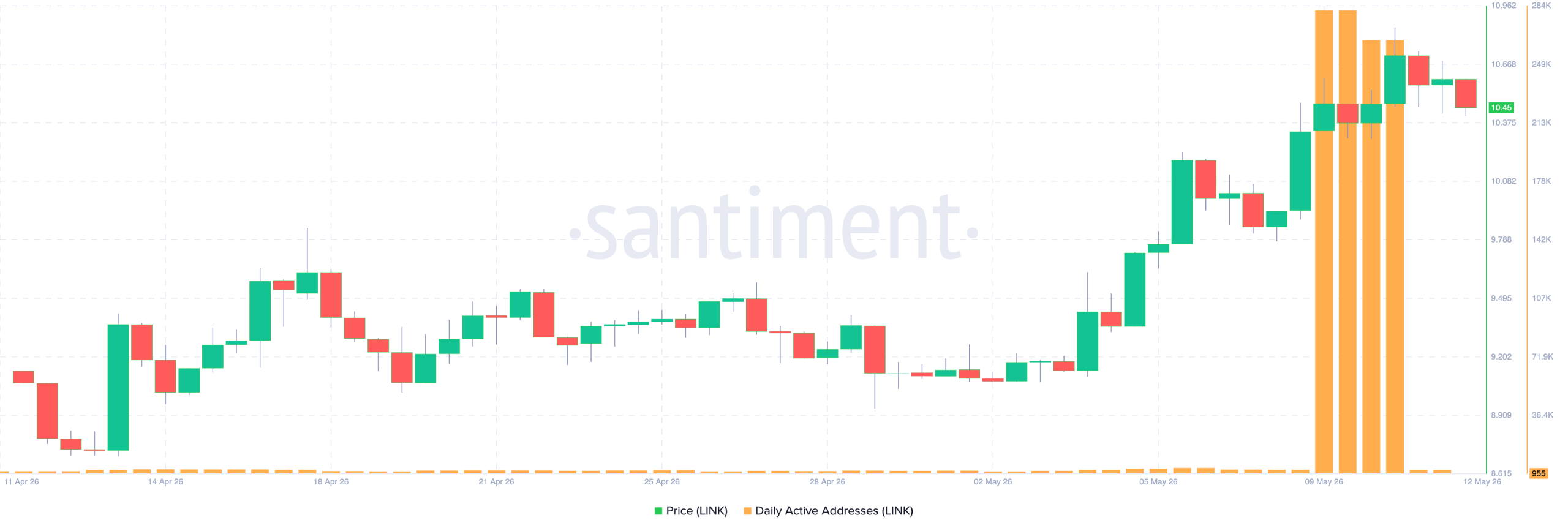
Over the weekend, Chainlink (LINK) recorded its two highest network activity days in nearly eight months.
On May 9, approximately 282,170 unique LINK addresses were active on-chain, followed by 264,090 on May 10.
The network has not experienced this level of activity since September 2025.
For analysts tracking blockchain fundamentals, sudden spikes in address activity are unlikely to occur by chance.
Instead, they signal a major shift in infrastructure adoption and institutional positioning.
In Chainlink’s case, the catalyst appears to be an accelerating migration away from LayerZero infrastructure toward Chainlink’s Cross-Chain Interoperability Protocol (CCIP).
During that period, Solv Protocol announced that it would fully migrate more than $700 million in tokenized Bitcoin assets, including SolvBTC and xSolvBTC, away from LayerZero infrastructure.
The protocol confirmed it would standardize cross-chain operations entirely through Chainlink CCIP.
That exploit was linked to vulnerabilities associated with LayerZero-powered infrastructure and broader RPC security failures.
Following the incident, Kelp DAO announced plans to abandon LayerZero’s OFT framework entirely. Consequently, it transitioned its rsETH restaking infrastructure onto Chainlink CCIP.
Solv Protocol subsequently disabled LayerZero bridge support across several major blockchain ecosystems to reduce systemic bridge risks, while Re.xyz, a decentralized reinsurance protocol with approximately $613 million in TVL, also announced plans to use CCIP exclusively to secure its reUSD infrastructure.
Combined, these migrations represent billions of dollars in DeFi liquidity moving toward Chainlink’s interoperability framework.
Why Chainlink CCIP Is Becoming the Security Standard
Cross-chain bridges have historically been among the weakest security layers in crypto infrastructure, accounting for billions of dollars in cumulative exploits over the past several years.
As institutional capital increasingly enters DeFi markets, security standards have become far more important than speed or speculative narratives.
However, Chainlink’s CCIP has positioned itself as a security-first interoperability solution through several core features.
Some of these include Decentralized Oracle Networks (DONs), Risk Management Network, and the SOC 2 Type 2 Compliance, which was recently verified by Deloitte.
LINK Whales Are Quietly Accumulating
The rise in protocol adoption also aligns with increasingly bullish on-chain accumulation trends.
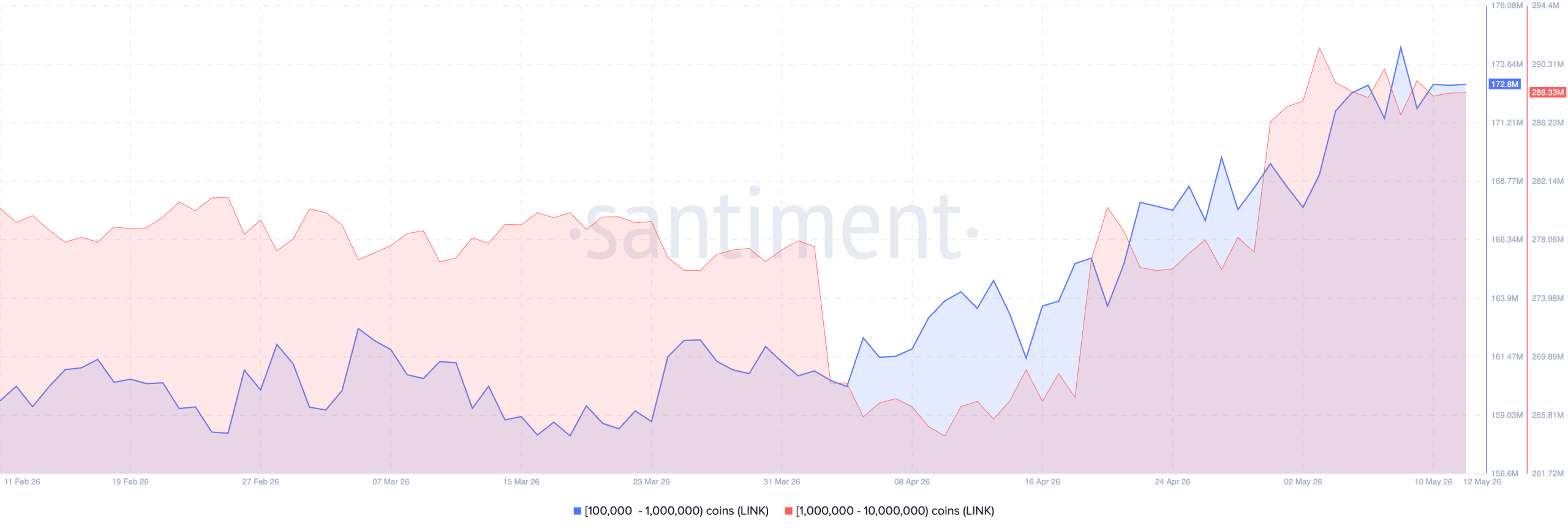
Before the address activity spike even occurred, whale wallets holding between 100,000 and 10 million LINK had already accumulated approximately 32.93 million additional LINK tokens over the previous 30 days.
That represents roughly 7.7% more supply absorbed by large holders.
This cohort now controls nearly 46% of the total circulating LINK supply.
At the same time, exchange balances continue trending lower as whales move LINK into self-custody wallets and long-term storage solutions.
Analysts believe this combination of growing infrastructure demand, declining supply of liquid exchanges, and aggressive whale accumulation could create conditions for a potential supply squeeze.
What Could Happen Next for LINK Price?
Unlike short-lived meme rallies, Chainlink’s current momentum appears increasingly tied to real utility.
As more institutional protocols migrate to CCIP and LINK becomes increasingly locked away by whales and infrastructure participants, liquid supply conditions may continue to tighten.
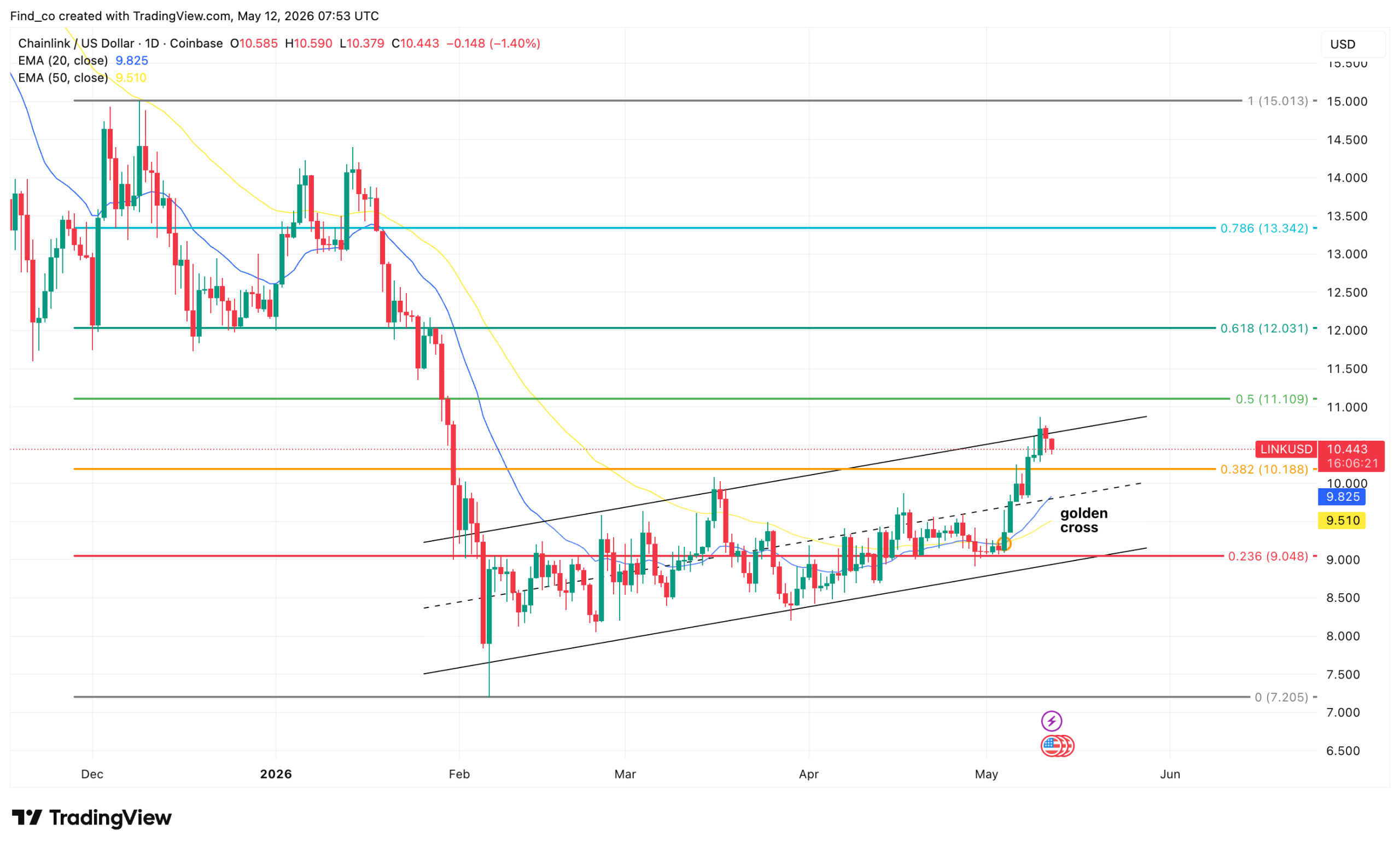
On the technical side, LINK’s price is showing a solid recovery after breaking out of its ascending channel. In the process, it has reclaimed the 0.382 Fib at $10.18.
Furthermore, the recent golden cross between the 20 EMA and 50 EMA adds to the bullish momentum shift.
As it stands, Chainlink’s price is now consolidating just above key support while holding the breakout structure.
If LINK maintains support above the $10, the next upside targets are the 0.5 Fib near $11.10 and the 0.618 level around $12.03.
A stronger continuation could eventually push toward the 0.786 Fib near $13.34.
Disclaimer:
The information provided in this article is for informational purposes only. It is not intended to be, nor should it be construed as, financial advice. We do not make any warranties regarding the completeness, reliability, or accuracy of this information. All investments involve risk, and past performance does not guarantee future results. We recommend consulting a financial advisor before making any investment decisions.
Victor Olanrewaju is a crypto analyst and reporter at CCN with deep roots in on-chain research and technical analysis. His crypto journey began in 2017, but it was the 2020 Uniswap airdrop that sparked a full-time pivot into the space.
With a foundation in copywriting, Victor honed his craft creating high-converting content for leading crypto brokers — most notably an XRP price prediction that ranked #1 on Google during the 2021 bull run.
He later joined AMBCrypto in 2022, where he combined storytelling with technical and on-chain analysis to cover key market narratives.
In 2024, he expanded his expertise at BeInCrypto, collaborating with analysts and using tools like Glassnode, Santiment, and IntoTheBlock to break down Bitcoin and altcoin trends.
At CCN, Victor covers the top cryptocurrencies, memecoins, macro shifts, blending real-time insights with deep-dive metrics.
He holds a Bachelor’s degree in Physics from the University of Ibadan, equipping him to simplify complex data for a wide audience. Follow his work or connect on LinkedIn or X.