Throughout March 2026, the country has offloaded tens of millions worth of BTC through a series of controlled, low-impact transfers.
No panic selling, no market shock—just steady, deliberate moves.
Behind it all is Druk Holding and Investments, Bhutan’s state-owned fund, which has been managing one of the more unusual sovereign Bitcoin treasuries in the world.
Try Our Recommended Crypto Exchanges
Sponsored
Disclosure
We sometimes use affiliate links in our content, when clicking on those we might receive a commission at no extra cost to you. By using this website you agree to our terms and conditions and privacy policy.
Bhutan first began selling Bitcoin in noticeable volume around July 2024.
Up to that point, the country had focused almost entirely on accumulation through its state-backed mining operations.
By December 2024, Arkham data showed it had offloaded 2,077 BTC, worth $163 million, in the second half of the year.
Those early sales followed the same low-key playbook of periodic transfers to institutional counterparties rather than dumping on open exchanges.
The pace picked up in 2025 and carried straight into 2026.
February 2026 alone saw about $30.7 million moved, including an 184 BTC transfer worth $14.09 million to the same bc1q-style address later used in March, plus two sends totaling around 200 BTC to QCP Capital and a 1.5 million-dollar USDT flow to a Binance hot wallet.
On Mar. 10, the 175 BTC transfer worth $11.85 million arrived at the recurring counterparty wallet, lifting 2026 totals to $42.5 million at the time.
Just over a week later, the Mar. 17 to 18 window brought the 973 BTC haul worth $72.3 million.
Reports broke down parts of it as a $44.44 million send to two unidentified addresses, a 20.5 BTC piece worth $1.52 million to QCP Capital, and flows toward Binance wallets.
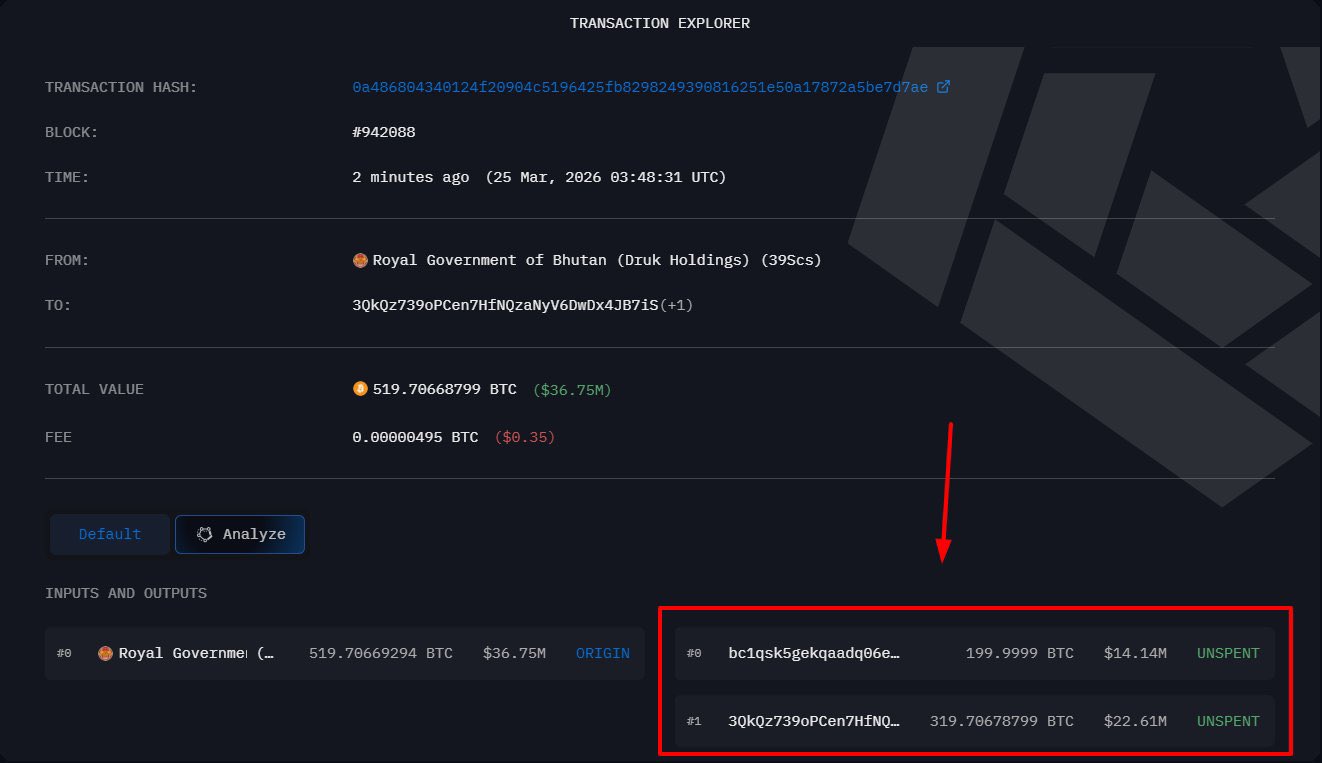
A very recent transfer of 519.7 BTC, worth about $36.75 million, to a Binance deposit address has kept the momentum alive as of late March.
Each move has been executed with the same care, suggesting treasury managers at Druk Holding are working from a playbook rather than reacting to daily price swings.
Why Is Bhutan Selling Bitcoin?
Unlike most governments, Bhutan didn’t buy Bitcoin—it mined it.
The country has been running state-backed mining operations since around 2019, using surplus hydropower.
With cheap, renewable energy and low domestic demand, it had a natural edge.
By 2023, mining had ramped up significantly, with thousands of BTC added to its reserves.
At one point, the country built up a stash of around 13,000 BTC, much of it mined at a very low cost basis.
Since then, mining activity appears to have tapered off.
At the same time, Bhutan started putting that Bitcoin to use.
One major factor is the Gelephu Mindfulness City project—a large-scale economic zone focused on sustainability and digital infrastructure.
Reports suggest Bhutan committed up to 10,000 BTC toward the initiative.
That doesn’t mean a full liquidation, but it does explain the steady need for liquidity.
The rest comes down to simple treasury management.
Bhutan is sitting on assets it mined at near-zero cost. Selling in phases—especially during strong price periods—locks in gains without disrupting markets.
And importantly, the timing doesn’t line up with panic or price crashes. There’s no urgency in the pattern.
A Different Kind of Bitcoin Seller
Bhutan’s approach stands out.
Most large BTC holders—especially governments—either hold passively or move funds in ways that spook the market. Bhutan has done neither.
Instead, it’s acting more like a disciplined fund: scaling out gradually, working with institutional desks, and avoiding unnecessary attention.
Even after months of selling, it still holds a sizable position worth hundreds of millions.
And if the current pattern continues, more of that Bitcoin will likely be sold the same way—quietly, steadily, and on its own terms.
Prashant Jha is a seasoned crypto journalist based in Delhi, India, with a Bachelor’s Degree in Computer Science Engineering. Passionate about the evolving world of blockchain and cryptocurrencies, he has been a dedicated voice in the industry since 2018. Prashant’s expertise lies in regulatory reporting, where he unravels complex legal and financial developments with clarity and precision. Before joining CCN in 2024, he honed his craft at Cointelegraph, establishing himself as a trusted name in crypto journalism.
His coverage spans major industry events, including the high-profile collapses of FTX, Three Arrows Capital (3AC), and LUNA, offering readers insightful analyses of their regulatory and market implications. Prashant’s technical background enables him to bridge the gap between intricate blockchain technology and its real-world applications, making his work accessible to novices and experts.
Beyond his professional pursuits, Prashant is an avid music enthusiast, often exploring diverse genres to unwind. A sports lover, he has a particular passion for cricket and frequently engages in discussions about the game. His multifaceted interests and sharp journalistic instincts make him a valuable contributor to CCN, where he continues shaping the crypto landscape's narrative.