10:52 AMClaude responded: Grayscale filed for the first U.Grayscale filed for the first U.S. spot privacy coin ETF (ZCSH), but ZEC has slid 5% from its $642 May 9 peak as bearish signals point to $530. Credit: CCN
Share
Key Takeaways
Grayscale has filed to convert its Zcash Trust into the first US spot privacy coin ETF.
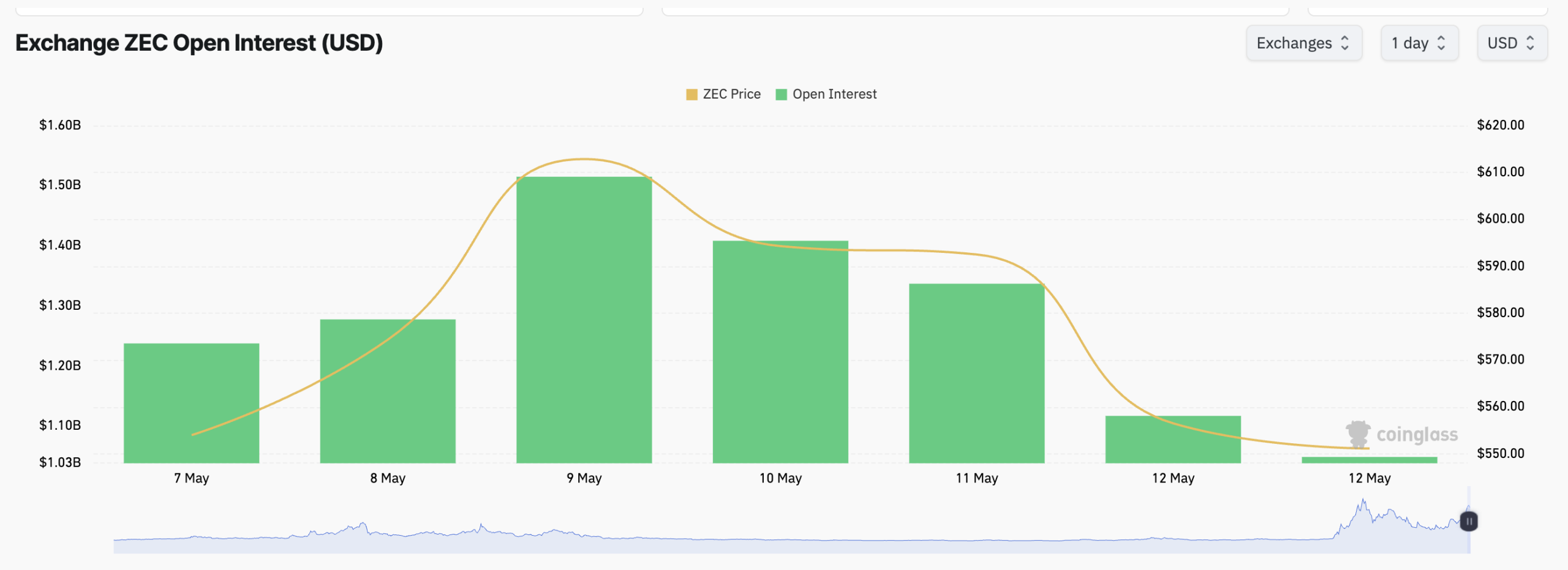
ZEC has slid 5% from its May 9 peak of $642.18 to $559, with futures open interest collapsing 30% to $1.05 billion as derivatives traders unwind long positions.
A bearish DMI crossover, falling Accumulation/Distribution Line, and weakening volume point to further downside.
Digital asset investment firm Grayscale is seeking to convert its Zcash Trust into a spot exchange-traded fund, a move that could test investor appetite for regulated exposure to privacy coins in the United States.
If approved, the product would become the first spot ETF tracking a privacy-preserving cryptocurrency on a US exchange.
Try Our Recommended Crypto Exchanges
Sponsored
Disclosure
We sometimes use affiliate links in our content, when clicking on those we might receive a commission at no extra cost to you. By using this website you agree to our terms and conditions and privacy policy.
Grayscale Files for First US Spot Privacy Coin ETF
Grayscale’smove follows the Securities and Exchange Commission’s (SEC) closure of its long-running review of privacy coins without enforcement action.
The decision has removed the single biggest regulatory overhang that had suppressed institutional interest in privacy assets for years.
The filing also lands as the broader demand for privacy coins is making a comeback.
On May 5, crypto investment firm Multicoin Capital disclosed via an X thread that it had built a “significant position” in ZEC, accumulated quietly since February.
In the thread, co-founder and Managing Partner Tushar Jain called Zcash a “return to the cypherpunk ideals crypto was founded on.”
Jain framed the thesis around growing government efforts to scrutinize and tax visible crypto holdings.
He argued that Bitcoin’s transparent balances leave holders exposed even where its protocol-level censorship resistance holds firm.
The May 6 news triggered a rally, sending ZEC to a five-month high of $642.18 by May 9.
However, the token has since trailed downward, and the attention on Grayscale’s filing has done little to revive momentum.
ZEC Price Cools as Spot Demand Fades
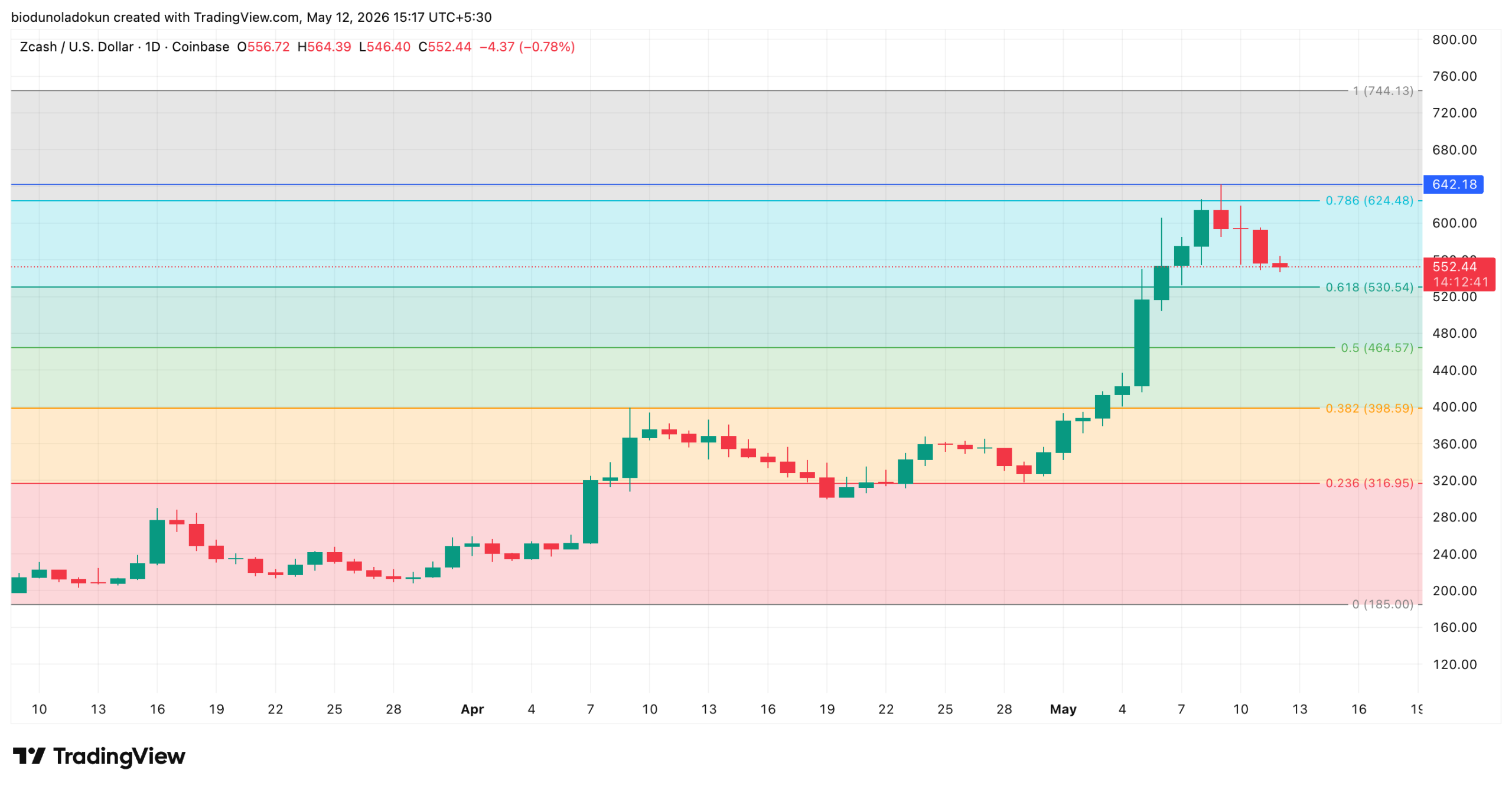
Currently trading at $559.02, ZEC has tumbled 5% from its May 9 peak of $642.18.
Over the past 24 hours, the altcoin is down 2%, and trading volume has also fallen 16%.
The pullback is happening even as news of Grayscale’s filing circulates, a sign that the development has done little to turn sentiment around.
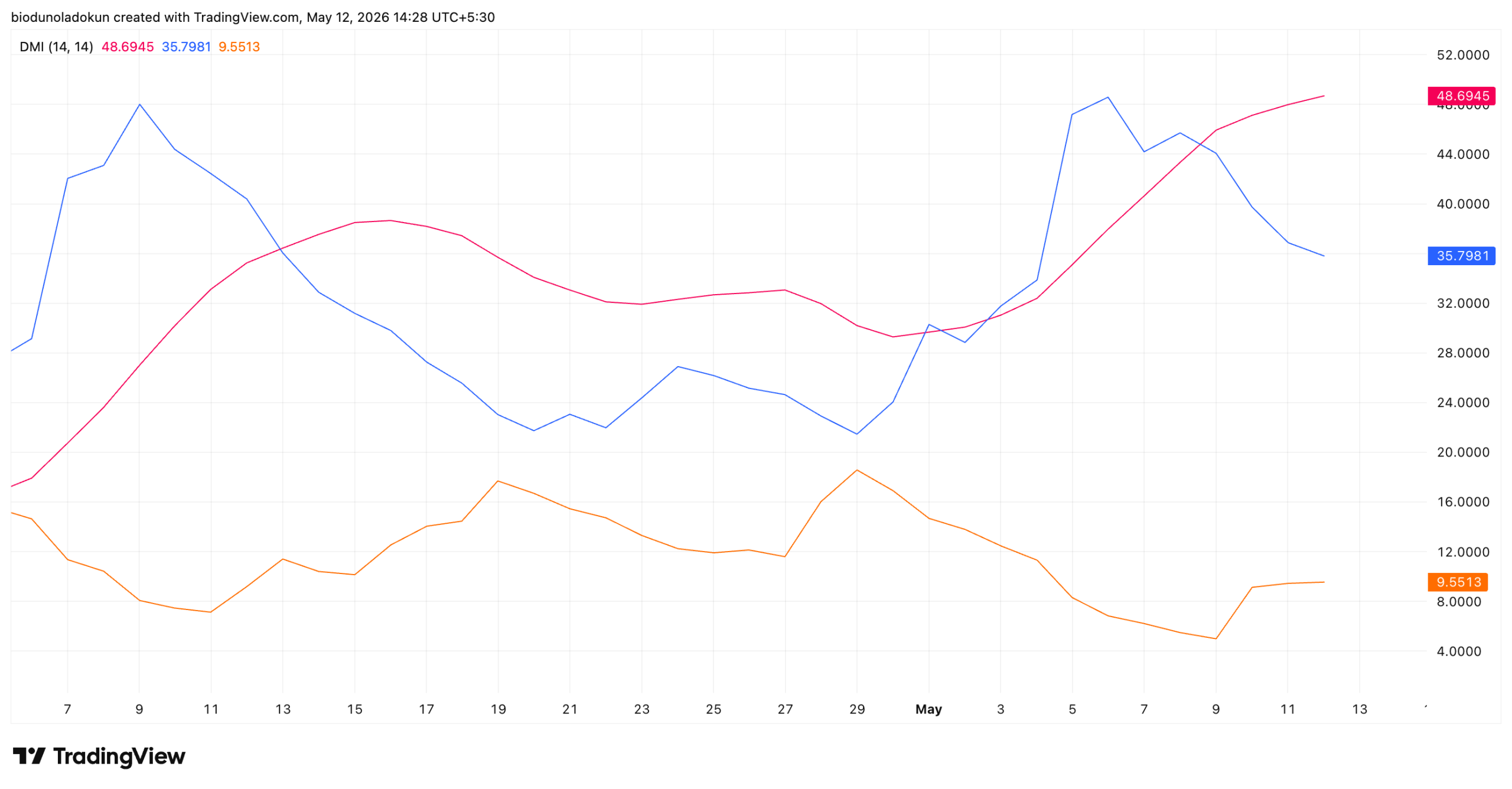
On the daily chart, ZEC’s Directional Movement Index (DMI) confirms the plunge in spot demand.
Readings from the indicator show that the positive directional index (+DI, blue) crossed below the negative directional index (-DI, red) on May 9 and has remained under it since.
The DMI measures the strength of an asset’s price trend.
It consists of two lines: the +DI, which tracks upward price movement, and the -DI, which tracks downward price movement.
When the +DI breaks below the -DI, especially after a rally period, it signals an early trend reversal and indicates that bearish pressure has overtaken bullish momentum.
The signal carries more weight given that ZEC’s Average Directional Index (ADX, orange) has been trending up since May 9.
A rising ADX during a bearish DMI crossover confirms that sell-side pressure is strengthening.
This suggests the downtrend has conviction behind it rather than being a brief pullback within an uptrend.
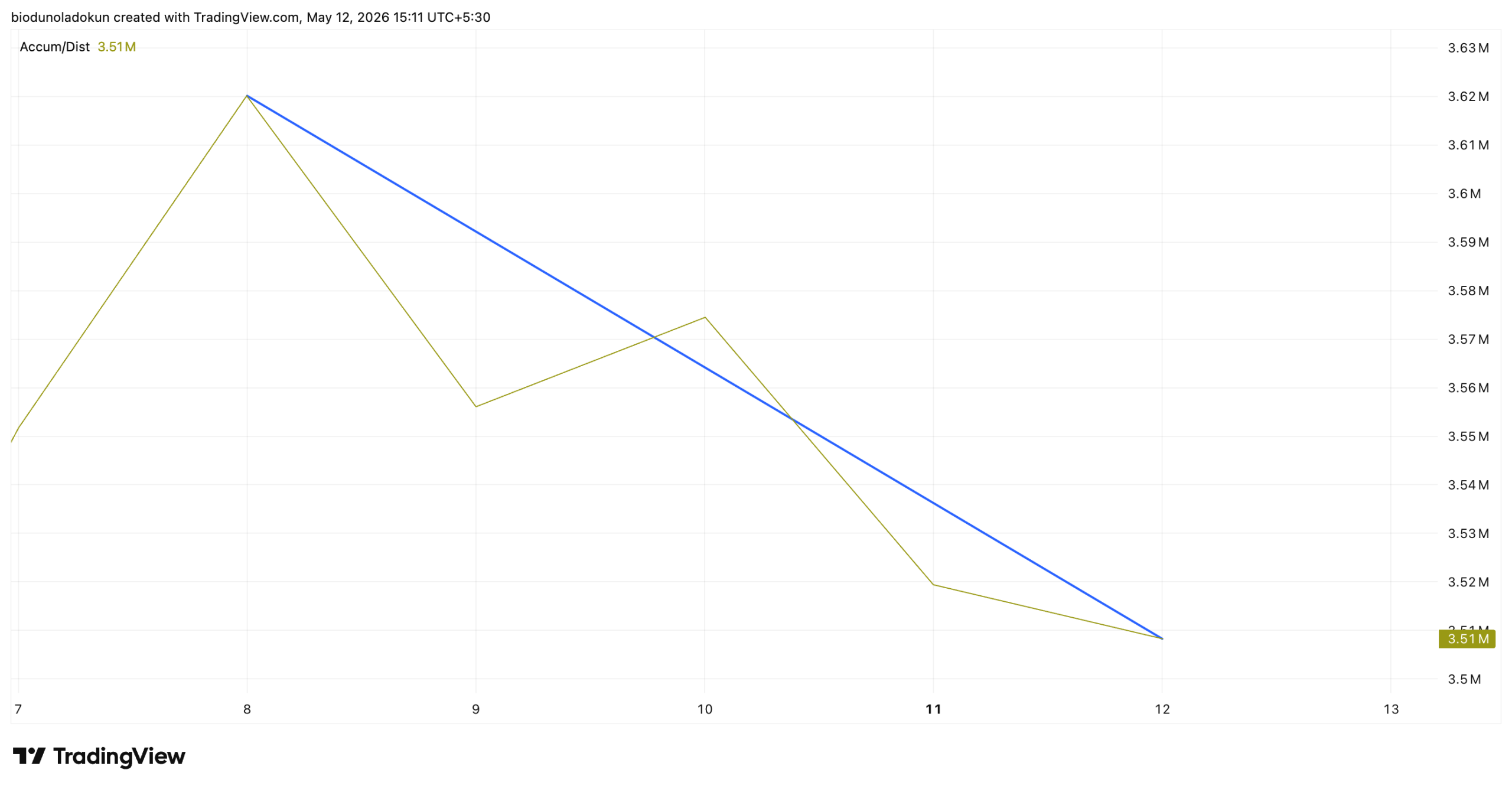
Furthermore, ZEC’s falling Accumulation/Distribution Line since May 9 supports this bearish outlook.
At press time, this momentum indicator, which measures the cumulative flow of money into and out of an asset, stands at 3.51 million.
Open interest measures the total value of outstanding futures contracts that have not yet been settled.
It is a key gauge of capital commitment in the derivatives market, with rising open interest signaling fresh money entering positions, while falling open interest signals traders closing out positions.
When open interest falls in tandem with price, as ZEC is now showing, it indicates that long positions are being unwound rather than new shorts being opened.
Traders who rode the ZEC’s rally to the five-month peak are now taking profits and exiting the market.
ZEC Price Prediction
ZEC is currently trading at $549.32, hovering just above a critical support floor formed at $530.54.
If the bearish momentum, as confirmed by the DMI crossover and falling open interest, continues, ZEC could lose the $530 support in the sessions ahead.
A daily close below that level could trigger a slide toward $464.57, where the next meaningful demand sits.
On the other hand, ZEC needs to reclaim the 0.786 Fib retracement at $624.48 to reignite bullish momentum.
A daily close above that level would put the May 9 high of $642.18 back in play, with the late-2025 all-time high of $744.13 as the next major resistance target.
Disclaimer:
The information provided in this article is for informational purposes only. It is not intended to be, nor should it be construed as, financial advice. We do not make any warranties regarding the completeness, reliability, or accuracy of this information. All investments involve risk, and past performance does not guarantee future results. We recommend consulting a financial advisor before making any investment decisions.
Abiodun Oladokun is a Research Analyst at CCN, where he covers cryptocurrency markets with a focus on on-chain analysis, technical assessments, and emerging trends across decentralized finance (DeFi), real-world assets (RWA), artificial intelligence (AI), decentralized physical infrastructure networks (DePIN), Layer 2s, and meme coins.
Prior to CCN, he served as a Senior On-Chain Analyst at BeInCrypto, producing market reports spanning diverse crypto sectors.
Before that, he conducted technical analysis and market assessments of various altcoins at AMBCrypto, where he also contributed long-form quarterly research papers on DeFi, NFTs, DAOs, and scaling architectures, leveraging on-chain platforms including Messari, Santiment, DefiLlama, and Dune Analytics.
He began his crypto career as a research analyst at SixthSense DAO, developing blockchain forensic tools to trace the history of stolen assets.
Abiodun is a lawyer called to the Nigerian Bar and the founder of Ilé Ijó, a Lagos-based electronic dance music collective.













 Zcash (ZEC) Breaks Cup-and-Handle Pattern, Hits Yearly High as Bulls Target $700 Retest