Key Takeaways
- Solana developers have proposed adjusting the disinflation rate from -15% to -30% annually.
- The change could cut the overall SOL supply by around 3% after six years.
- Any impact on price would depend on demand growth.
Solana developers Ichigo and Lostin (GitHub handles 0xIchigo and lostintime101) have proposed slashing SOL inflation by accelerating reductions in staking rewards currently scheduled to occur over six years.
Under SIMD (Solana Improvement Document)-0411, total emissions would be reduced by 22.3 million SOL compared to current projections.
But would the proposal tighten supply enough to boost SOL’s price?
SIMD-0411 Explained
When Solana was launched in 2020, inflation was initially set at 8% annually, with the rate reducing by 15% per year until it stabilizes at the long-term rate of 1.5%.
According to the current schedule, Solana is set to reach its terminal inflation rate in early 2032.
However, Ichigo and Lostin want to accelerate this timeline by adjusting disinflation (the rate at which inflation decreases) from -15% to -30%.
They argue that the change is needed to fix what SIMD-0411 refers to as the “leaky bucket” of high inflation.
“High token inflation increases sell pressure, as some stakers treat staking rewards as ordinary income and need to sell a portion to cover taxes.” As such, “even small reductions in issuance can save the network hundreds of millions of dollars per year,” the document states.
Solana Inflation and Proposed Emissions Schedule
Under Solana’s current emissions schedule, the total token supply is projected to reach around 721.5 million SOL in six years.
By switching to -30% disinflation, the six-year projection falls to 699.2 million SOL, Ichigo and Lostin’s model shows.
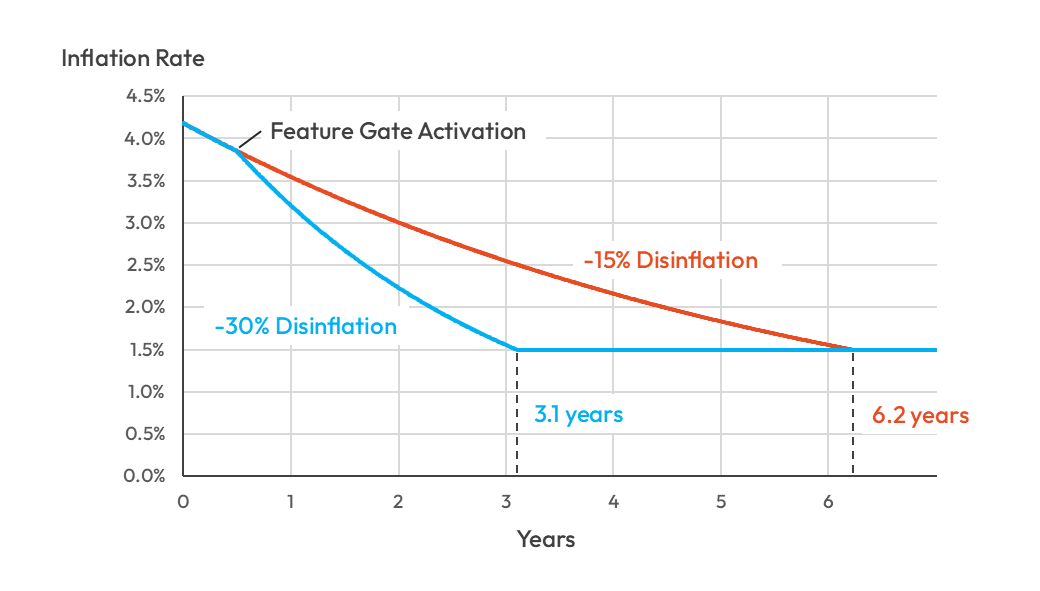
- SIMD-0411 inflation modeling. Source: Github.
By causing around a 3% reduction in the SOL supply over six years, SIMD-0411 could boost the token’s price. But any effect of the price of SOL would also depend on demand.
Potential Impact on SOL Price
If demand for SOL grows at its historical pace, a lower-supply path could have a disproportionate effect on the token’s price.
On the other hand, if demand remains flat, the supply reduction may not produce an immediate or dramatic price change.
Ultimately, if SIMD-0411 is adopted, the most plausible price effect would be gradual rather than sudden.
Issuance pressure would lighten each year, staking yields would decline more quickly, and long-term dilution would fall, making SOL structurally scarcer.
In such a scenario, even modest demand growth could amplify the deflationary tilt introduced by the proposal. Conversely, weak demand would be expected to mute the effect.

James Morales is CCN’s blockchain and crypto policy reporter. He has been working in the news media since 2020, writing about topics such as payments, banking and financial technology. These days, he likes to explore the latest blockchain innovations and the evolving landscape of global crypto regulation.
With an educational background in social anthropology and media studies, James uses his platform as a journalist to explore how new technologies work, why they matter and how they might shape our future.