XRP faces a $1.35-$1.38 support test as bullish positions crowd and whales withdraw tokens from exchanges, according to Bitrue. | Credit: CCN.com
Share
Key Takeaways
Bitrue expects XRP to test the $1.35–$1.38 range as crowded leveraged longs increase the risk of a liquidation-driven pullback.
Whale exchange inflows have fallen to their lowest level since 2021, suggesting reduced potential selling pressure.
Large exchange withdrawals do not necessarily mean whales are selling or abandoning XRP.
XRP traders are crowding into bullish positions just as large holders pull tokens away from centralized exchanges, creating a fragile setup ahead of a potentially decisive support test.
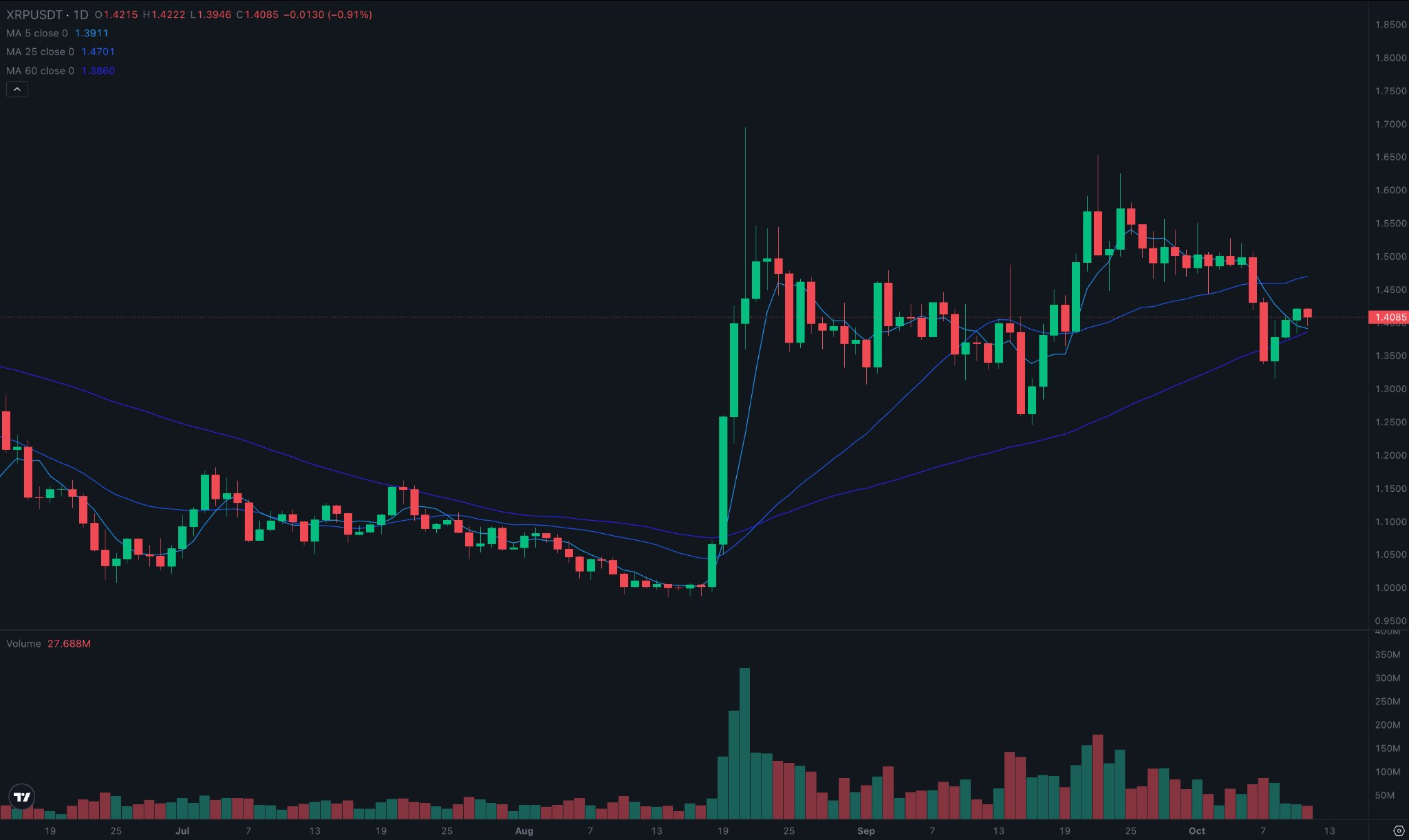
Trading near $1.41 in Bitrue Research Institute’s latest assessment, XRP remains above a rising support zone that has supported its recovery since August.
But leveraged optimism has outpaced momentum, leaving the market vulnerable to a sudden reversal.
Bitrue expects XRP to dip toward $1.35-$1.38 this week before attempting a meaningful rebound. Meanwhile, declining whale deposits suggest large holders are supplying fewer tokens to exchanges, potentially limiting selling pressure if support survives.
Try Our Recommended Crypto Exchanges
Sponsored
Disclosure
We sometimes use affiliate links in our content, when clicking on those we might receive a commission at no extra cost to you. By using this website you agree to our terms and conditions and privacy policy.
Bitrue’s AI indicators show a market leaning heavily toward gains without a strong underlying trend.
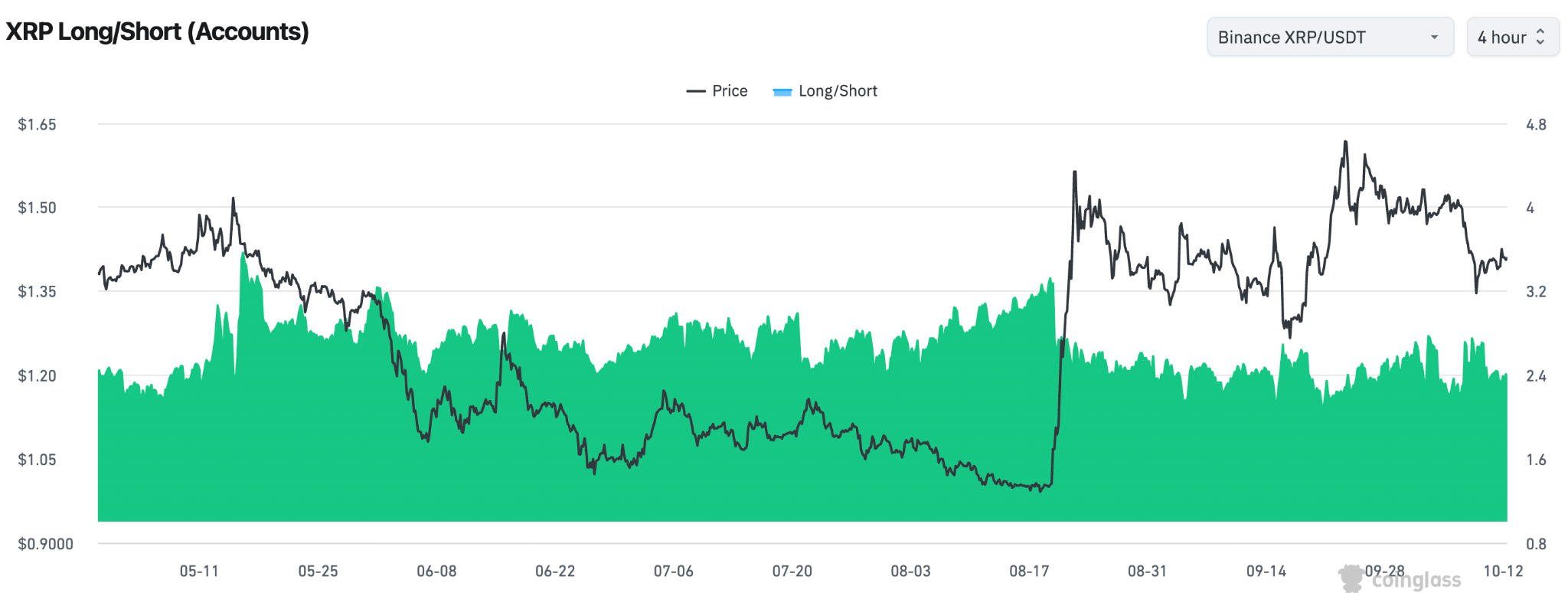
Its momentum reading is Neutral, while the trend remains Flat across timeframes. Volatility is elevated, the long-to-short ratio stands at 2.32, and taker buy volume accounts for approximately 68% of activity.
Together, those readings suggest bullish positioning has become crowded even as price direction remains uncertain.
XRP long/short positions. | Credit: Bitrue
The imbalance matters because leveraged traders can become forced sellers when prices fall. A decline that triggers liquidations could generate additional selling, pushing XRP lower and triggering further closures.
However, the figures represent Bitrue’s reported indicators rather than proof that every XRP trader holds the same position. The supplied assessment also does not specify the ratio’s methodology or measurement window.
“The real tension right now lies between crowded leveraged longs and quieter whale activity,” a senior analyst at Bitrue Research Institute said.
The institute sees that tension resolving first through a support test, with traders’ bullish exposure creating the conditions for a short-term shakeout.
Whales Withdraw From Exchanges, Without Necessarily Exiting XRP
Large holders appear to be stepping back from exchange activity rather than clearly abandoning the token.
According to the assessment, the three-month average of whale inflows to a centralized exchange has fallen to approximately $61 million, its lowest level since 2021.
The report also cites roughly 104.7 million XRP leaving two centralized exchanges combined, with large holders dominating those withdrawals.
🚨WHALE ALERT: Two BIG Whales Bet OVER $10.87 MILLION On $XRP Long — Making Nearly $300K In PROFITS! 🤯🔥
On Sept. 29, whales accounted for 82% of centralized exchange outflows. Their share has since eased slightly, but the broader pattern suggests fewer whale-held tokens remain immediately available on trading platforms.
Exchange withdrawals do not establish that investors have sold XRP. Tokens can move into private custody, between wallets, or through other arrangements without changing ownership.
Likewise, lower deposits can indicate reduced potential selling pressure, but they do not guarantee fresh demand or a rising price.
That distinction explains the apparent contradiction: leveraged traders may face a painful correction even while large holders reduce exchange-side supply.
The $1.38 Level Could Decide What Comes Next
Bitrue identifies $1.38, near XRP’s rising 60-day moving average, as the immediate battleground.
A successful defense of the $1.35-$1.38 zone would preserve the higher-low structure and could open the door to a recovery toward $1.45-$1.50.
A decisive break below support on rising volume would instead increase the likelihood of a deeper decline toward $1.32.
The next macroeconomic catalyst is the US consumer price index report, scheduled for Oct. 14 at 8:30 am Eastern Time, according to the Bureau of Labor Statistics.
A contained inflation reading could help sentiment, although XRP’s response would also depend on expectations and broader market conditions.
Bitrue cites ongoing XRP ETF inflows and Evernorth’s Nasdaq listing as supporting factors. However, it considers both secondary to the immediate positioning imbalance.
For now, its forecast hinges on sequence: XRP tests support first, then potentially rebounds. Reduced whale deposits may soften supply pressure, but crowded longs remain vulnerable until buyers demonstrate they can defend the critical zone.
Disclaimer:
The information provided in this article is for informational purposes only. It is not intended to be, nor should it be construed as, financial advice. We do not make any warranties regarding the completeness, reliability, or accuracy of this information. All investments involve risk, and past performance does not guarantee future results. We recommend consulting a financial advisor before making any investment decisions.
Giuseppe Ciccomascolo began his career as an investigative journalist in Italy, where he contributed to both local and national newspapers, focusing on various financial sectors.
Upon relocating to London, he worked as an analyst for Fitch's CapitalStructure and later as a Senior Reporter for Alliance News. In 2017, Giuseppe transitioned to covering cryptocurrency-related news, producing documentaries and articles on Bitcoin and other emerging digital currencies. He also played a pivotal role in establishing the academy for a cryptocurrency exchange website. Crypto remained his primary area of interest throughout his tenure as a writer for ThirdFloor.













 XRP Price Nears $1 Breakdown as Sellers Overpower Bullish News