Key Takeaways
- Galaxy Research cut its CLARITY Act passage odds from 75% in May to just 10% on Aug. 14.
- Ethics disputes, bank opposition and a shrinking Senate calendar are threatening the bill’s 2026 prospects.
- XRP would lose a major statutory catalyst if CLARITY fails, but existing court rulings and upcoming SEC initiatives mean its regulatory position would not reset.
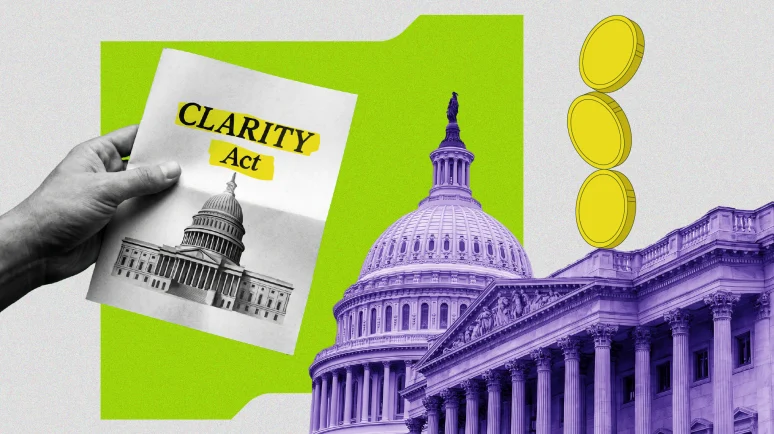
The chances of the CLARITY Act becoming law in 2026 have collapsed to just 10%, according to Galaxy Research, marking a dramatic reversal for legislation once viewed as Washington’s best chance to establish comprehensive crypto market rules this year.
Galaxy Head of Research Alex Thorn lowered the firm’s estimate to 10% on Aug. 14, arguing that unresolved political disputes and an exceptionally narrow Senate calendar have left the bill requiring something close to a legislative miracle.
That is a stunning decline from May. After the Senate Banking Committee advanced H.R. 3633 in a bipartisan 15-9 vote on May 14, Thorn raised Galaxy’s passage probability to 75%.
By July 24, Galaxy had cut the estimate to 30% as negotiations stalled. It is now 10%.
Why CLARITY Act Odds Crashed to 10%
The problem is increasingly political rather than technical.
Thorn identified three major obstacles: unresolved demands for stronger crypto ethics restrictions on government officials, pressure from community banks over stablecoin yield, and disputes over protections for non-custodial software developers. Those disagreements have made reaching the 60 Senate votes needed to overcome a filibuster increasingly difficult.
Time may be the bigger problem.
The Senate left for its August recess without voting on the bill. Thorn noted that lawmakers return on Sept. 14, but the chamber has only around two to three working weeks before senators leave Washington for midterm-election activity around Oct. 2. Without immediate action, there may simply be insufficient floor time.
The collapse is particularly striking because the Senate Banking Committee’s 15-9 vote showed the legislation had genuine bipartisan support only three months ago.
Does This Crush XRP’s Regulatory Hopes?
For XRP, a CLARITY failure would remove an important catalyst, but it would not return the token to the regulatory uncertainty of the SEC-Ripple lawsuit era.
The Ripple case formally ended in August 2025 when both sides dismissed their appeals. That left intact Judge Analisa Torres’ ruling that Ripple’s XRP sales on public exchanges did not constitute securities transactions, while certain institutional sales violated securities laws. Ripple’s $125 million penalty and injunction also remained in force.
The SEC has subsequently moved much further on crypto regulation. Its March 2026 interpretation created a taxonomy including “digital commodities” that are not securities and explained when non-security crypto assets can nevertheless be sold as part of investment contracts. The interpretation does not specifically name XRP, an important distinction.
SEC Could Move Even Without the CLARITY Act
This is where Thorn’s latest argument becomes important for XRP and the wider market.
Galaxy now expects the SEC to release Reg Crypto, its Innovation Exemption, or both over the coming weeks or months, even if Congress cannot pass CLARITY. Reg Crypto would establish a new route for cryptoasset issuance, while the proposed Innovation Exemption is intended to facilitate experimental onchain trading of tokenized securities.
Neither initiative had appeared as a published rule on the SEC’s rulemaking index as of Aug. 16.
So for XRP, the 10% CLARITY estimate is a setback, but not regulatory collapse. The bigger loss would be permanence: agency interpretations can change under future administrations, while an act of Congress would put the market-structure framework into federal law.
Top Trending Crypto Articles
The information provided in this article is for informational purposes only. It is not intended to be, nor should it be construed as, financial advice. We do not make any warranties regarding the completeness, reliability, or accuracy of this information. All investments involve risk, and past performance does not guarantee future results. We recommend consulting a financial advisor before making any investment decisions.

Dr. Guneet Kaur is a senior editor at CCN.com and a Science Fellow at Exponential Science. She is a fintech and blockchain expert with extensive experience in digital finance education, blockchain ecosystems, and cryptocurrency markets. She has worked with global media such as Cointelegraph, as well as education and blockchain platforms, to design and lead strategic content and learning initiatives. As an educator and assessor for top-tier executive programs, she bridges real-world fintech trends with academic insight.
Dr. Kaur is also a published researcher and peer reviewer across fintech and data science journals, including Financial Innovation Journal and International Journal of Big Data Intelligence and Applications. Her work spans data-driven analysis, Web3 innovation, and technical content development. With a strong foundation in both industry and academia, she translates complex financial technologies into practical applications, empowering learners, professionals, and institutions across the rapidly evolving digital finance landscape.











 XRP Price Nears $1 Breakdown as Sellers Overpower Bullish News