Ondo Finance to SEC: Delay Nasdaq’s Tokenized Securities Plan — Transparency at Risk!
Share
Key Takeaways
Nasdaq has filed a proposal with the SEC to allow trading of stock shares as blockchain tokens, settling through the Depository Trust Company (DTC) clearinghouse.
Ondo Finance submitted a letter urging the SEC to delay or deny approval of Nasdaq’s plan until more information is made public.
Ondo warns that without clarity on how DTC will handle tokenized trades, regulators and market participants “cannot fairly assess” the risks.
While SEC Commissioner Hester Peirce calls tokenized assets a “high priority,” watchdog groups like Better Markets caution that rushing in could weaken safeguards.
Nasdaq’s ambitious proposal to bring tokenized stocks into mainstream U.S. markets is facing resistance from an unexpected ally of blockchain innovation — Ondo Finance.
The blockchain asset firm has called on the U.S. Securities and Exchange Commission (SEC) to delay or even reject Nasdaq’s plan to enable trading of tokenized securities.
In an open letter to the regulator, Ondo warned that Nasdaq’s filing lacks transparency and may grant unfair advantages to large market participants, since crucial settlement details remain undisclosed.
This debate is about much more than a single exchange proposal, it’s a snapshot of how the United States is trying to balance financial innovation with fairness and investor protection in the age of blockchain.
Try Our Recommended Crypto Exchanges
Sponsored
Disclosure
We sometimes use affiliate links in our content, when clicking on those we might receive a commission at no extra cost to you. By using this website you agree to our terms and conditions and privacy policy.
These tokenized shares would function as digital twins of conventional stocks, mirroring their rights, value, and identifiers, such as CUSIP numbers.
In essence, a tokenized share is still the same stock, it’s just recorded and transferred via blockchain technology rather than traditional electronic ledgers.
Nasdaq’s filing emphasizes that the move would not create a new crypto exchange or bypass regulations. Instead, the goal is to modernize existing infrastructure by using blockchain as a new settlement layer.
Orders for tokenized trades would be flagged in Nasdaq’s system and settled through the Depository Trust Company (DTC), the backbone of the U.S. post-trade settlement process.
Under the proposal:
Tokenized trades would still settle on a T+1 timeline, just like traditional ones.
Both tokenized and non-tokenized shares would trade in a single order book, ensuring equal pricing and transparency.
Nasdaq and DTC would handle conversions between regular and tokenized shares seamlessly behind the scenes.
Nasdaq argues that this system preserves market integrity while unlocking blockchain’s benefits, such as faster settlement, reduced reconciliation errors, and potential for real-time transparency.
How Depository Trust Company’s Blockchain Settlement System Fits In
The DTC is the clearinghouse responsible for settling nearly all U.S. stock trades. Its role in Nasdaq’s plan is critical: it would act as the bridge between traditional securities accounts and tokenized blockchain records.
Here’s how it would work:
A trade marked for tokenized settlement reaches DTC.
DTC moves the corresponding shares into a special control account.
It then mints equivalent tokens on a blockchain ledger and sends them to the buyer’s digital wallet.
When the tokenized share is converted back, DTC burns the token and re-credits the traditional share.
This structure keeps total shares consistent between both systems. However, Nasdaq’s filing admits that DTC’s blockchain infrastructure is still in development. The exchange described its understanding of DTC’s plans as only a “preliminary sense of the process.”
That uncertainty, what Ondo calls a lack of transparency, lies at the heart of the controversy.
Inside Ondo Finance’s Letter to SEC: Why Nasdaq’s Tokenized Securities Raise Fairness Questions
In October 2025, Ondo Finance submitted a detailed letter urging the SEC to pause Nasdaq’s proposal until more is known about how DTC’s system will work.
However, Ondo argued that Nasdaq’s plan rests on undisclosed information, creating an uneven playing field for market participants.
The firm’s main points to the SEC include:
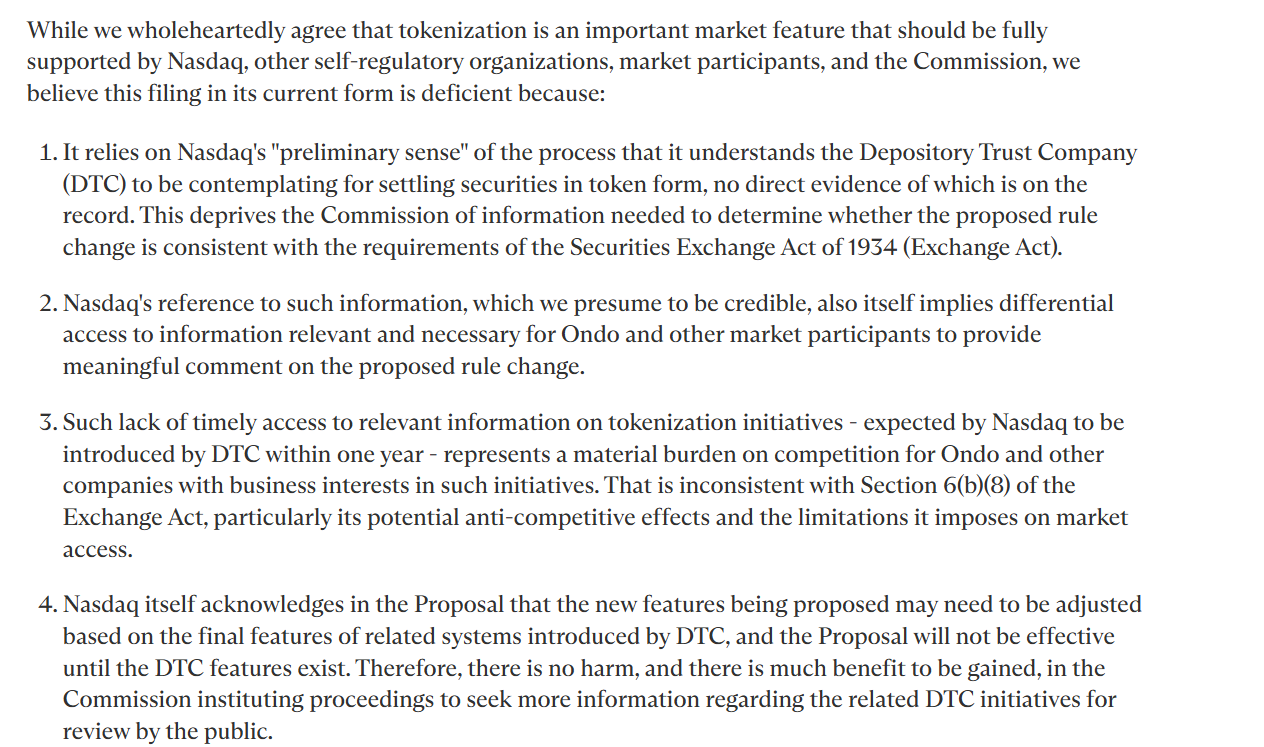
Lack of evidence and transparency: Nasdaq’s proposal is based only on its “preliminary sense” of how the DTC plans to handle blockchain-based settlement. No official or verifiable documentation has been provided. Without direct evidence, the SEC cannot determine whether the plan complies with the Securities Exchange Act of 1934, making the filing legally and procedurally insufficient.
Unequal access to critical information: Nasdaq’s references to non-public information about DTC’s systems suggest that some market participants, including Nasdaq itself, may have privileged access to details unavailable to others. This creates an uneven playing field and prevents firms like Ondo and the broader public from offering meaningful, informed comments during the SEC’s review process.
Risk of anti-competitive access: The lack of timely, public access to DTC’s tokenization plans could distort competition. Nasdaq expects DTC to roll out its blockchain settlement system within a year, but without equal access to information, other companies working on similar tokenization initiatives may face barriers to entry. Ondo argues this violates Section 6(b)(8) of the Exchange Act, which prohibits exchange rules that impose unnecessary or unfair burdens on competition.
An Open Letter to the SEC: A Call for Transparency. | Source: Ondo Finance
Even Nasdaq admits its proposal cannot take effect until DTC’s system is finalized. Given that, Ondo contends there is no harm in delaying approval. Instead, the SEC should institute further proceedings, gather more information about DTC’s initiative, and allow for public review and feedback. This would ensure transparency, fairness, and regulatory consistency before implementation.
Ondo’s head of regulatory affairs, Peter Curley, urged the SEC to ensure open collaboration and transparent standards before making any ruling. The firm emphasized that tokenization should benefit the entire market, not just a select few with insider access.
Why Transparency Matters in Tokenized Markets
Ondo Finance’s stance touches on a core principle of U.S. markets: equal access to information. If some firms have knowledge of or early access to DTC’s blockchain settlement system, they could build technology and services around it before others even know the details.
This could create competitive imbalances, where early movers gain operational advantages, faster settlements, better liquidity access, or lower transaction costs, while others struggle to catch up. Ondo’s letter frames this as not just a business issue but a market fairness concern.
Transparency is also essential for regulatory oversight. The SEC cannot effectively evaluate the safety or systemic risks of a new trading model without understanding how it operates.
Approving Nasdaq’s plan without full visibility into DTC’s blockchain infrastructure would set a precedent of trusting private systems without scrutiny, a risky move in highly regulated markets.
In short, Ondo is reminding regulators and exchanges that innovation should not outpace accountability.
The SEC’s Balancing Act: Innovation vs. Investor Protection
The SEC now faces a delicate balancing act. On one hand, tokenization offers exciting potential for modernizing U.S. markets. On the other hand, the agency must ensure stability, fairness, and investor protection remain uncompromised.
Recent statements from SEC officials suggest that tokenization is a priority area of research. Commissioner Hester Peirce has described blockchain-based securities as a “high focus” for future regulation. The SEC even hosted a Tokenization Roundtable in mid-2025, exploring how distributed ledger technology could improve efficiency in traditional markets.
Given the technical uncertainties and Ondo’s public objections, it’s likely the SEC will extend its review period or request additional details from Nasdaq and DTC. The agency could:
Approve the plan with conditions requiring greater transparency.
Mandate a pilot program under strict oversight.
Or, delay approval until DTC’s system is fully developed and publicly documented.
Ondo’s intervention makes the second and third options more likely.
Tokenized Securities: Why They Matter
To understand why this debate is significant, it helps to grasp what tokenized securities are and why they’re considered the next frontier in financial infrastructure.
A tokenized security represents a traditional asset, such as a stock, bond, or ETF, on a blockchain. Each token corresponds 1:1 to the underlying asset, maintaining the same ownership rights and legal protections.
Potential benefits include:
Faster settlement times, potentially even same-day or instant.
Reduced costs by automating reconciliation between intermediaries.
Enhanced transparency via public blockchain records.
Programmability, allowing new features like smart dividends or fractional ownership.
However, integrating blockchain into regulated markets also introduces technical and legal challenges, especially around custody, cybersecurity, and regulatory oversight.
Nasdaq’s plan attempts to solve these challenges within existing systems, rather than building a parallel crypto exchange. Ondo’s response shows that even industry insiders want strong governance and equal access before tokenization scales up.
How Other Countries Are Regulating Tokenized Securities
While the U.S. takes a cautious approach, other jurisdictions are already experimenting with or adopting frameworks for tokenized securities.
European Union: The EU launched its DLT Pilot Regime in 2023, a regulatory sandbox allowing exchanges and clearinghouses to trade tokenized stocks and bonds under controlled conditions. Participants receive temporary exemptions from certain financial rules, giving regulators a chance to study tokenized market behavior before full-scale rollout. This “test-and-learn” model balances innovation with oversight.
Switzerland: Switzerland legalized tokenized securities through its DLT Act in 2021. The law gives blockchain-based securities the same legal standing as traditional ones, creating clarity for issuers and investors. The SIX Digital Exchange (SDX) now operates under this framework, listing tokenized bonds and equities with full regulatory approval. Switzerland’s success demonstrates how clear rules and open standards can foster confidence in digital finance.
Singapore: Singapore’s Monetary Authority (MAS) integrates tokenized securities into existing laws while promoting innovation. Through Project Guardian, it has tested blockchain settlement for bonds and deposits with major banks. Licensed platforms like InvestaX are already offering tokenized securities under regulatory supervision, showing how collaboration between regulators and industry can drive adoption responsibly.
These international examples highlight that transparency, legal certainty, and phased implementation are universal themes, exactly what Ondo Finance is advocating for in the U.S.
What Happens Next for Nasdaq, the SEC and Tokenized Finance
Nasdaq’s proposal is still under formal SEC review, with an initial 45-day window that can be extended into late 2025. Given Ondo Finance’s objections, the process could stretch well into 2026.
If approved, Nasdaq’s plan would mark the first major integration of blockchain into the U.S. equity market’s core infrastructure, potentially transforming how stocks are issued, traded, and settled.
If delayed, it may signal that regulators want more transparency and coordination between exchanges, clearinghouses, and fintech firms before approving blockchain-based trading.
Either outcome will shape how the U.S. financial system embraces tokenization, whether as a tightly regulated evolution of existing systems or a more open, interoperable ecosystem.
Conclusion
Ondo Finance’s call for transparency isn’t a rejection of progress, it’s a reminder that trust and innovation must evolve together. Blockchain promises faster and fairer markets, but if early implementations favor only a handful of large players, that promise could quickly unravel.
By urging the SEC to pause Nasdaq’s plan, Ondo is pushing for a tokenized future that’s open, equitable, and accountable. Its letter reinforces a truth often forgotten amid hype: in finance, technological breakthroughs are only as strong as the confidence behind them.
Whether the SEC sides with caution or greenlights Nasdaq’s proposal, the conversation sparked by Ondo Finance is already reshaping how regulators, exchanges, and investors think about blockchain integration.
The dawn of tokenized finance is here, but its success depends not just on code or ledgers, but on the transparency and fairness that have long defined healthy markets.
Nasdaq has proposed allowing the trading of traditional stocks and ETFs in tokenized form — meaning digital versions of shares recorded on a blockchain. These tokenized securities would have the same rights and identifiers as regular stocks but would settle using blockchain technology through the Depository Trust Company (DTC).
Why is Ondo Finance urging the SEC to reject or delay Nasdaq’s plan?
Ondo Finance supports tokenization but argues Nasdaq’s plan lacks transparency. In its letter to the SEC, Ondo said key details about DTC’s blockchain settlement system remain undisclosed. Without public information, regulators and investors cannot fully assess the risks or fairness of the proposal.
How does tokenized settlement differ from traditional stock trading?
Traditional trades are settled through centralized systems like DTC using electronic book entries. Tokenized settlement moves those records onto a blockchain, creating digital tokens that represent shares. This can improve speed and transparency, but it also requires new rules, technology, and risk management.
How are other countries regulating tokenized securities?
The European Union has launched a “DLT Pilot Regime” for controlled tokenized stock trading. Switzerland legally recognizes tokenized securities under its DLT Act, and Singapore regulates them through licensed platforms under the Monetary Authority of Singapore. These models highlight transparency and phased testing — principles Ondo Finance is advocating for in the U.S.
Disclaimer:
The information provided in this article is for informational purposes only. It is not intended to be, nor should it be construed as, financial advice. We do not make any warranties regarding the completeness, reliability, or accuracy of this information. All investments involve risk, and past performance does not guarantee future results. We recommend consulting a financial advisor before making any investment decisions.
Onkar Singh has three years of experience as a digital finance content creator. Throughout his career, he has collaborated with various DeFi projects and crypto media outlets. In his leisure time, he enjoys fitness activities at the gym and watching movies across different genres. Balancing his professional and personal interests, Onkar continues to contribute to the digital finance landscape while pursuing his hobbies.


 Easy
Easy