Why the CLARITY Act Died in the Senate: 5 Big Reasons
Share
Key Takeaways
The CLARITY Act failed to clear the Senate’s 60-vote threshold despite more than a year of negotiations and 126 changes Republicans said Democrats requested.
Trump-related ethics concerns dominated the debate, but fights over bank deposits, securities rules, enforcement, and the legislative calendar also fractured support.
The 50-49 procedural result does not necessarily kill the bill: Sen. Thom Tillis changed his vote to preserve a route for reconsideration.
After more than a year of negotiations, 126 revisions requested by Democrats and a final weekend scramble to rewrite some of its most controversial provisions, the CLARITY Act still could not get through the Senate’s front door.
The Senate voted 50-49 on Sept. 15 to invoke cloture on the motion to proceed to the Digital Asset Market Clarity Act, leaving supporters 10 votes short of the 60 required. The vote was procedural rather than a vote on final passage.
This afternoon, Senate Democrats proved they were never truly serious about protecting consumers and preserving American leadership. I sat at the table with Senate Democrats working in good faith to get this done while they played games.
This means the Senate did not vote down the substance of the entire bill, but it refused to end debate and move it into formal consideration.
The result was nevertheless striking because the legislation had previously demonstrated at least some bipartisan momentum. It advanced from the Senate Banking Committee 15-9 in May, and Republicans said the final text incorporated 126 substantive changes requested by Democrats.
So how did a bill that had been negotiated for more than a year end up without a single Democratic vote on the floor?
The answer goes well beyond the familiar argument over whether the Securities and Exchange Commission or the Commodity Futures Trading Commission should regulate crypto.
Five different fault lines converged at almost exactly the wrong time.
Try Our Recommended Crypto Exchanges
Sponsored
Disclosure
We sometimes use affiliate links in our content, when clicking on those we might receive a commission at no extra cost to you. By using this website you agree to our terms and conditions and privacy policy.
1. CLARITY Became a Vote on Trump’s Crypto Business, Not Just Crypto Regulation
The biggest obstacle was one that the original market-structure debate was never designed to address: whether a sitting president should be allowed to hold substantial financial interests in an industry his administration regulates.
President Donald Trump reported more than $1.4 billion from crypto businesses in 2025, including more than $500 million in revenue from World Liberty Financial crypto products, according to his government financial disclosure.
That changed the politics surrounding CLARITY.
For Democrats who might otherwise have supported a market-structure framework, the question was no longer simply whether the SEC or CFTC should oversee a particular token.
It was whether Congress could rewrite the rules governing an industry while the president had significant financial exposure to that same industry.
Sen. Mark Warner illustrated the problem particularly clearly. Warner said negotiators had come close to resolving difficult law-enforcement and national-security issues, but the conflict-of-interest question ultimately prevented him from supporting the procedural vote.
Republicans tried to close that gap.
Their final proposal incorporated much of the Tillis-Gallego ethics framework and expanded the role of state attorneys general in enforcement. Republicans described those provisions as among the toughest ethics restrictions imposed on federal elected officials.
Democrats disagreed that the safeguards went far enough. Their late counterproposal sought, among other things, stronger enforcement and a requirement that a president divest once holdings crossed a specified threshold.
That distinction proved crucial.
The dispute was no longer whether CLARITY needed ethics rules. Both sides had effectively accepted that it did.
They could not agree on what those rules were meant to prevent.
2. Crypto Bill Turned Into a Fight Over Bank Deposits
One of the less obvious reasons CLARITY struggled had little to do with Bitcoin, token classifications or decentralized exchanges.
It was about bank deposits.
Payment stablecoins increasingly compete for the same dollars consumers traditionally hold in bank accounts. If crypto platforms can offer rewards or interest-like incentives on stablecoin balances, banking groups argue customers could move deposits from banks into stablecoins.
That became particularly sensitive for community banks.
All 77 state bankers associations, together with the American Bankers Association and Independent Community Bankers of America, pressed senators to tighten the bill’s stablecoin provisions before the vote. They argued that deposit losses could ultimately reduce the money available for mortgages, agricultural lending, and small-business credit.
Republicans attempted an unusual compromise.
The final CLARITY text gave the Treasury secretary authority to intervene if stablecoin incentives caused damaging deposit flight, creating what supporters called a regulatory “circuit breaker.”
But banking groups argued that the mechanism acted too late. Their position was essentially that regulators should not have to wait for substantial deposit flight before closing the loophole.
That transformed an abstract crypto-policy fight into something senators from agricultural and rural states could view through the lens of local credit.
The concern crossed party lines. Republican Sen. Josh Hawley, who ultimately opposed advancing the bill, raised concerns about the consequences for agricultural lending.
That helps explain why CLARITY’s problems were not purely partisan.
CLARITY was trying to regulate crypto market structure while simultaneously refereeing a much bigger fight over who gets to hold America’s cash.
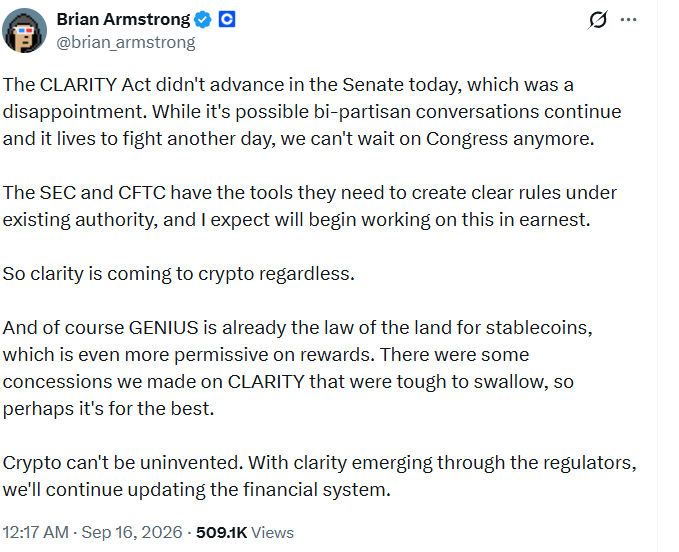
Armstrong Reacts to CLARITY Vote Failure. | Source: @brian_armstrong
3. Crypto Bill Was No Longer Just About Crypto Assets
Another fault line received less attention than the Trump ethics battle: critics argued that CLARITY could affect conventional financial assets as well.
Sen. Elizabeth Warren argued on the Senate floor that provisions in the legislation could allow companies unrelated to crypto to place assets on blockchains and potentially escape protections that otherwise apply under securities law.
She also objected to provisions that expand banks’ ability to conduct activities involving digital assets, including crypto-backed lending, derivatives, and blockchain infrastructure.
Those were arguments made by Warren and other opponents, rather than an agreed interpretation of what the bill would do; supporters said the legislation instead created clearer regulatory guardrails and consumer protections.
That disagreement exposed a deeper problem.
CLARITY started as an attempt to answer a seemingly straightforward question:
When is a digital asset a security, and when is it a commodity?
By the time the Senate reached its vote, lawmakers were debating something much broader: what happens when traditional securities, banks, exchanges and financial products themselves move onto blockchain rails?
That made the legislation harder to contain politically.
A senator did not have to oppose cryptocurrency to worry about how CLARITY might interact with securities law, banking regulation or investor protections.
In other words, the closer crypto gets to mainstream finance, the harder it becomes to write a “crypto-only” law.
4. More Than 100 Compromises Still Could Not Produce a Coalition
Perhaps the strangest part of CLARITY’s failure is how much negotiation preceded it.
The final draft contained 126 substantive changes requested by Democrats, according to Republican sponsors. Those changes covered issues including ethics, stablecoins, developer protections, consumer safeguards and enforcement.
Yet no Democrat ultimately voted to proceed.
That suggests the problem was no longer a collection of individual provisions that could easily be traded away one by one.
The coalition itself had broken down.
Democratic senators who had been viewed as potentially reachable, including Kirsten Gillibrand, Catherine Cortez Masto, Angela Alsobrooks, Cory Booker, and Mark Warner, ultimately opposed advancing the bill.
Here is the full list of votes for Clarity, you are are urged to vote accordingly!
**CLARITY Act cloture — Sept. 15, 2026 — 49 Yes, 50 No, 1 Not Voting**
Alsobrooks — No Baldwin — No Banks — Yes Barrasso — Yes Bennet — No Blackburn — Yes Blumenthal — No Blunt…
Meanwhile, Republicans did not hold their entire conference either.
Susan Collins, Josh Hawley, and Jerry Moran opposed cloture. Thom Tillis ultimately recorded a “no” vote as well, although his switch was procedural rather than opposition to the legislation.
That produced an unusual situation.
The bill had undergone more than a hundred negotiated changes, but those compromises did not add up to 60 votes.
In fact, the number of concessions may reveal something about why CLARITY became so difficult to finish. Every additional issue brought into the negotiations, including stablecoins, DeFi, developer liability, banking, ethics, national security, and enforcement, created another constituency capable of deciding the final text still did not go far enough.
CLARITY was trying to resolve too many unresolved crypto battles in a single piece of legislation.
5. The Senate Ran Out of Political Time
The fifth reason may ultimately prove as important as anything written in the bill.
CLARITY did not merely need more negotiations.
It needed them immediately.
Congress is preparing to leave Washington ahead of the November midterm elections, sharply reducing the remaining legislative window. Reuters reported that the failed vote effectively put the legislation on ice as lawmakers prepare to leave Washington this month.
The timing changed to negotiating incentives.
When lawmakers have months available, voting to begin debate can be relatively low-risk because controversial provisions can still be amended.
When Congress is approaching an election recess, advancing a 600-plus-page financial-regulation package can look much closer to accepting the framework that already exists.
The final Republican text was released only shortly before the vote. Democrats then submitted another counterproposal Monday night, focused partly on expanding the ethics provisions. No agreement was reached before Tuesday’s vote.
Sen. Cynthia Lummis made the compressed timetable explicit before the vote, describing the moment as “now or never” for CLARITY.
That urgency was intended to force a deal.
Instead, it may have made “no” easier.
Lawmakers who remained uncomfortable with one major provision had little reason to assume there would be enough time to fix it later.
CLARITY May Have Failed, But It Is Not Technically Dead
The immediate result looks severe.
Bitcoin fell more than 5% as the vote appeared headed for defeat, while shares of Coinbase and Circle fell as much as 10%, according to Reuters.
The failure also leaves the SEC and CFTC with a larger role in determining crypto policy through agency rulemaking rather than legislation.
But there is an important procedural detail hidden inside the 50-49 result.
Republican Sen. Thom Tillis originally voted yes before switching his vote to no. Reportedly, the switch preserved his ability to seek reconsideration of the failed vote.
People are missing a key detail about today’s Clarity Act vote.
Sen. Thom Tillis initially voted YES, but switched his vote to NO after it became clear the cloture motion had failed.
Why?
Under Senate procedure, a senator who voted with the prevailing side can ask to… https://t.co/Bs0aDSCw4G
Under Senate procedure, a senator on the prevailing side can move to reconsider a vote. Tillis’s switch, therefore, did not necessarily signal that he had abandoned CLARITY; it helped preserve a procedural route for supporters to bring the cloture question back without simply beginning the legislative process from scratch. Tillis subsequently said the maneuver was intended to allow work on the legislation to continue.
There is even a recent crypto precedent. The GENIUS Act initially failed a cloture vote in May 2025, but the Senate later reconsidered and advanced it.
Whether CLARITY can repeat that sequence is another question. The calendar before the midterms is considerably tighter, and supporters would still have to find the missing votes.
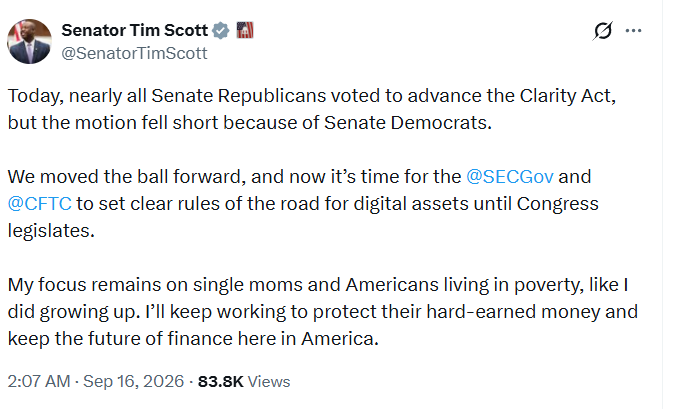
Tim Scott Urges Regulators to Set Crypto Rules. | Source: @SenatorTimScott
The SEC and CFTC have already been working on digital-asset rules, and industry executives, including Coinbase CEO Brian Armstrong, have argued that the agencies can use their existing authority to provide at least some regulatory clarity. But agency rules are also easier for future administrations to reverse or challenge than a framework enacted by Congress.
So Sept. 15 may not ultimately be remembered as the day the CLARITY Act died.
It may instead be the day Washington discovered that deciding who regulates crypto was the easy part. The harder questions are now who can profit from it, whether stablecoins should compete with bank deposits, how blockchain-based finance fits into securities law, and how much of that architecture Congress is actually capable of settling in a single bill.
Disclaimer:
The information provided in this article is for informational purposes only. It is not intended to be, nor should it be construed as, financial advice. We do not make any warranties regarding the completeness, reliability, or accuracy of this information. All investments involve risk, and past performance does not guarantee future results. We recommend consulting a financial advisor before making any investment decisions.
Dr. Guneet Kaur is a senior editor at CCN.com and a Science Fellow at Exponential Science. She is a fintech and blockchain expert with extensive experience in digital finance education, blockchain ecosystems, and cryptocurrency markets. She has worked with global media such as Cointelegraph, as well as education and blockchain platforms, to design and lead strategic content and learning initiatives. As an educator and assessor for top-tier executive programs, she bridges real-world fintech trends with academic insight.
Dr. Kaur is also a published researcher and peer reviewer across fintech and data science journals, including Financial Innovation Journal and International Journal of Big Data Intelligence and Applications. Her work spans data-driven analysis, Web3 innovation, and technical content development. With a strong foundation in both industry and academia, she translates complex financial technologies into practical applications, empowering learners, professionals, and institutions across the rapidly evolving digital finance landscape.