FDIC Rules Out Deposit Insurance for Stablecoins Under GENIUS Act — Here's What It Means for Your Money
Share
Key Takeaways
FDIC has proposed that payment stablecoins under GENIUS Act are ineligible for federal deposit insurance, directly or through pass-through mechanisms.
Stablecoin holders are protected by mandatory 1:1 reserve backing under GENIUS Act, not by any government backstop.
Bank deposits recorded on a blockchain retain full FDIC insurance. Only payment stablecoins lose that protection.
FDIC is drawing this line now, before a bank failure forces the question, protecting both consumers and financial system stability.
The Federal Deposit Insurance Corporation (FDIC) Chairman Travis Hill delivered a message during an American Bankers Association summit in Washington that every stablecoin holder, fintech executive, and bank compliance officer needed to hear: stablecoin users will not be protected by federal deposit insurance – neither directly nor through any backdoor mechanism known as “pass-through insurance.”
The FDIC, Hill confirmed, is planning to formalize this position in a forthcoming proposed rule. It is a decision that carries enormous consequences for the $312 billion stablecoin market, the competitive dynamics between banks and crypto firms, and the long-term architecture of the U.S. digital payment system.
Stablecoin market cap just hit a new all-time high of $312B.
Last year, amidst a regulatory framework in the US, the supply of stables exploded, adding $100B before stagnating.
Now, it appears to finally be breaking out again. This means more liquidity, more assets onchain,… pic.twitter.com/3RlDQLwvuH
To understand why this matters, you first need to understand what was actually at stake.
Pass-Through Insurance Question Nobody Was Asking Loudly Enough
The FDIC’s deposit insurance guarantee, the iconic $250,000 per-account protection that has anchored American consumer confidence in banks since 1933, does not only protect direct bank account holders. It also operates through a mechanism called pass-through insurance, which has existed for decades.
How Pass-Through Insurance Works for Fintechs and Broker-Dealers
Under pass-through insurance rules, a third party such as a broker-dealer, a fintech, or a prepaid card network can hold deposits at a bank on behalf of end-customers. Those deposits are insured as if each end-customer deposited the money directly. This is why many fintech apps that partner with FDIC-insured banks can credibly advertise FDIC protection to their users. Insurance passes through from the bank to the end-customer.
Why Stablecoin Issuers Wanted This Coverage
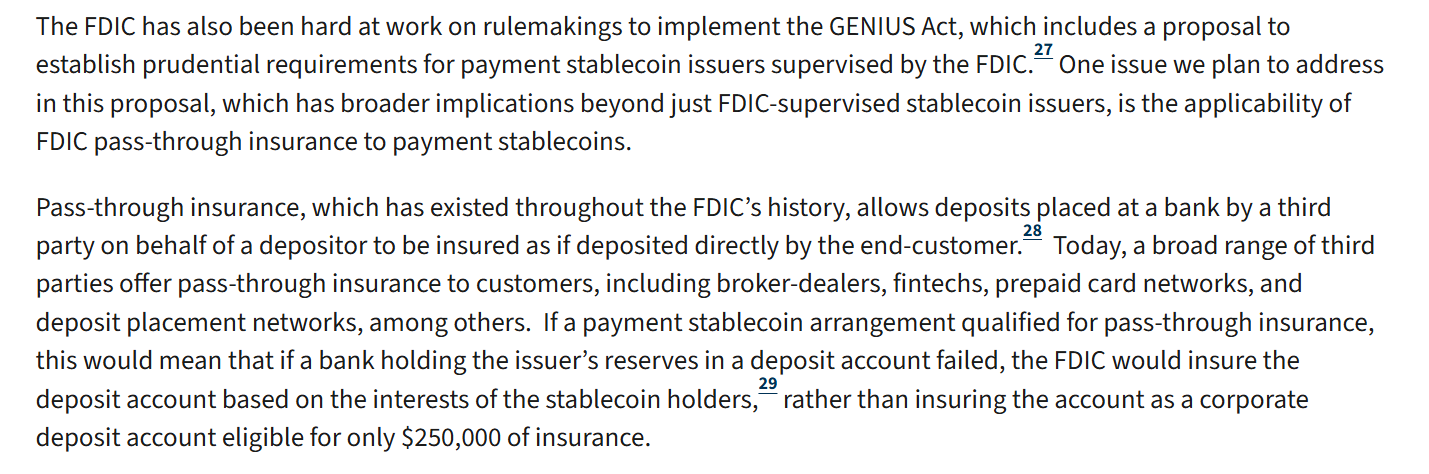
The question that Hill’s announcement resolves is whether this same mechanism could apply to payment stablecoins. In theory, a stablecoin issuer holding reserve funds in an FDIC-insured bank account could potentially argue that stablecoin holders are the real beneficial owners of those deposits, and thus eligible for pass-through coverage.
His reasoning for rejecting this is sound. The GENIUS Act explicitly states that payment stablecoins are not “subject to deposit insurance” and prohibits any party from representing that stablecoins are backed by the full faith and credit of the United States. Allowing pass-through insurance to flow through to stablecoin holders would be, in FDIC’s view, a contradiction in terms. You cannot prohibit a product from being marketed as deposit-insured while simultaneously making it functionally deposit-insured.
FDIC rejects deposit insurance for stablecoins. | Source: FDIC
GENIUS Act: What It Establishes and What It Does Not
Enacted on July 18, 2025, GENIUS Act is the first comprehensive U.S. federal law to bring dollar-pegged digital tokens into a formal regulatory perimeter, a milestone that the crypto industry had pursued for nearly a decade.
Core Requirements Under GENIUS Act Framework
GENIUS Act defines a payment stablecoin as a digital asset designed for use as a means of payment, with issuers obligated to redeem it at a fixed monetary value. Only permitted payment stablecoin issuers (PPSIs) may issue these tokens for U.S. persons. PPSIs must be subsidiaries of insured depository institutions, federally qualified nonbank issuers, or state-qualified issuers with federal approval.
The GENIUS Act is the result of months of good-faith, bipartisan negotiations and has benefited from extensive consultation with industry participants, legal and academic experts, and government stakeholders.
— U.S. Senate Banking Committee GOP (@BankingGOP) May 19, 2025
Law mandates full 1:1 reserve backing with cash or high-quality liquid assets such as U.S. Treasury bills. Issuers must publish recurring reserve reports with clear asset breakdowns. GENIUS Act also prohibits issuers from paying interest to stablecoin holders, a provision that has generated fierce debate between banking industry and crypto exchanges.
What GENIUS Act Deliberately Left Out
What GENIUS Act is explicit about, and what Hill reinforced, is that this regulatory legitimization does not come with a government guarantee. Stablecoins are backed by reserves, not by taxpayers. That distinction is philosophically and practically enormous.
Why FDIC Is Drawing This Line Now
Timing matters here. Many of GENIUS Act’s implementing regulations are required to be issued in final form by July 18, 2026, before the statute takes effect. FDIC is moving proactively to resolve legal ambiguities before a crisis forces the question.
Lessons from SVB Collapse and USDC De-Peg
2023 Silicon Valley Bank collapse provides an instructive precedent. During SVB’s collapse in March 2023, USDC de-pegged sharply, dropping to as low as $0.87. Circle later confirmed it had $3.3 billion, roughly 8% of USDC’s total reserves at that time, parked at SVB. Although Circle recovered funds and USDC returned to its peg, the incident exposed a key vulnerability: lack of immediate liquidity and deep ambiguity about insurance status.
A clear, pre-established rule on deposit insurance would have reduced panic that drove that de-peg. FDIC’s proposed rule would answer this question definitively before a failure makes it urgent.
Safety Net That Does Exist: Reserve Requirements Explained
It is important to be clear about what stablecoin holders do have under the GENIUS Act framework, even without FDIC insurance.
Comparing Stablecoin Reserves to Money Market Funds
While stablecoins will not receive FDIC insurance that has buttressed Americans’ bank accounts for generations, law mandates full reserve backing, providing structural protection through issuers’ own safety net.
This is analogous to how money market funds operate. They are not FDIC-insured, but their regulatory requirements, primarily holding highly liquid, high-quality assets, provide a structural safety cushion.
The key difference from bank deposits is that there is no government backstop if something goes catastrophically wrong. The 2008 “breaking of the buck” at the Reserve Primary Fund, which held commercial paper issued by Lehman Brothers, remains a stark reminder that no reserve regime is perfectly immune to systemic stress during a crisis such as the 2008 Financial Crisis.
What Happened – Reserve Primary Fund: Ground Zero for Breaking the Buck | Source: Faster Capital.
Think of it this way: bank deposits sit in a safe secured by a government lock, while stablecoins under the GENIUS Act sit in a vault with a high-quality, audited lock – but no government key.
Market Implications: Who This Decision Affects
The stablecoin market has grown significantly heading into 2026.
USDC vs USDT: Regulatory Positioning in Post-GENIUS Landscape
U.S. dollar-backed stablecoins reached more than $260 billion in the third quarter of 2025. USDC is currently the dominant GENIUS Act-compliant U.S. stablecoin and remains the only major stablecoin compliant with both GENIUS Act in the U.S. and MiCA regulation in EU.
Tether’s USDT, managed through an offshore structure, is not GENIUS Act-compliant for U.S. users. This prompted Tether to launch USAT in January 2026, issued through a nationally chartered U.S. bank regulated by OCC and backed by Cantor Fitzgerald.
For individual retail users, no-insurance ruling clarifies risk directly. Stablecoins are not bank accounts. They offer speed, programmability, and low transaction costs, but users bear issuer risk that bank depositors simply do not.
Bank Deposit Flight Risk: Real Numbers Behind Concern
Banks have watched stablecoin market’s rise with considerable alarm.
How Stablecoins Could Reshape $6.6 Trillion Deposit Market
Research from the Treasury Department advisory council identified U.S. transactional deposits, a $6.6 trillion market, as at risk from stablecoins. Citigroup research estimates stablecoins outstanding will grow to between $0.5 trillion and $3.7 trillion by 2030, potentially displacing bank deposits of $182 billion to $908 billion.
Hill addressed concern that customers may move money from banks into stablecoins, contending that funds generally do not leave the aggregate banking system, as stablecoin reserves typically sit in bank accounts or Treasury securities. However, distribution effects are real and could disadvantage smaller community banks that lack relationships needed to hold those reserve deposits.
Tokenized Deposits vs Stablecoins: Critical Distinction
One nuance in FDIC’s announcement deserves close attention. FDIC is not treating all blockchain-based financial products equally.
Why Tokenized Deposits Still Qualify for FDIC Insurance
Hill clarified that tokenized deposits, which are bank deposits represented as programmable tokens on a blockchain, should be treated as deposits under existing law, regardless of technology or recordkeeping format. Tokenized deposits therefore remain eligible for standard FDIC insurance treatment.
This distinction is significant. Tokenized deposits are bank deposits, just recorded on-chain. Payment stablecoins are a fundamentally different product. They are claims on an issuer, not claims on a bank account. Regulatory treatment now formally reflects that economic reality, closing a loophole that ambiguity had left open.
Clarity Over Comfort
FDIC’s forthcoming proposed rule will formalize what sound legal analysis of GENIUS Act already suggested: stablecoins are not deposits, and they will not be treated as deposits. This is a reasonable, coherent policy outcome. The GENIUS Act was never designed to make stablecoins a government-guaranteed product. It was designed to make them regulated, reserve-backed, and transparent.
For stablecoin industry, this is not a death sentence. It is a clarification. A well-run, fully reserved, audited stablecoin can be a trusted payment instrument without a government backstop. For users, the message is equally clear: understand what you hold.
For banks watching from the sidelines, FDIC has drawn a line that reinforces deposit insurance guarantee’s singular value, a feature of bank accounts that no stablecoin, by law and by design, can ever replicate.
No. FDIC has formally proposed that payment stablecoins under GENIUS Act are not eligible for federal deposit insurance, either directly or through pass-through mechanisms. Stablecoin holders bear issuer risk that traditional bank depositors do not.
What protects stablecoin holders if not FDIC insurance?
The GENIUS Act requires full 1:1 reserve backing with cash or U.S. Treasury bills, along with regular published reserve reports. This provides structural protection, but no government guarantee exists if an issuer fails. Think of it as a well-audited vault without a government key.
Are tokenized deposits treated the same way as stablecoins?
No, and this distinction matters. Tokenized deposits are standard bank deposits recorded on a blockchain. They retain full FDIC insurance coverage. Payment stablecoins are claims on an issuer, not a bank, so they fall outside deposit insurance protection entirely.
How does this ruling affect USDC and USDT users?
USDC users operating under the GENIUS Act framework now have regulatory clarity: their holdings carry no FDIC backing. USDT is not GENIUS Act-compliant for U.S. users at all. Both products remain usable for payments and transfers, but neither should be treated as equivalent to an insured bank deposit.
Disclaimer:
The information provided in this article is for informational purposes only. It is not intended to be, nor should it be construed as, financial advice. We do not make any warranties regarding the completeness, reliability, or accuracy of this information. All investments involve risk, and past performance does not guarantee future results. We recommend consulting a financial advisor before making any investment decisions.
She is a fintech writer based in Canada with an academic background in psychology and project management. She has previously contributed to crypto media platforms, including Cointelegraph. Her professional experience includes work as a relationship manager in the telecommunications industry, and her writing since 2020 has focused on digital assets, blockchain technology, and artificial intelligence, with attention to their interaction with traditional finance.


 Easy
Easy