Telegram takes control of TON as its largest validator, cutting fees and boosting integration. Discover what this shift means for users and the crypto market. | Credit: CCN
Share
Key Takeaways
Telegram is set to become the largest validator on TON, taking a leading role in the network’s future.
Transaction fees have dropped sharply, with further upgrades expected in the coming weeks.
Deeper integration could bring hundreds of millions of Telegram users closer to Web3 tools.
Telegram is moving from partner to power center in the TON ecosystem.
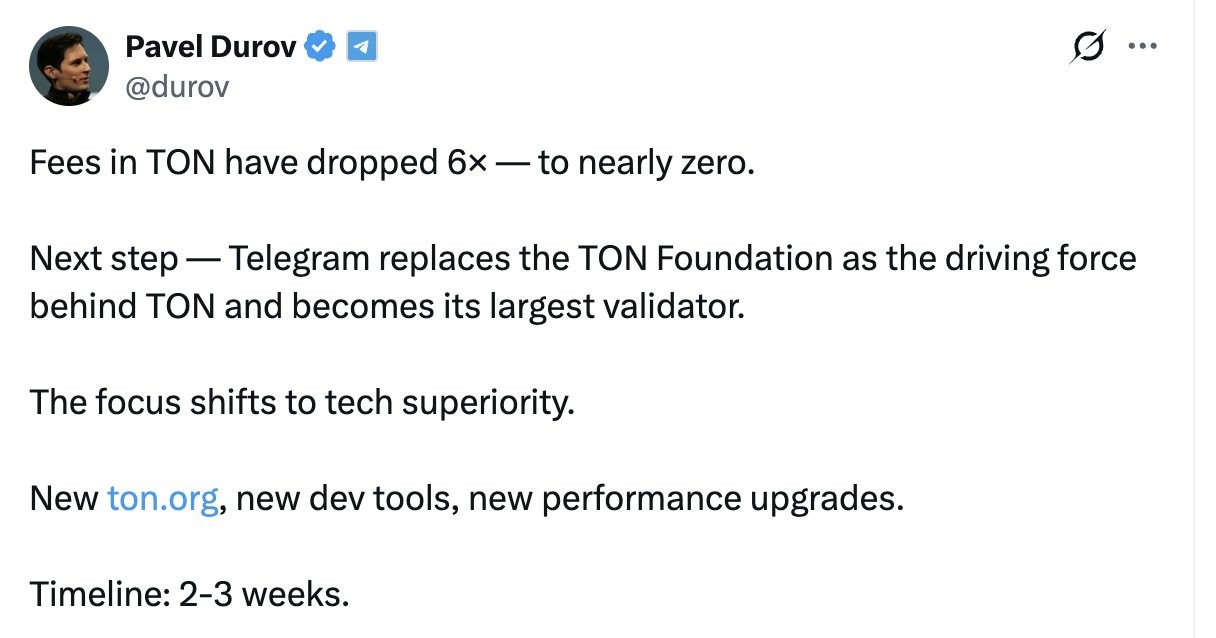
In an update shared on May 4, 2026, Telegram founder Pavel Durov outlined a shift that places the messaging platform at the core of The Open Network (TON).
The company is set to replace the TON Foundation as the primary driver of the blockchain and become its largest validator.
For a network already closely tied to Telegram’s user base, the change formalizes a relationship that had been building for years.
Earn Crypto with These Top Mining Apps
Sponsored
Disclosure
We sometimes use affiliate links in our content, when clicking on those we might receive a commission at no extra cost to you. By using this website you agree to our terms and conditions and privacy policy.
Telegram’s role was influential but indirect, focused on integrating wallets, promoting mini-apps, and driving user adoption.
That balance is now shifting.
Telegram is increasing its on-chain presence by staking millions of TON tokens (reportedly around 2.2 million) to become the largest validator.
Alongside that, it is taking on a more direct role in areas such as infrastructure, technical performance, and long-term development.
In practical terms, this means faster decision-making and tighter coordination between the blockchain and the app that brings it users.
At the same time, early changes are already visible.
Transaction fees have been reduced roughly sixfold, bringing costs down to near-zero levels, around 0.00039 TON (about $0.0005).
Further updates expected in the coming weeks include improvements to developer tools, performance upgrades, and a redesigned ton.org website aimed at supporting broader ecosystem growth.
TON announcement. Source: Pavel Durov on X.
A Long Road Back to Telegram
The shift also closes a loop that began years ago.
TON was first introduced in 2018 as the Telegram Open Network, backed by a record $1.7 billion token sale.
The project aimed to build a high-speed, scalable blockchain that could support payments and applications directly within Telegram.
That effort was halted in 2020 after regulatory action from the US Securities and Exchange Commission (SEC), which led Telegram to abandon the original launch, return funds to investors, and open-source the project’s code.
Development continued independently. A group of developers revived the network under the name The Open Network, with Toncoin as its native asset.
By 2021, the network was live again, operating under a Proof-of-Stake model.
Adoption accelerated in 2023 and 2024, driven largely by Telegram-based mini-apps and viral use cases.
Projects like Notcoin and Hamster Kombat introduced millions of users to blockchain-based interactions.
Additionally, integrations such as USDT support, self-custody wallets, and partnerships with infrastructure providers expanded the ecosystem’s reach.
What the Shift Means for Telegram’s Users and Developers
For users, the direction is toward simplicity.
The goal is to make blockchain functionality feel native inside Telegram, whether through payments, tipping, or in-app transactions, without requiring users to navigate complex crypto interfaces.
Lower fees support that vision. Near-zero transaction costs make microtransactions viable at scale, opening the door to new use cases such as in-app purchases, rewards systems, and advertising payments built on TON.
For developers, closer alignment with Telegram offers both tools and distribution.
While the system still includes other validators, the balance of power is clearly changing.
Supporters see this as a practical evolution, prioritizing performance and user adoption.
Critics may view it as a step away from the original decentralized model.
For now, the focus appears to be on execution.
By aligning the blockchain more closely with one of the world’s largest messaging platforms, TON is positioning itself as infrastructure for consumer-facing crypto applications rather than a purely independent network.
A Broader Signal for the Crypto Market
Telegram’s move reflects a wider trend across the industry.
Prashant Jha is a seasoned crypto journalist based in Delhi, India, with a Bachelor’s Degree in Computer Science Engineering. Passionate about the evolving world of blockchain and cryptocurrencies, he has been a dedicated voice in the industry since 2018. Prashant’s expertise lies in regulatory reporting, where he unravels complex legal and financial developments with clarity and precision. Before joining CCN in 2024, he honed his craft at Cointelegraph, establishing himself as a trusted name in crypto journalism.
His coverage spans major industry events, including the high-profile collapses of FTX, Three Arrows Capital (3AC), and LUNA, offering readers insightful analyses of their regulatory and market implications. Prashant’s technical background enables him to bridge the gap between intricate blockchain technology and its real-world applications, making his work accessible to novices and experts.
Beyond his professional pursuits, Prashant is an avid music enthusiast, often exploring diverse genres to unwind. A sports lover, he has a particular passion for cricket and frequently engages in discussions about the game. His multifaceted interests and sharp journalistic instincts make him a valuable contributor to CCN, where he continues shaping the crypto landscape's narrative.