Pavel Durov believes censorship of Telegram has backfired. | Source: CCN
Share
Key Takeaways
Telegram censorship has backfired, Pavel Durov says.
Political pressure intensifies.
Telegram is rolling out new AI-powered tools and bot capabilities via its “Cocoon” network.
Telegram founder Pavel Durov on Tuesday praised what he called a growing “digital resistance” in Russia and Iran, saying millions of users continue to access the messaging platform despite government restrictions.
The comments come as the company unveiled new artificial intelligence-powered tools and bot capabilities.
Sponsored
Disclosure
We sometimes use affiliate links in our content, when clicking on those we might receive a commission at no extra cost to you. By using this website you agree to our terms and conditions and privacy policy.
Pavel Durov Celebrates Telegram Censorship Failings
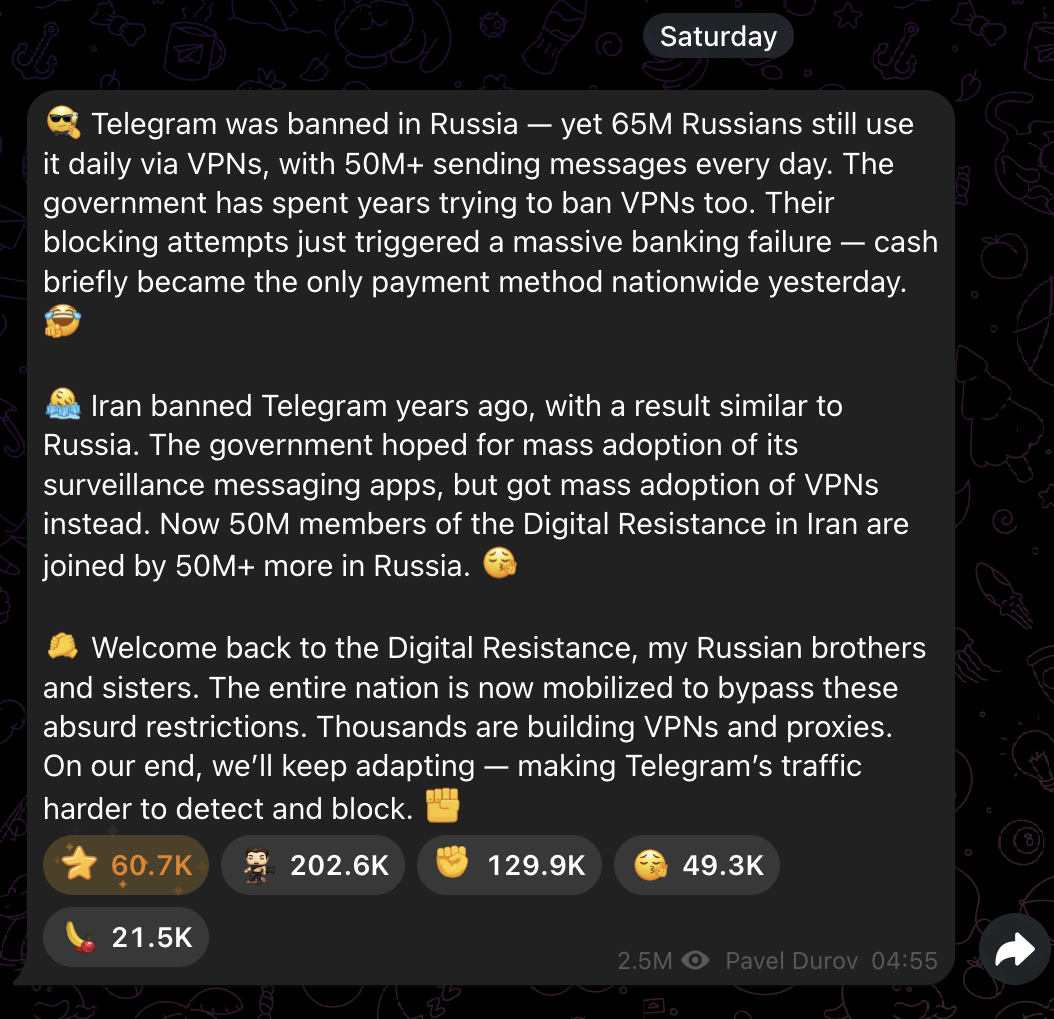
In a series of posts on Telegram, Durov said attempts by authorities in both countries to curb access to the app had failed, instead driving widespread use of virtual private networks (VPNs) and other circumvention tools.
“Telegram was banned in Russia — yet 65 million Russians still use it daily via VPNs, with more than 50 million sending messages every day,” Durov wrote.
He added that efforts to block VPN services had backfired, claiming that recent restrictions had contributed to disruptions in Russia’s banking system that had briefly forced reliance on cash payments.
Pavel Durov highlights Telegram users in Russia and Iran | Source: Telegram
He drew parallels with Iran, where Telegram has been officially banned since 2018, saying the outcome had been similar.
“Now 50 million members of the Digital Resistance in Iran are joined by 50 million-plus more in Russia,” Durov said, describing users bypassing restrictions as part of a broader movement.
“Thousands are building VPNs and proxies,” he added.
Telegram Crackdowns Spur User Pushback, Pavel Durov Says
Authorities in Russia have intensified pressure on Telegram in recent months, arguing the platform fails to comply with domestic laws and does not adequately cooperate in tackling alleged criminal activity, including terrorism-related content.
According to reporting by CNBC, the Kremlin has sought to promote a state-backed messaging service as an alternative.
The push, by a broader tightening of internet controls since the invasion of Ukraine, has drawn criticism from some pro-government figures and activists.
The criticism questions that Telegram could disrupt communication networks relied upon by civilians, businesses and even pro-war groups.
Telegram remains deeply embedded in Russian public life, used by officials, bloggers, businesses and volunteers supporting military efforts.
Some users have reported slower speeds and intermittent disruptions, while authorities have also been linked to wider mobile internet outages justified on security grounds.
Russian regulators have also targeted Durov personally, with authorities opening a criminal case accusing him of “assisting terrorism activity,” though no formal charges have been filed.
In Iran, where authorities banned Telegram over security concerns, Durov said the restrictions similarly failed to displace the platform.
Instead, they triggered a surge in VPN adoption and development, as users sought to maintain access.
Russia Disruption Linked To VPN
Durov also said Russia’s recent efforts to block VPN services had triggered wider technical disruptions, including problems with domestic payment systems, according to Reuters.
The incident, which Russian authorities have not fully explained, caused temporary chaos for consumers.
Moscow’s metro reportedly allowed passengers through turnstiles without payment, while some venues asked visitors to pay in cash during the disruption.
Russia’s largest lender, Sberbank, acknowledged a technical issue on Friday but did not provide details.
Some local media outlets later removed reports that linked the outage to state efforts to block VPNs or websites.
Authorities have also targeted messaging platforms, including Telegram and WhatsApp, arguing that malicious actors use them for criminal and extremist activity.
Telegram Rolls Out AI Tools
Alongside his comments on censorship, Durov highlighted a series of new Telegram features centered on artificial intelligence and automation.
The company said it has introduced an AI-powered text editor embedded in the message interface, allowing users to rewrite, translate or modify messages in different styles.
The tool runs on Telegram’s “Cocoon” network, which the company describes as a decentralized system designed to process AI requests with “100% confidentiality.”
Meanwhile, Telegram said it is expanding its bot ecosystem, enabling bots to create and manage other bots, lowering technical barriers for users and developers to deploy AI-driven services.
The platform has also added real-time streaming responses for chatbots, aimed at improving interactions with AI assistants.
Additional updates include expanded polling features — such as attaching media, enabling user-generated options and setting time limits.
“Telegram users can expect new AI-related features built on 100% confidentiality,” Durov said, adding that the company would scale its infrastructure.
August reports from consumer watchdog Which? identified multiple scam groups operating on Telegram, including channels posing as recruitment agencies offering fake job opportunities linked to brands such as Shein or film platforms like IMDb.
Victims were typically promised easy income for simple online tasks, only to be persuaded to pay upfront fees to unlock higher earnings — payments that were never returned.
Durov previously said Telegram had received “hundreds of reports about scams and blackmail,” prompting a renewed enforcement push.
“Based on these reports, this week we’re banning numerous channels for doxing and extortion,” he wrote, adding that action would be taken where there is “undeniable evidence” of wrongdoing.
He also warned against attempts to evade enforcement through duplicate channels.
“To those running such channels: don’t waste your time creating clones — we’ll find you,” he said.
Telegram has long faced criticism from regulators and law enforcement agencies over its moderation practices, particularly its use of encrypted communications, which can make oversight more difficult.
In Russia, authorities have cited fraud and security concerns in imposing restrictions on some Telegram services, including voice calls, as part of a wider effort to assert greater control over digital platforms.
Telegram said it removes “millions of pieces of harmful content every day” and continues to invest in tools to combat abuse.
Kurt Robson is a London-based reporter at CCN, specialising in the fast-moving worlds of crypto and emerging technology. He began his career covering local news in Cornwall after graduating from Falmouth University with First Class Honours in Journalism. There, he cut his teeth on everything from council meetings to missing swans.
He quickly rose through the ranks to become a frontline journalist at several of the UK’s leading national newspapers. Over the years, he has interviewed musicians and celebrities, reported from courtrooms and crime scenes, and secured multiple front-page exclusives.
Following the upheaval of the COVID-19 pandemic, Kurt shifted his focus to technology journalism—just ahead of the AI boom. With a natural curiosity and a trained eye for emerging trends, he has found a new rhythm in reporting on innovation.
At CCN, Kurt's work focuses on the cutting edge of crypto, blockchain, AI, and the evolving digital world. Drawing on his background in people-first reporting and his deep interest in disruptive tech, Kurt delivers stories that are insightful, entertaining, and human-centric.