Key Takeaways
- Pokémon cards rose about 28% year-to-date in 2026, outperforming the S&P 500’s 13% gain and Bitcoin’s 29% decline.
- The trading-card market is now estimated at $10–15 billion, fueled by scarcity, nostalgia, retail demand and record-breaking sales.
- Logan Paul’s $16.5 million Pikachu Illustrator sale demonstrated the extraordinary demand at the top of the collectibles market.
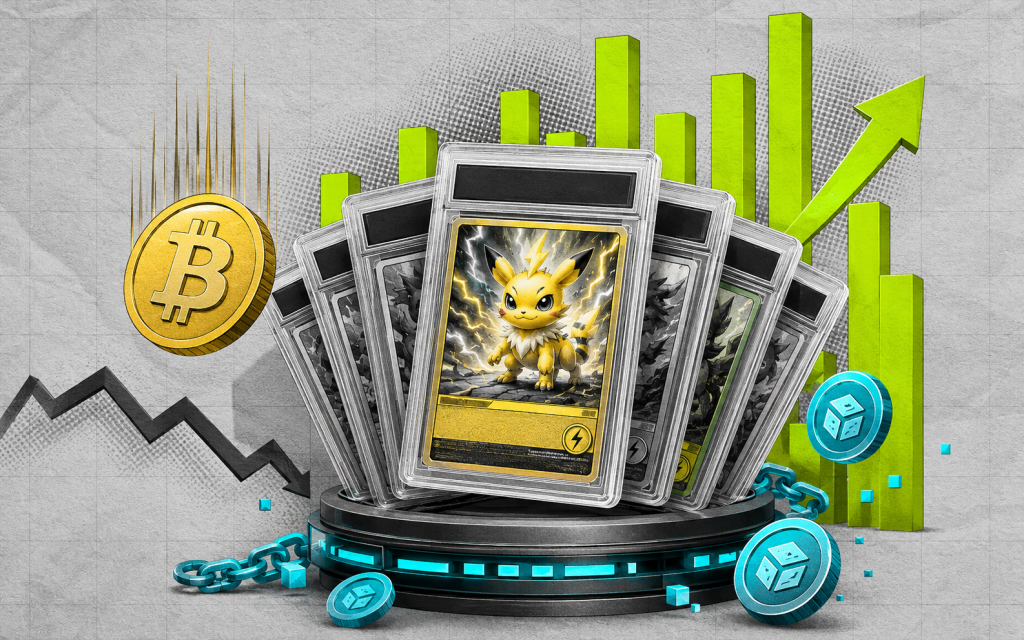
Pokémon cards have outperformed both Bitcoin and the S&P 500 in 2026, highlighting how the once-niche hobby has evolved into a multibillion-dollar alternative asset market.
A Pokémon card index gained approximately 28% year-to-date, compared with a 13% rise for the S&P 500 and a 29% decline for Bitcoin.
The surge comes as collectors camp outside retailers for new releases, celebrity purchases generate headlines and crypto companies race to bring card trading onchain.
Pokémon Card Market Reaches New Heights
Demand for Pokémon cards has become increasingly visible at major retailers. In April, hundreds of buyers reportedly lined up outside a Costco in British Columbia at 3:30 a.m. to purchase Prismatic Evolutions boxes.
Products selling for roughly $100 at retail were subsequently listed for multiples of that price on secondary markets.
Target said trading-card sales increased nearly 70% last year, driven largely by Pokémon, while Walmart reported a 200% jump in trading-card sales through its online marketplace. Both retailers have introduced purchase limits to discourage scalping.
At the top of the market, influencer Logan Paul sold his Pikachu Illustrator card to AJ Scaramucci, founder of Solari Capital and son of financier Anthony Scaramucci, for $16.5 million. Paul reportedly made more than $8 million in profit.
Estimates place the wider trading-card market between $10 billion and $15 billion. TCGCharts values the graded-card segment alone at approximately $10.8 billion.
Crypto Platforms Put Collectibles Onchain
Despite the market’s growth, trading physical cards remains cumbersome. Owners typically have to send cards for grading, wait for authentication, list them on a marketplace, pay fees, and ship them to buyers.
Platforms including Deadstock, Courtyard, and Collector-Crypto are attempting to streamline that process.
Cards are authenticated and held in secure vaults, while blockchain-based tokens representing ownership are issued for round-the-clock trading. Token holders can redeem the underlying cards later.
The model applies the same real-world asset infrastructure already used for gold, private credit, and US Treasuries to collectible cardboard.
Courtyard has recorded approximately $139 million in 30-day trading volume, suggesting meaningful demand for faster settlement and digitally transferable ownership.
ATH Labs is also betting that access to inventory will matter more than tokenization alone. Through a partnership with Japan Trading Card Center, Deadstock has secured exclusive access to tokenize inventory from one of Asia’s largest card-sourcing networks.
eBay Still Controls Price Discovery
Blockchain may make settlement faster, but it cannot guarantee liquidity. eBay remains the dominant marketplace for trading cards, recording $2.62 billion in individual card sales during 2025. Its large buyer base and extensive record of completed transactions make it central to price discovery.
That advantage is particularly important because seemingly identical cards can command very different prices depending on grade, centering, provenance, and condition. Rare cards may trade so infrequently that only a handful of comparable sales exist.
Tokenized marketplaces must therefore solve a chicken-and-egg problem: sellers want access to buyers, while buyers gravitate toward platforms with deep inventory and reliable pricing.
The platforms most likely to succeed may be those that secure exclusive supply and build genuine liquidity, rather than simply attaching tokens to collectibles.
Even when the asset is a Charizard, the winning proposition could be better market infrastructure rather than blockchain hype.
Top Trending Crypto Articles
The information provided in this article is for informational purposes only. It is not intended to be, nor should it be construed as, financial advice. We do not make any warranties regarding the completeness, reliability, or accuracy of this information. All investments involve risk, and past performance does not guarantee future results. We recommend consulting a financial advisor before making any investment decisions.

Giuseppe Ciccomascolo began his career as an investigative journalist in Italy, where he contributed to both local and national newspapers, focusing on various financial sectors.
Upon relocating to London, he worked as an analyst for Fitch's CapitalStructure and later as a Senior Reporter for Alliance News. In 2017, Giuseppe transitioned to covering cryptocurrency-related news, producing documentaries and articles on Bitcoin and other emerging digital currencies. He also played a pivotal role in establishing the academy for a cryptocurrency exchange website. Crypto remained his primary area of interest throughout his tenure as a writer for ThirdFloor.