Key Takeaways
- Japan’s Nikkei 225 and South Korea’s Kospi fell sharply as surging crude prices hit energy-importing Asian economies first.
- Brent crude rose about 27% to roughly $117.58 a barrel as markets priced in a deeper supply shock tied to the U.S.-Iran conflict and disruption around the Strait of Hormuz.
- Bitcoin and the broader crypto market have been more stable than Asian equities, even as some traders turned to oil-linked crypto derivatives to express the war trade.
- Arthur Hayes has warned that global markets may still be underpricing the risk of a longer conflict, leaving room for a later crypto sell-off.
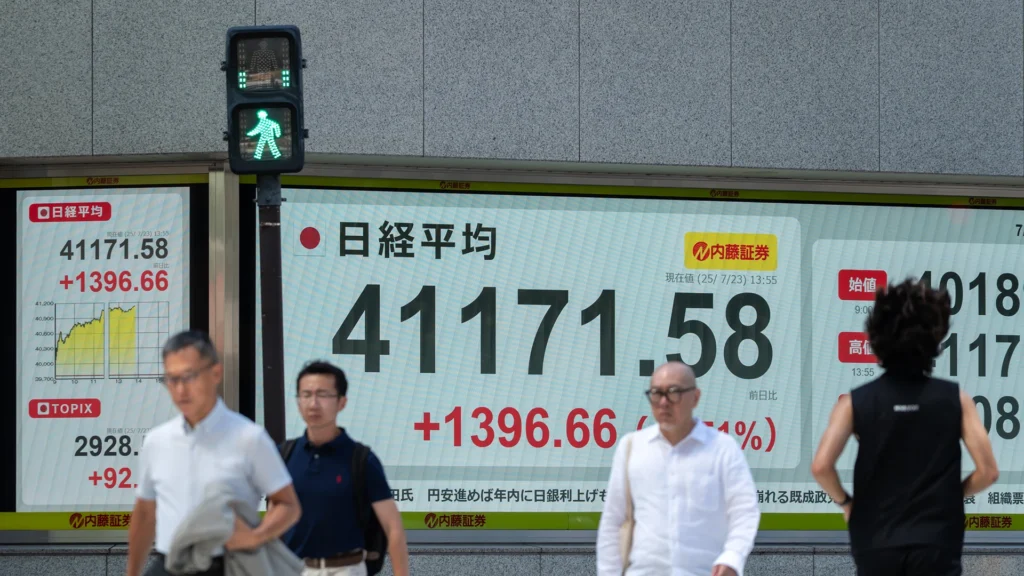
Asian stock markets fell sharply Monday as surging oil prices deepened fears of a wider U.S.-Iran war.
Japan’s Nikkei 225 dropped about 7%, while South Korea’s Kospi fell 8.2%, as Brent crude jumped roughly 27% to around $117.58 a barrel, one of its largest daily gains on record.
The sell-off was particularly severe in Japan and South Korea because both economies rely heavily on imported energy.
A sudden rise in oil prices feeds quickly into fuel costs, inflation expectations and currency pressure, leaving investors to reassess the outlook for growth and interest rates.
Asian Markets Are Pricing the Oil Shock First
For Japan and South Korea, the oil rally is an immediate economic shock, not just a geopolitical headline.
South Korea said it would impose a domestic fuel price cap and consider broader support measures after local assets sold off, the won weakened and trading curbs were triggered.
That helps explain why Asian equities have fallen harder than crypto.
Higher crude raises input costs, fuels inflation fears and hits import-dependent economies first.
Crypto Has Been More Stable, for Now
Digital assets have been hit by the geopolitical shock, but not as hard as Asian equities.
Bitcoin rebounded above $73,000 after falling to around $63,000 following the initial U.S. and Israeli strikes on Iran.
Fresh inflows into U.S. spot Bitcoin Exchange-Traded Funds (ETFs) and improved futures positioning helped kickstart BTC’s comeback.
Still, that does not make Bitcoin a safe-haven asset.
For now, crypto is holding up better because it is less directly tied to the oil-driven pressures hitting Asian stocks, including import costs, earnings expectations and inflation fears.
Some of the War Trade Is Moving Through Crypto Derivatives
Part of the reaction is showing up in crypto-linked commodity markets rather than in spot Bitcoin.
Over the weekend, traders used platforms such as Hyperliquid to trade oil-, gold- and silver-linked perpetuals while traditional markets were closed, turning crypto rails into a round-the-clock venue for macro hedging.
Coinbase is part of the picture too, offering regulated oil and gold futures through its derivatives arm.
The products differ, but the trend is the same: traders are increasingly using crypto-connected markets to price commodity and geopolitical risk directly.
Hayes Warns Markets May Be Underpricing the Risk
Crypto’s relative calm may not last.
In a recent interview, Arthur Hayes said he does not think markets are fully pricing a longer U.S.-Iran war.
If oil stays high and financial conditions tighten, Bitcoin and the broader crypto market could face another leg lower.
That view matches a broader defensive tone in global markets, even without a full crypto capitulation so far.
Oil Remains the Main Story
The core driver of the sell-off remains oil.
Both Brent and WTI briefly approached $120 a barrel as traders priced in prolonged disruption around the Strait of Hormuz, through which roughly one-fifth of the world’s oil passes.
Supply cuts in the region have added to fears that the shock could prove more than temporary.
That matters for crypto because a sustained rise in energy prices could keep inflation high, reduce the likelihood of rate cuts and tighten liquidity conditions across risk assets.
Those are the kinds of macro pressures that tend to catch up with digital assets sooner or later.
Why Crypto Isn’t Panicking Yet
The divergence is straightforward.
Asian equities are pricing the direct economic hit from higher oil prices.
Crypto is facing the same geopolitical backdrop, but ETF inflows, earlier deleveraging and derivatives positioning have softened the immediate reaction.
That may look like resilience. It may also mean the repricing is not over.
If oil stays above $110 and the conflict widens, the same macro pressures hitting the Nikkei and Kospi could start weighing more heavily on Bitcoin and the broader crypto market.
Top Trending Crypto Articles

PhD, researcher and writer exploring AI, blockchain, and the philosophy of tech, with a focus on DeScAI, governance, and trust.