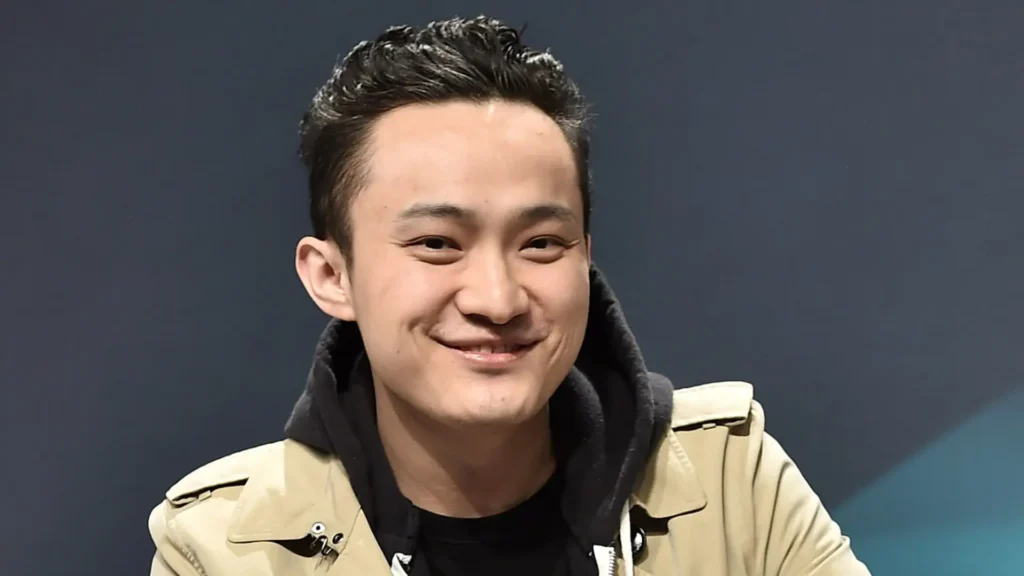
What started as a calculated move to gain political access and influence has quickly turned into a high-stakes loss, involving frozen funds, collapsing token prices, and an escalating dispute with the very project he backed.
We sometimes use affiliate links in our content, when clicking on those we might receive a commission at no extra cost to you. By using this website you agree to our terms and conditions and privacy policy.
By January 2025, he had expanded that position to $75 million, doubling down despite broader market skepticism around the project.
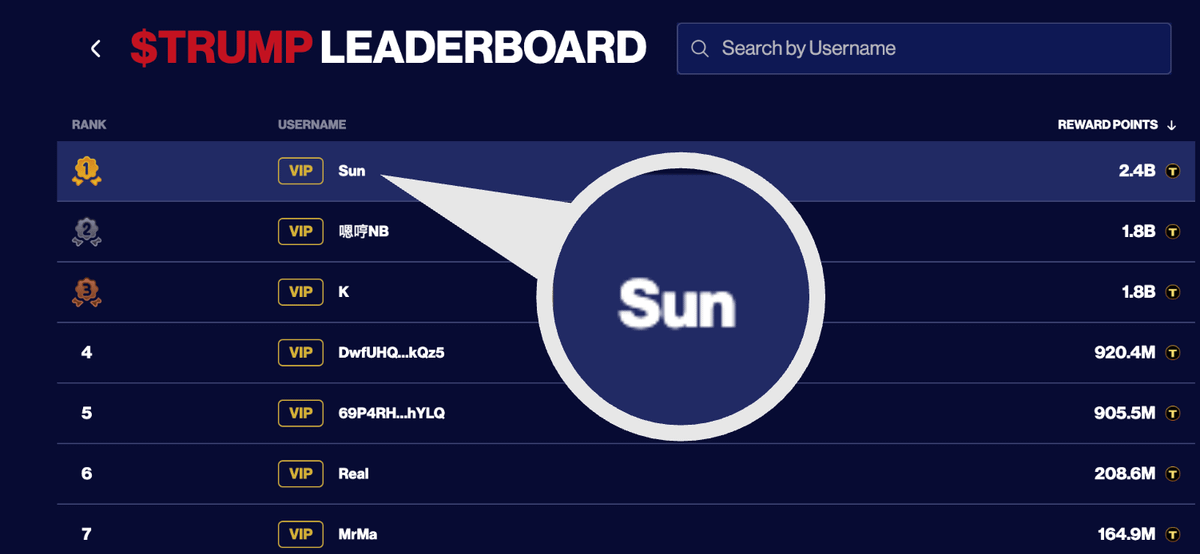
Justin Sun topped among Trump memecoin holders. Credit: X.
At the same time, Sun was building exposure to the TRUMP memecoin.
By May 2025, his holdings, valued at roughly $18–19 million, made him the largest known holder, securing access to an exclusive dinner with President Trump at Trump National Golf Club.
Sun continued to scale his position.
In July 2025, he publicly committed an additional $100 million to the memecoin, reinforcing what appeared to be a long-term alignment with Trump-linked crypto assets.
Additional pledges followed, including a reported $20 million commitment later that year, bringing his total exposure across both WLFI and TRUMP to approximately $190 million.
From High Conviction to Heavy Losses
The returns on that strategy have been sharply negative.
WLFI, once a flagship DeFi project, has seen its token price fall significantly.
Sun’s $75 million stake—roughly 545 million tokens—is now worth about $43 million, reflecting a steep decline from both the entry price and peak valuations.
Losses on the TRUMP memecoin have been even more severe.
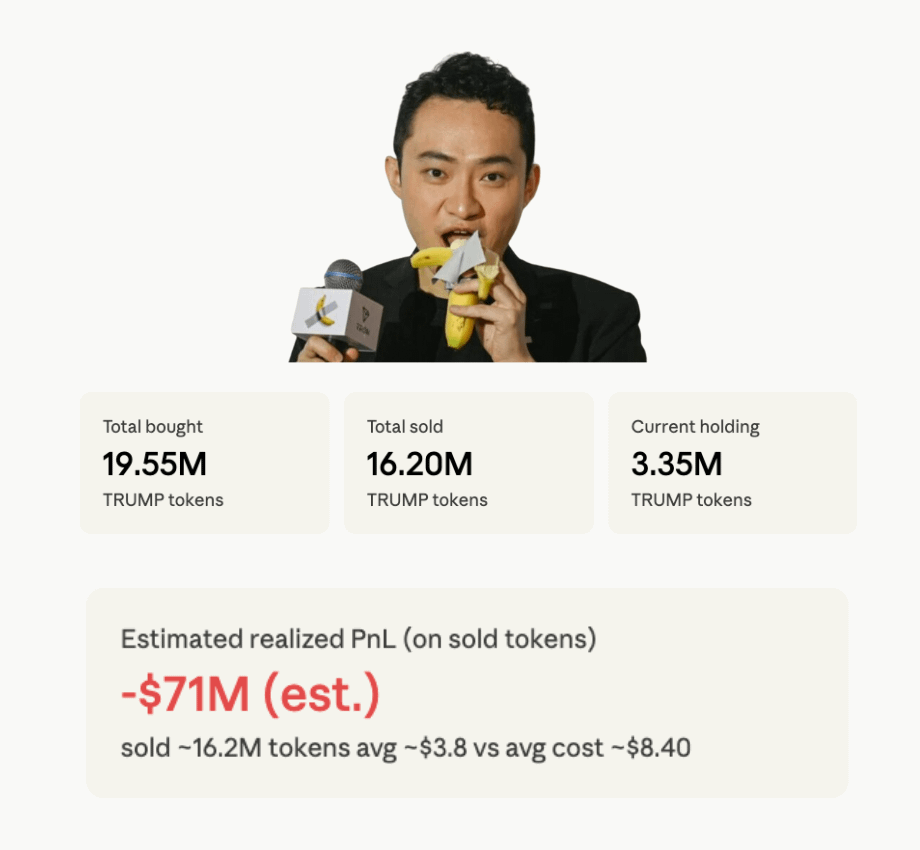
Sun’s purchases were concentrated near peak prices, and the token has since collapsed, with estimates suggesting declines of up to 95% from those levels.
His combined positions—spanning early purchases, the $100 million commitment, and subsequent buys—have resulted in losses exceeding $70 million, according to market observers.
Taken together, Sun’s Trump-linked portfolio has lost well over $100 million in value, transforming what was meant to be a strategic investment into one of the most expensive miscalculations in recent crypto history.
A Reputation Comes Full Circle
The fallout carries an added layer of irony.
Sun has long faced criticism within the crypto industry for aggressive promotion tactics and allegations of market manipulation.
In 2023, the U.S. Securities and Exchange Commission charged him and his entities with fraud-related violations, including unregistered token sales and wash trading.
Critics have frequently portrayed him as a figure who benefits from hype-driven cycles—entering early, promoting heavily, and exiting ahead of retail participants.
Now, the dynamic appears reversed.
Sun has accused WLFI of embedding a “backdoor” in its token contract that enables selective freezes.
He called the project a “personal ATM” for its operators and described himself as its “first and single largest victim.”
WLFI has rejected those claims. The team argued that it implemented the blacklist in response to suspicious activity and warned of potential legal action.
A Costly Lesson in Crypto and Politics
Beyond the personal losses, the episode reflects broader risks at the intersection of crypto and political alignment.
But as the market turned and governance tensions escalated, that strategy began to unravel.
The combination of illiquid tokens, sharp price declines, and disputed control mechanisms has exposed vulnerabilities that extend beyond any single project.
For the broader crypto market, the lesson is clear: influence does not guarantee protection, and even well-connected investors remain exposed to the same structural risks as everyone else.
For Justin Sun, the outcome is more direct.
What began as a $190 million bet on access and alignment has become a case study in how quickly those assumptions can break down.
Prashant Jha is a seasoned crypto journalist based in Delhi, India, with a Bachelor’s Degree in Computer Science Engineering. Passionate about the evolving world of blockchain and cryptocurrencies, he has been a dedicated voice in the industry since 2018. Prashant’s expertise lies in regulatory reporting, where he unravels complex legal and financial developments with clarity and precision. Before joining CCN in 2024, he honed his craft at Cointelegraph, establishing himself as a trusted name in crypto journalism.
His coverage spans major industry events, including the high-profile collapses of FTX, Three Arrows Capital (3AC), and LUNA, offering readers insightful analyses of their regulatory and market implications. Prashant’s technical background enables him to bridge the gap between intricate blockchain technology and its real-world applications, making his work accessible to novices and experts.
Beyond his professional pursuits, Prashant is an avid music enthusiast, often exploring diverse genres to unwind. A sports lover, he has a particular passion for cricket and frequently engages in discussions about the game. His multifaceted interests and sharp journalistic instincts make him a valuable contributor to CCN, where he continues shaping the crypto landscape's narrative.