Justin Sun Accuses Trump-Linked WLFI of Freezing 544M Tokens — Here’s Are the Claims
Share
Key Takeaways
Justin Sun claims 544 million WLFI tokens were frozen after transferring $9 million worth of tokens to exchanges.
Sun alleges WLFI used a blacklist function that was not clearly disclosed to investors.
World Liberty Financial says restrictions were security measures and has suggested legal action.
The dispute raises questions about centralization, governance transparency, and investor protections in DeFi projects.
A public dispute has emerged between Justin Sun and World Liberty Financial, a decentralized finance platform reportedly linked to the business network surrounding Donald Trump.
The controversy centers on 544 million WLFI tokens that Sun claims were frozen after he transferred a portion of his holdings to exchanges. Sun alleges the project used a blacklist function embedded in the token contract, while WLFI has rejected the claims and suggested legal action may follow.
我一直是特朗普总统及其加密友好政策的坚定支持者。
作为World Liberty Financial的早期支持者,我在项目初期投入了大量资金,因为我相信该项目向公众展示的愿景:一个促进金融自由、去除中介、将去中心化金融的福祉带给普通民众的DeFi平台。
The situation has quickly gained attention across crypto markets, not only because of the figures involved, but also because it raises broader questions about centralization, governance transparency, and investor protections in DeFi projects.
How the Justin Sun vs WLFI Dispute Began
The conflict appears to have started after Justin Sun transferred approximately $9 million worth of WLFI tokens to cryptocurrency exchanges. Shortly afterward, Sun stated publicly that his wallet had been restricted and that 544 million WLFI tokens were effectively frozen.
Sun argued that the freeze came without prior warning and claimed the token contract included a blacklist mechanism that had not been clearly disclosed to investors. He also emphasized that he had invested roughly $75 million in WLFI, making him one of the largest known investors in the project.
According to Sun, the move contradicted the core principles of decentralized finance, where investors typically expect control over their own assets without intervention from a centralized authority. He framed the incident as a governance and transparency issue rather than a technical misunderstanding.
Crypto commentator Quinten François said the $WLFI–Justin Sun dispute began after Sun allegedly moved newly unlocked WLFI tokens to his exchange HTX, calling them ‘test transactions.’
According to François, Sun then offered high yields to WLFI presale investors to lock their tokens on HTX, while allegedly selling tokens behind the scenes. He claims Sun may have planned to cover user balances later using future token unlocks.
François added that the WLFI team froze Sun’s wallet, alleging a contract breach, while Sun denied wrongdoing and said the freeze was ‘without cause.’
At the time of writing, Sun’s claims remain allegations. No independent audit or court ruling has confirmed whether a hidden blacklist function was used or whether the freeze followed existing project rules.
WLFI Pushes Back Against the Claims
World Liberty Financial responded publicly, rejecting Sun’s accusations and defending its actions. The project stated that wallet restrictions were implemented as part of security and risk-management measures, rather than targeting a single investor.
WLFI suggested that certain addresses were restricted due to potential phishing risks or suspicious activity, and argued that such controls were necessary to protect the broader community. The project also accused Sun of mischaracterizing events and attempting to create a misleading narrative.
In some public responses, WLFI indicated that legal action could follow, escalating what had initially been a governance dispute into a potential legal confrontation.
While the tone of the responses has been strong, these counter-claims are also unverified. As with Sun’s allegations, the final outcome will likely depend on documentation, contract analysis, or potential legal proceedings.
Justin Sun called on World Liberty Financial to publicly disclose who controls the guardian wallet and multisig governing WLFI, saying investors deserve transparency over who has the power to freeze assets.
Sun said on-chain data shows a single guardian address blacklisted his wallet, and that the same address also controls a second guardian safe with a threshold of one, meaning one individual could freeze any holder’s assets with a single signature.
He argued that while seizing assets requires a 3-of-5 multisig vote, freezing only needs one signature, raising concerns about centralized control within a project that promotes decentralization.
Sun added that community governance becomes “meaningless” if real authority sits with an anonymous wallet, and urged the WLFI team to identify who controls the keys if there is nothing to hide.
Does WLFI Have the Ability to Freeze Wallets?
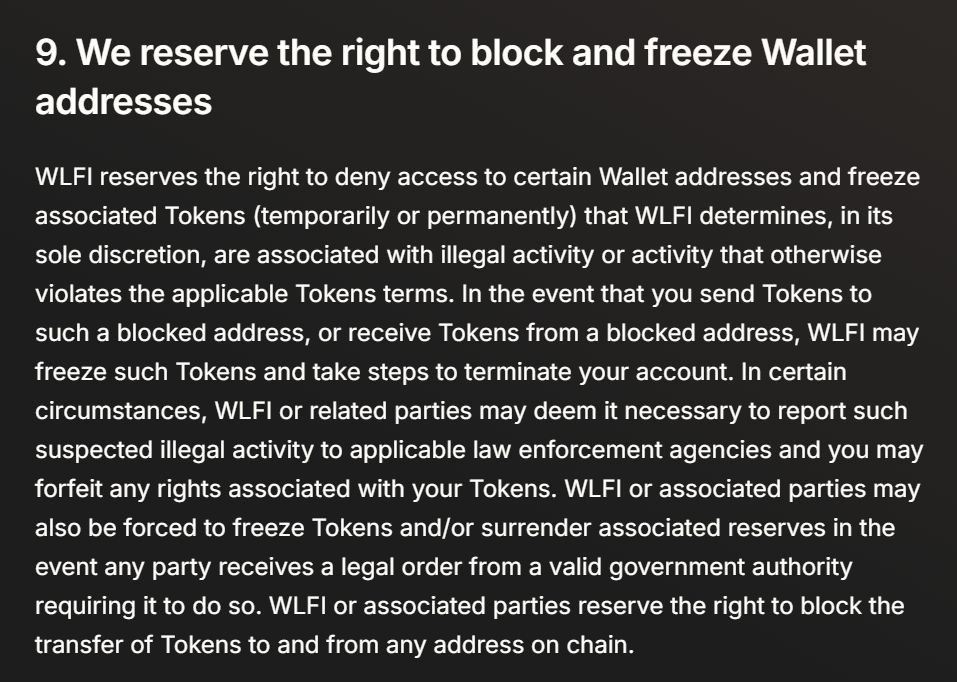
A central question in the dispute is whether WLFI had the technical ability to freeze wallets in the first place. Publicly available documentation from WLFI suggests that the project reserves the right to restrict or block certain wallet addresses under specific circumstances.
These circumstances reportedly include security threats, malicious activity, or violations of platform rules. Such mechanisms are not uncommon in newer DeFi projects, particularly those seeking to prevent exploits or protect liquidity.
The same disclosure also indicates that tokens interacting with blocked addresses could be frozen as part of risk-management or compliance actions. This suggests that WLFI maintains administrative controls over token transfers, which is not uncommon in newer DeFi projects but can raise concerns about decentralization.
Importantly, this documentation does not automatically validate Justin Sun’s claims. Instead, it confirms that wallet freezing mechanisms may exist, leaving open questions about how and when they were used.
Evidence of Wallet Freezes Before the Justin Sun Dispute
The Justin Sun case is not the first time WLFI wallets were reportedly frozen. Several earlier incidents indicate that wallet restrictions have been used previously.
In September 2025, blockchain data showed that a guardian address associated with WLFI blacklisted a wallet owned by Justin Sun, which held roughly 545 million WLFI tokens. The blacklisting reportedly followed outbound transactions from Sun’s address, including one worth around $9 million.
Moreover, WLFI froze hundreds of wallets during a phishing-related security event. The project stated that the freeze was implemented to protect users and prevent potential losses following compromised wallets.
In another security-related case, WLFI confirmed that some wallets were frozen after third-party security lapses exposed recovery phrases, again describing the action as a protective measure.
Why This Matters for the Justin Sun vs WLFI Dispute
The existence of wallet-freezing capabilities is central to the broader dispute. If WLFI clearly disclosed these controls, the issue becomes one of governance and enforcement. If disclosure was limited or unclear, the controversy shifts toward transparency and investor expectations.
The dispute has also raised broader questions about decentralized finance projects that maintain administrative control. While such controls may improve security, they can also create centralization risks that investors may not fully understand.
As learned, the dispute has escalated into a potential legal confrontation, with both sides accusing each other of misconduct and raising questions about governance transparency.
Why Justin Sun’s Involvement Matters
Justin Sun is one of the most prominent figures in the crypto industry. As the founder of TRON and a major investor across multiple blockchain ecosystems, his involvement naturally draws attention.
Sun has previously made high-profile acquisitions, including BitTorrent, and has often played an active role in shaping crypto narratives. Because of this influence, disputes involving Sun tend to receive outsized coverage.
His reported $75 million investment in WLFI added credibility to the project early on. That same investment now raises questions, as a major backer publicly disputes governance decisions.
When a large investor claims their tokens were frozen, it can impact:
Market confidence
Project credibility
Governance perception
Even if the dispute is eventually resolved, the episode highlights the risks investors face when governance structures are unclear.
Political Links Increase Scrutiny Around the WLFI Dispute
The situation has drawn additional attention because WLFI is reportedly connected to business interests linked to Donald Trump.
Political connections often amplify scrutiny in crypto, particularly when disputes arise. Investors and analysts tend to watch politically connected projects closely, especially when governance conflicts emerge.
While there is no indication of regulatory action related to this dispute, the political dimension increases visibility and may contribute to heightened public debate.
Centralization vs Decentralization Debate in DeFi
Beyond the personalities involved, the dispute highlights a larger issue within decentralized finance: how decentralized are many DeFi projects in practice?
Some platforms include emergency controls to prevent hacks or malicious activity. Others rely on governance mechanisms that allow administrators to intervene when necessary.
These features can improve security but also create centralization risks. Investors may assume they control their tokens fully, only to discover that administrators retain certain powers.
The Justin Sun-WLFI dispute illustrates this tension. If wallet freezes are possible, investors may question whether the platform operates more like a traditional financial system than a decentralized one.
What Happens Next?
The situation remains unresolved, and several outcomes are possible. The dispute could move toward legal proceedings, particularly given WLFI’s public comments about potential lawsuits. Alternatively, the parties may negotiate privately and reach a settlement.
Another possibility is an independent audit of the WLFI contract, which could clarify whether blacklist functions exist and how they were used.
Until more information emerges, the situation remains a dispute based on competing claims, rather than confirmed wrongdoing by either side.
Why Investors Are Watching Closely
This dispute comes at a time when investors are increasingly focused on governance and transparency. High-profile conflicts can influence how investors evaluate new DeFi projects.
Issues such as smart contract permissions, insider governance, and disclosure practices have become more important following previous industry controversies. The WLFI dispute touches on all of these areas.
Even if the disagreement is resolved, it highlights the importance of reviewing:
Smart contract permissions
Governance structures
Investor disclosures
These factors often determine how decentralized a project truly is.
Governance Dispute With Broader DeFi Implications
Justin Sun claims 544 million WLFI tokens were frozen using a blacklist function that he says was not disclosed. World Liberty Financial denies wrongdoing and argues that restrictions were implemented for security and market protection.
At this stage, both sides have presented competing narratives, and no independent ruling has determined what happened. The dispute remains ongoing, with potential legal, governance, or technical resolution still ahead.
Regardless of the outcome, the situation underscores a broader lesson for crypto investors: decentralization claims should always be examined alongside actual governance and contract controls.
As the story develops, further disclosures or audits may provide clearer answers. For now, the Justin Sun and WLFI dispute remains one of the most closely watched governance conflicts in crypto.
Justin Sun claims his tokens were frozen after he transferred some holdings to exchanges. WLFI says restrictions were implemented for security and risk management reasons. The exact reason remains disputed.
How many tokens were involved?
Sun stated that 544 million WLFI tokens in his wallet were frozen, making this one of the largest governance disputes involving a DeFi investor.
Does WLFI have the ability to freeze wallets?
Public documentation suggests WLFI may have wallet restriction capabilities, but it remains unclear how these controls were disclosed to investors.
Has the dispute been resolved?
No. The dispute remains ongoing, and both sides have presented competing claims. Legal action or an independent audit may provide further clarity.
Disclaimer:
The information provided in this article is for informational purposes only. It is not intended to be, nor should it be construed as, financial advice. We do not make any warranties regarding the completeness, reliability, or accuracy of this information. All investments involve risk, and past performance does not guarantee future results. We recommend consulting a financial advisor before making any investment decisions.
Onkar Singh has three years of experience as a digital finance content creator. Throughout his career, he has collaborated with various DeFi projects and crypto media outlets. In his leisure time, he enjoys fitness activities at the gym and watching movies across different genres. Balancing his professional and personal interests, Onkar continues to contribute to the digital finance landscape while pursuing his hobbies.


 Easy
Easy