XRP Whales Pull 231M Tokens From Binance in Biggest Six Month Outflow as Price Jumps 50%
Share
Key Takeaways
Volante Technologies supports FedNow connectivity and a separate Ripple connection and has historically confirmed that its platform could settle through XRP.
FedNow itself does not settle transactions in XRP. Federal Reserve documentation shows FedNow settles by debiting and crediting banks’ designated Federal Reserve master accounts.
A financial institution could potentially combine XRP and FedNow in a multi-rail payment flow, with XRP handling a cross-border leg and FedNow handling the final US dollar payout. There is no public evidence that banks are doing this at scale today.
Claims that XRP can now be used “through FedNow” have resurfaced after crypto users connected two pieces of Volante Technologies’ payments infrastructure: its support for the Federal Reserve’s instant-payment network and its longstanding Ripple integration.
There is evidence behind both connections. What the evidence does not show is XRP settling inside FedNow.
Volante first announced an interface between its VolPay payments suite and Ripple in October 2015, saying banks could connect to Ripple without making costly changes to their core systems. Ripple co-founder Chris Larsen described Volante as providing banks with a bridge from legacy standards into Ripple.
Years later, in a June 2020 X response preserved by multiple sources, Volante went further, stating that its platform “can be used to settle through XRP via our @Ripple connection.”
We sometimes use affiliate links in our content, when clicking on those we might receive a commission at no extra cost to you. By using this website you agree to our terms and conditions and privacy policy.
Volante joined the Federal Reserve’s FedNow pilot in 2021 and subsequently built a unified platform supporting FedNow and The Clearing House’s RTP network.
In 2023, it helped a US custodian bank complete FedNow pilot testing across send, receive, and bank-to-bank transactions.
Volante is also currently listed in the FedNow Service Provider Showcase.
Its entry is unusually relevant to the XRP discussion. Alongside FedNow-related services, Volante lists extensions into “next-generation cross-border” networks, including Ripple, Visa Direct, and Mastercard Send.
That establishes the technical overlap:
FedNow → Volante
and
Ripple/XRP → Volante
But it does not establish:
FedNow → XRP settlement
The Federal Reserve explicitly warns that inclusion in its showcase does not constitute an endorsement or a relationship with the provider, and that showcase companies are not used by the Fed to operate FedNow.
What Actually Settles When You Send Money Through FedNow?
FedNow’s own documentation settles the question of whether XRP runs underneath the network.
Suppose Bank A sends $10,000 through FedNow to a customer at Bank B.
Bank A, or its service provider, submits an ISO 20022 payment message. Bank B confirms that it can accept the payment. FedNow then debits the designated Federal Reserve master account of Bank A and credits the designated master account of Bank B.
There is no XRP conversion in that process. There is no public blockchain transaction.
And there is no bridge cryptocurrency.
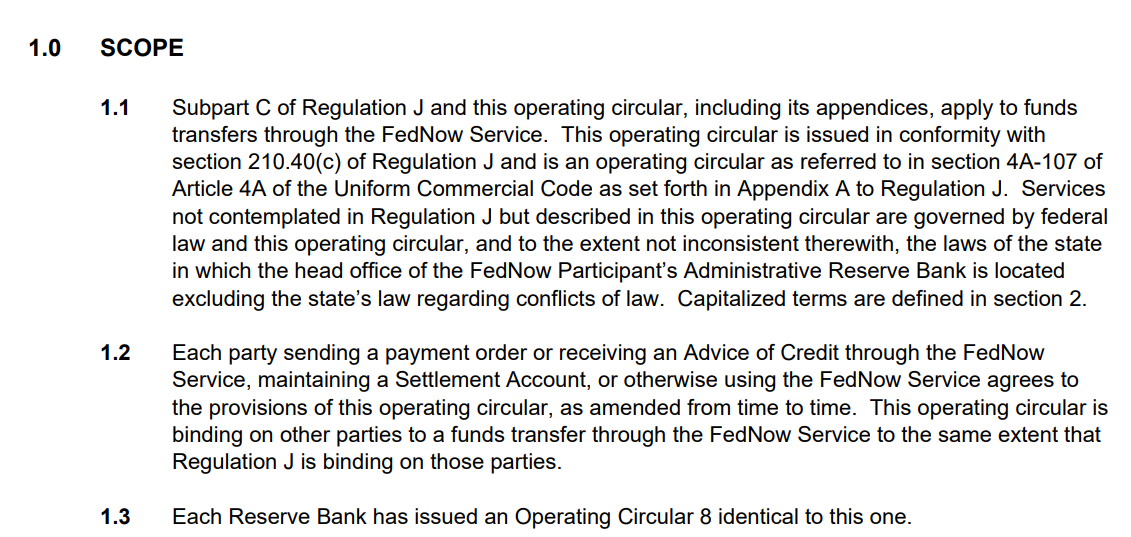
FedNow Operating Circular 8 likewise states that debits and credits are made against the Settlement Account, normally a Federal Reserve master account belonging to the participant or its correspondent.
Fund transfer through the FedNow service| Source: frbservices.org
So an XRP token cannot simply enter FedNow and become the asset that settles a FedNow payment under the system’s current design.
Where XRP Could Fit
There is, however, a more credible way XRP and FedNow could be used within the same end-to-end payment.
Consider a company outside the US sending money to an American supplier.
A theoretical workflow could look like:
Foreign currency → XRP → XRPL → XRP sold for USD → US bank/payment provider → FedNow → recipient bank account
XRP would handle the cross-border liquidity leg. Once XRP had been converted into dollars and the dollars were inside the US banking system, FedNow could handle the domestic instant-payment leg.
Volante’s role could be to orchestrate access to separate rails within a single payments platform.
That is materially different from saying “FedNow uses XRP.”
Volante describes its current platform as multi-rail, supporting FedNow, RTP, Fedwire, SWIFT, SEPA, and other payment networks rather than consolidating them into a single settlement system.
The architecture is closer to a routing hub: a bank can connect to several networks through the same technology stack and select the appropriate rail for each part of a payment.
Does This Create New XRP Demand?
Not based on the evidence available today.
Volante’s XRP capability is not a new 2026 integration. Its Ripple interface dates to 2015, while the explicit statement about XRP settlement dates to 2020.
What has changed is that FedNow now exists alongside those capabilities on Volante’s broader payments infrastructure.
There is currently no Federal Reserve announcement naming XRP, no FedNow specification identifying XRP as a settlement asset, and no disclosed transaction showing a bank sending XRP into FedNow through Volante.
The Fed’s current description of FedNow is that it remains a service through which participating banks and credit unions move money instantly on behalf of customers.
That leaves the evidence in an interesting middle ground.
Can a Volante customer theoretically use XRP in a payment workflow that also touches FedNow? Yes. Volante has supported both technologies.
Does XRP settle FedNow transactions? No evidence supports that claim.
The real adoption signal would come when a bank or payments company identifies a production flow where Volante routes an XRP-based cross-border payment into a FedNow dollar payout.
Until such a transaction is disclosed, the XRP-FedNow connection is best described as compatible payment infrastructure rather than confirmed XRP adoption by the Federal Reserve.
Disclaimer:
The information provided in this article is for informational purposes only. It is not intended to be, nor should it be construed as, financial advice. We do not make any warranties regarding the completeness, reliability, or accuracy of this information. All investments involve risk, and past performance does not guarantee future results. We recommend consulting a financial advisor before making any investment decisions.
Dr. Guneet Kaur is a senior editor at CCN.com and a Science Fellow at Exponential Science. She is a fintech and blockchain expert with extensive experience in digital finance education, blockchain ecosystems, and cryptocurrency markets. She has worked with global media such as Cointelegraph, as well as education and blockchain platforms, to design and lead strategic content and learning initiatives. As an educator and assessor for top-tier executive programs, she bridges real-world fintech trends with academic insight.
Dr. Kaur is also a published researcher and peer reviewer across fintech and data science journals, including Financial Innovation Journal and International Journal of Big Data Intelligence and Applications. Her work spans data-driven analysis, Web3 innovation, and technical content development. With a strong foundation in both industry and academia, she translates complex financial technologies into practical applications, empowering learners, professionals, and institutions across the rapidly evolving digital finance landscape.













 XRP Price Rises as XRP Ledger Adds $2.6B in Tokenised Assets