Key Takeaways
- The OCC finalized its first GENIUS Act rule, effective Jan. 18, 2027, covering reserves, redemptions, custody and supervision.
- Issuers remain barred from directly paying interest, while third-party rewards arrangements face case-by-case review.
- Stablecoin reserves must at least match outstanding tokens, with redemptions generally processed within two business days.
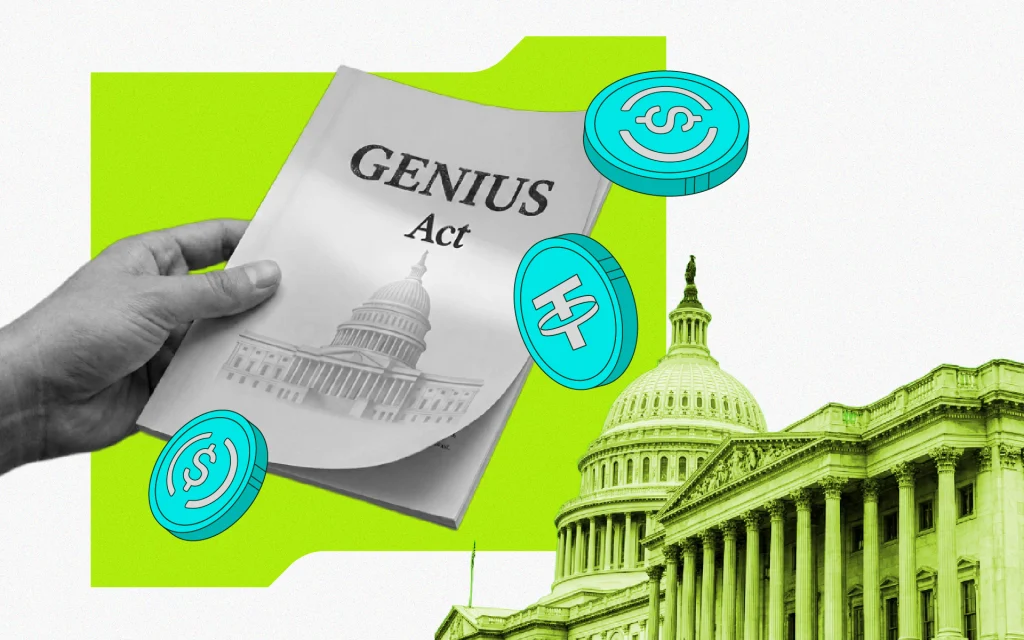
The first final federal banking rule implementing President Donald Trump’s GENIUS Act has arrived, giving stablecoin companies a clearer operating framework while leaving a contested opening for customer rewards.
The Office of the Comptroller of the Currency finalized its regulations on Oct. 21, ahead of the law’s Jan. 18, 2027 effective date.
The framework covers issuers under OCC jurisdiction, including requirements for reserves, redemptions, custody and supervision.
Its most consequential change from the proposal concerns yield: issuers remain prohibited from paying interest directly to holders, but certain third-party rewards arrangements will face individual scrutiny rather than a presumption of illegality.
Stablecoin Rewards Survive, With Conditions
The OCC dropped proposed language that would have presumed certain arrangements involving affiliates or related third parties violated the law’s interest prohibition.
That matters because stablecoin issuers and the platforms distributing their tokens perform different roles. An issuer creates and redeems the token, while an exchange may offer customers rewards for holding it.
The final approach leaves more room for those programs, subject to case-by-case assessment. It does not give every existing arrangement automatic approval or prevent regulators from challenging structures designed to evade the prohibition.
The agency says the market is still developing and that experience supervising these arrangements could support further rulemaking.
For crypto platforms, the immediate benefit is flexibility. For customers, rewards remain dependent on the provider’s terms and regulatory treatment, rather than becoming a guaranteed feature of stablecoins.
Reserves and Redemptions Get a Federal Rulebook
Beyond rewards, the rule establishes operating requirements for payment stablecoin businesses overseen by the OCC.
Issuers must maintain reserve assets worth at least as much as their outstanding stablecoins and generally process redemption requests within two business days. Those requirements address the central promise of payment stablecoins: holders should be able to exchange tokens for their underlying monetary value.
The framework also covers risk management, audits, reporting, capital, custody and oversight of foreign issuers. Its reach includes qualifying nonbank issuers, relevant bank subsidiaries and certain state-qualified issuers where the OCC has authority.
However, this is one part of implementation. Bank Secrecy Act, anti-money-laundering and sanctions requirements will be addressed through separate rulemaking coordinated with Treasury.
Treasury Secretary Scott Bessent presented the announcement as a foundation for private-sector innovation and American leadership in digital assets. The practical change is a defined compliance framework for businesses seeking to issue payment stablecoins under federal supervision.
Banks Push Back as the January Deadline Approaches
The American Bankers Association criticized the rewards interpretation, arguing that intermediaries could deliver economically equivalent yield while issuers technically comply with the direct-payment ban.
Its concern is competition for deposits. If customers shift money into rewarded stablecoin balances, banks argue that funding available for lending could shrink. ABA President and CEO Rob Nichols said the final approach undermines Congress’s intent to protect local lending.
That disagreement leaves rewards exposed to further supervisory decisions and potential rule changes as regulators gain experience.
Meanwhile, existing issuers face an immediate licensing challenge. Beginning Jan. 18, issuing payment stablecoins in the US generally requires approval, with unauthorized issuance carrying criminal penalties.
The OCC has outlined a waiver process for applicants with substantially complete applications pending by the deadline. Eligible businesses may request temporary relief, potentially lasting up to 12 months, while their applications are reviewed.
Such relief requires an agency decision; filing an application alone does not automatically authorize continued issuance. The OCC will announce separately when it begins accepting applications.
For stablecoin businesses, the next phase is therefore concrete: prepare reserves, redemption systems, compliance controls and licensing submissions before the framework takes effect.
Top Trending Crypto Articles
The information provided in this article is for informational purposes only. It is not intended to be, nor should it be construed as, financial advice. We do not make any warranties regarding the completeness, reliability, or accuracy of this information. All investments involve risk, and past performance does not guarantee future results. We recommend consulting a financial advisor before making any investment decisions.

Giuseppe Ciccomascolo began his career as an investigative journalist in Italy, where he contributed to both local and national newspapers, focusing on various financial sectors.
Upon relocating to London, he worked as an analyst for Fitch's CapitalStructure and later as a Senior Reporter for Alliance News. In 2017, Giuseppe transitioned to covering cryptocurrency-related news, producing documentaries and articles on Bitcoin and other emerging digital currencies. He also played a pivotal role in establishing the academy for a cryptocurrency exchange website. Crypto remained his primary area of interest throughout his tenure as a writer for ThirdFloor.