As blockchain adoption continues to expand beyond cryptocurrencies, attention is increasingly turning to real-world assets (RWAs) such as real estate, loans, and other financial instruments being brought on-chain. This shift is driven by improvements in infrastructure, growing institutional interest, and the search for more transparent and efficient financial systems.
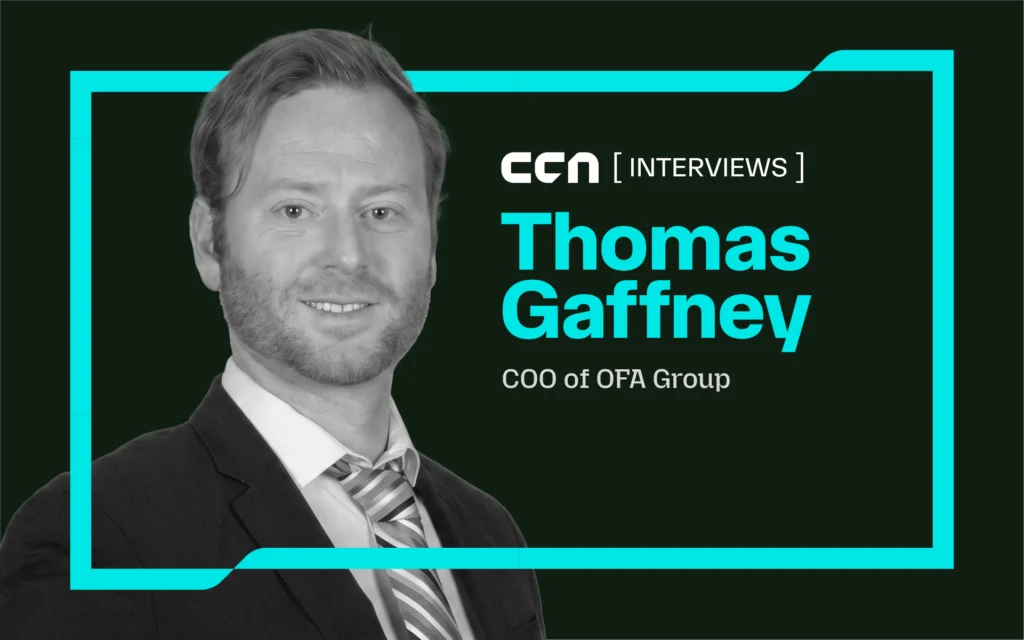
Against this backdrop, a recent conversation between Dr. Guneet Kaur, Senior Editor at Crypto Citizens Network (CCN), and Thomas Gaffney, Chief Operating Officer of OFA Group, explores how blockchain is being applied to real-world assets and the broader implications for financial systems.
At the heart of their discussion lies one of the most talked-about trends in the crypto industry today: the rise of real-world assets on blockchain. From tokenized real estate to on-chain mortgages, RWAs promise to bridge the gap between traditional financial systems and decentralized infrastructure. But how sustainable is this growth? What barriers remain? And where do companies like OFA Group fit into the equation?
What follows is a deep dive into that conversation, unpacking the mechanics, challenges, and future of tokenized assets.
Growing Momentum Around Real-World Assets
Regarding the surge of interest in RWAs, Gaffney attributes it primarily to the evolution of blockchain infrastructure, which has now reached a point where practical implementation is possible.
‘What I think is driving the growth in RWAs is the development and expansion of crypto infrastructure.’
He explains that while the idea of tokenizing real-world assets has existed for years, earlier technological limitations made it impractical. High costs, lack of scalability, and immature systems meant that early attempts were more experimental than functional.
‘People have been talking about putting real-world assets on-chain for a very long time; the technology has evolved, gotten better because before it wasn’t really scalable.’
He references early NFT experiments as an example of these inefficiencies.
‘The first NFTs were these cats on Ethereum and gas fees were very expensive, so it wasn’t really feasible.’
Now, with improved infrastructure and more efficient blockchain networks, the concept has moved into a phase of real adoption. Gaffney believes this growth is not temporary.
‘I do think that the growth is sustainable and having a blockchain infrastructure as the foundational layer for financial products such as RWAs is just a better system overall.’
Sustainability and Regulatory Foundations
While technological readiness is important, Gaffney emphasizes that regulation will ultimately determine how far and how fast RWAs can scale.
‘I think that the passing of the CLARITY Act in the United States will be very important. It will provide regulatory rails for RWAs to operate on.’
He highlights the need for clear definitions around digital assets, including whether they qualify as securities or commodities. Without such clarity, institutional players may hesitate to fully engage.
He also introduces the idea that stablecoins themselves represent a form of RWA.
‘Technically, a stablecoin is an RWA because what you’re doing is backing a dollar with a dollar on-chain.’
This perspective positions stablecoins as a gateway to broader RWA adoption. As more financial activity takes place on-chain using stablecoins, the transition toward tokenized real-world assets becomes more natural.
‘I think you’re going to see massive growth, it’s just a much more efficient system. The real-time valuation of different assets that traditionally didn’t have any liquidity, such as development projects or very large commercial real estate.’
Barriers related to adoption and education
Despite the optimism, Gaffney remains grounded in acknowledging the challenges. The biggest obstacle, according to him, is not technological but human.
‘In order to get more people onboarded with crypto, I think we will need some time and increased education around the technology.”t
He uses the example of email adoption to illustrate how long transformative technologies can take to reach mainstream use.
‘Email was invented back in the 1960s and it didn’t really reach mass saturation until the adoption of the iPhone.’
Blockchain technology, by comparison, is still relatively young.
“Blockchain’s been around for about 15 years, but smart contracts are really only 10 years old.’
He also points to transparency as one of the strongest advantages of RWAs, especially when compared to traditional financial systems that have historically lacked visibility.
‘If it was on-chain, you have real-time data and transparency on what’s in each financial instrument.’
However, institutional adoption requires time, integration into workflows, and a shift in mindset.
Role of OFA Group Within the RWA Ecosystem
Gaffney outlines the company’s role as a technology enabler rather than a financial intermediary. Through its platform Hearth Labs, the company works with institutional clients to bring assets onto the blockchain.
‘It is a technology service provider; we work with institutional investors to help put their assets that exist in the real-world into a tokenized version on-chain.’
He describes a large-scale project involving a one billion dollar development in Long Island, where OFA Group is responsible for structuring and tokenizing the asset.
‘We are the service provider for clients looking to tokenize their real-world assets via a non-fungible token smart contract, also known as a RWA. We then fractionalize the interest of the RWA into categories of fungible tokens so that the client can use the tokens as digital ownership investors in the clients project. This also allows the client to have secondary trading, on a traditionally illiquid asset.’
The company focuses on building infrastructure, handling compliance processes such as KYC and AML, and ensuring that the tokenization process is streamlined. For these services, OFA charges a service fee.
Process of Tokenization Explained Simply
One of the most insightful parts of the conversation is Gaffney’s explanation of how tokenization works in practice. He breaks down the process into understandable components centered around a Special Purpose Vehicle (SPV).
‘What you do is you take a SPV and then you fractionalize that out so that retail investors and institutional investors can get a piece of that instrument.’
The SPV holds the underlying asset, while tokens represent ownership or rights associated with that asset. These tokens can be structured in different ways depending on investor needs.
‘For example, if the SPV wants to structure 3 different types of ownership rights in the SPV, you can create 3 different tokens and each one has a different ownership rights in the SPV. This flexibility allows for tailored investment structures that can accommodate various levels of risk and return.
Expanding Access to Investment Opportunities
A major theme that emerges is the democratization of finance. Tokenization allows smaller investors to participate in opportunities that were previously limited to institutions.
‘Traditionally, only institutional investors would have the opportunity to make certain exclusive investments such as commercial real estate at the development level. With RWAs and putting these investments on-chain, retail investors are going to be able to get access.’
Although the underlying financial instruments may not change dramatically, the accessibility and transparency do.
‘There’s not that much difference. It’s the efficiency and transparency that RWAs offer which the retail community will be interested in.’
This shift has the potential to broaden participation in large-scale projects such as real estate developments.
Importance of a Non-Custodial Approach
Gaffney explains that OFA Group has deliberately chosen a non-custodial model. This means the company does not hold or control client assets, a decision driven largely by regulatory considerations.
‘The reason why we structured it this way mainly is compliance, we are not involved in any broker dealer activity.’
By avoiding custody and transaction execution, the company reduces its regulatory exposure.
This structure allows OFA Group to operate within existing legal frameworks while still providing valuable services.
Managing Regulatory Differences Across Regions
The conversation also touches on the complexity of operating across different jurisdictions. Regulations vary widely, and companies must adapt accordingly.
‘Our baseline is the United States, which usually has the strictest regulations.’
By aligning with the strictest standards first, OFA Group positions itself to expand into other regions more easily.
‘If we start transacting in the European Union or in the UK, we’re going to make sure we’re following their regulations as well.’
This approach reflects a cautious but strategic path toward global scalability.
Expanding Beyond Real Estate Assets
Finally, Gaffney emphasizes the flexibility of the tokenization model, noting that its applications extend far beyond real estate. According to him, the same underlying framework can be adapted to a wide variety of asset classes without significant structural changes.
‘It’s very transferable. Whatever you want to put on-chain, we can put on-chain.’
To illustrate this, he points to the example of mortgages, explaining how they could be serviced directly on blockchain infrastructure using stablecoins as a means of payment.
‘We could take mortgages and put them on-chain. For example, if a customer wants to pay in USDC, we could do that right now.’
Despite the technological readiness, he underscores that the primary challenge is not capability but adoption. The systems are in place, but broader participation depends on bringing users and institutions into the ecosystem.
‘It’s just about onboarding the customer and helping provide those services.’
Future Outlook for Real-World Assets
The relationship between on-chain activity and the growth of real-world assets is, in Gaffney’s view, deeply interconnected. As more transactions take place on blockchain networks, the likelihood of increased adoption of tokenized assets rises significantly.
‘The more you’re transacting on-chain, the more likely you are to see RWA assets increase.’
He also outlines a tangible benchmark for success, particularly within the real estate segment of RWAs. For him, meaningful progress would be reflected in large-scale adoption measured in the trillions.
‘If the RWA real estate tokens exceed $1 trillion in the next five years, I would see that as a major success.’
When it comes to OFA Group, success is defined by its ability to consistently support clients and enable the transition of traditional assets onto blockchain infrastructure.
‘We will continue to help clients and bring their assets on-chain.’
The information provided in this article is for informational purposes only. It is not intended to be, nor should it be construed as, financial advice. We do not make any warranties regarding the completeness, reliability, or accuracy of this information. All investments involve risk, and past performance does not guarantee future results. We recommend consulting a financial advisor before making any investment decisions.

Dr. Guneet Kaur is a senior editor at CCN.com and a Science Fellow at Exponential Science. She is a fintech and blockchain expert with extensive experience in digital finance education, blockchain ecosystems, and cryptocurrency markets. She has worked with global media such as Cointelegraph, as well as education and blockchain platforms, to design and lead strategic content and learning initiatives. As an educator and assessor for top-tier executive programs, she bridges real-world fintech trends with academic insight.
Dr. Kaur is also a published researcher and peer reviewer across fintech and data science journals, including Financial Innovation Journal and International Journal of Big Data Intelligence and Applications. Her work spans data-driven analysis, Web3 innovation, and technical content development. With a strong foundation in both industry and academia, she translates complex financial technologies into practical applications, empowering learners, professionals, and institutions across the rapidly evolving digital finance landscape.


 Easy
Easy